

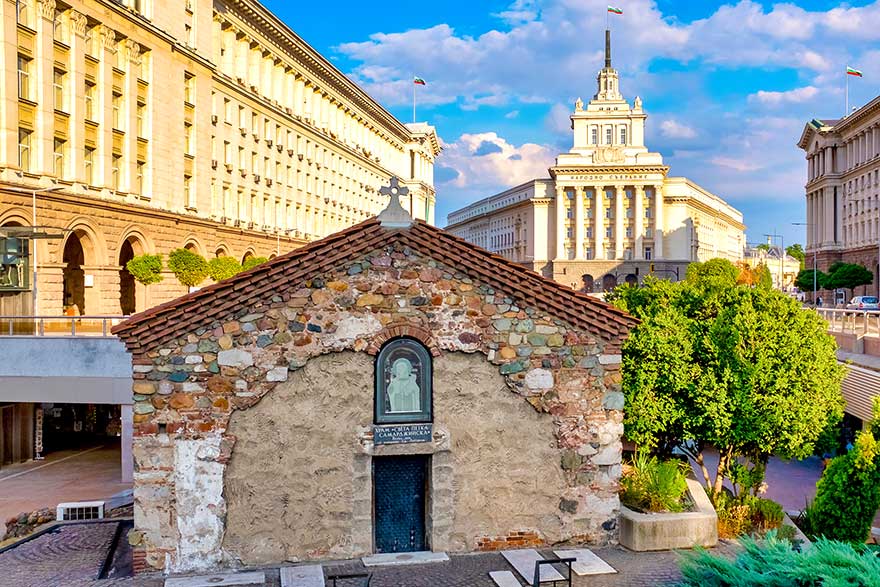
A small church with one of the biggest stories in downtown Sofia
In the very center of Sofia, where metro lines, Roman ruins, government buildings, and busy shopping passages overlap, St. Petka Samardzhiyska feels almost hidden in plain sight. Tucked near the Serdika metro station, between the Hotel Balkan area and the old Central Department Store, the church sits below today’s street level and offers one of those rare Sofia moments where the city’s many historical layers are visible at once.
Why travelers should stop here
This is not Sofia’s grandest church, and that is exactly its charm. St. Petka Samardzhiyska is intimate rather than monumental: a compact, active medieval church that survives in the middle of the capital’s busiest civic core. It is one of the very few active medieval churches in the city that were not converted into mosques during Ottoman rule, which gives the building an unusual historical continuity and a strong sense of resilience.
The history beneath the pavement
The site itself is older than the visible church. The church stands on the remains of a Roman cult building and attributes the site to the 11th century, while the standing structure dates to the 14th century and notes that an ancient Roman tomb, probably from the 4th century AD, was found beneath it. For a traveler, the simplest way to understand St. Petka is as a layered monument: Roman below, medieval above, and modern Sofia all around it.
The church is dedicated to St. Paraskevi, or Petka, of Iconium, and its second name comes from the samardzhii — the pack-saddle makers who maintained the temple during Ottoman times. That guild connection matters because it gives the church a distinctly urban and local identity. This was not an isolated monastery or a royal foundation, but a working city church shaped by craftsmen and community memory.
Its architecture also tells the story of survival. The church was built low, partly dug into the earth, without a bell tower and without prominent exterior decoration, in keeping with the restrictions placed on Christian buildings during Ottoman rule. The result is a modest exterior that almost disappears into the cityscape — and that quietness is part of its power today.
What to look for inside
Inside, the atmosphere shifts from urban bustle to stillness. The church is a single-nave, vaulted structure with thick brick-and-stone walls, and its most important treasures are the fresco layers painted in the 14th, 15th, and 18th centuries. St. Pimen Zografski is believed to have worked here, and the scene of the Exaltation of the Holy Cross on the north wall is considered especially rare in Bulgaria. Even where the paintings are fragmentary, they carry the worn, luminous beauty that makes old Orthodox interiors so compelling.
Why it matters in modern Sofia
The church is also part of the story of Sofia’s 20th-century reinvention. As the capital rebuilt after World War II and the Largo ensemble took shape in the 1950s, sites such as St. Petka Samardzhiyska were preserved, restored, and exhibited rather than erased. That is one reason the church feels so striking today: it stands inside a highly modernized administrative center, yet it still preserves the scale and mood of an older Sofia.
Practical visitor background
For travelers, this is an easy stop to add to a walk in central Sofia. The church is open to visitors free of charge all year round, and its location beside the Serdica metro makes it especially convenient if you are exploring on foot or by public transport.
The surroundings add even more value. Nearby are St. Nedelya Church, Sofia Synagogue, Banya-Bashi Mosque, and the Catholic Cathedral of St. Joseph, all clustered in the same central zone (the square of Tolerance), making this part of Sofia one of the city’s clearest expressions of layered religious and urban history. Just a short walk away, the Serdica Ancient Cultural and Communicative Complex reveals Roman streets, cult buildings, water systems, and other remains of ancient Serdica beneath the modern square, while the St. George Rotunda stands nearby as the oldest preserved Roman building in Sofia.
Seen in context, St. Petka Samardzhiyska becomes one of the best introductions to Sofia itself: Roman foundations, medieval faith, Ottoman-era adaptation, postwar preservation, and a living spiritual function, all compressed into one modest sanctuary in the heart of the capital. For travelers who prefer texture over spectacle, this is one of downtown Sofia’s most rewarding pauses.