

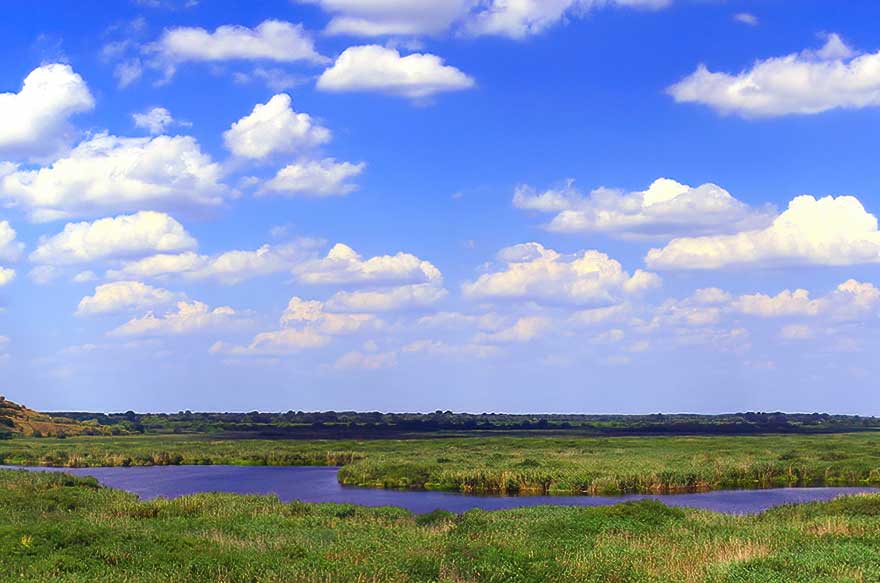
Srebarna is one of Bulgaria’s most important wetlands: a freshwater lake, reedbed, and marsh ecosystem close to the Danube and the village of Srebarna, west of Silistra. UNESCO describes it as the last preserved Danube riverside lake in Bulgaria and a rare survivor of a wetland type that was once common along the river. Its international importance comes above all from birds: pelicans, cormorants, herons, ibises, spoonbills, ducks, and geese use the lake for nesting, feeding, wintering, or migration.
Srebarna’s protected-area designations
The name “Srebarna” is often used to refer to several overlapping protected areas. They are connected, but they do not all cover the same territory. When reading figures for Srebarna, it is important to know which layer is being discussed.
| Designation | What it means | Official area/status |
|---|---|---|
| Srebarna Managed Nature Reserve | The strict national protected area around the lake and wetland. This is the core conservation area under Bulgarian law. | 892.05 ha, designated in 1948, expanded in 1993, and re-categorized in 1999. The adjacent Pelikanite protected site, historically linked to the reserve buffer, is listed separately at 542.8 ha. |
| Srebarna Nature Reserve – UNESCO World Heritage property | The World Heritage property is inscribed for its outstanding wetland biodiversity and birdlife. It is not the same as the full national reserve or the wider biosphere park. | Inscribed in 1983 under natural criterion (x). UNESCO lists the World Heritage property as 638 ha, with a 673 ha buffer zone. |
| Srébarna / Srebarna UNESCO Biosphere Reserve or Biosphere Park | Srebarna Ramsar Site | UNESCO lists the current biosphere reserve surface as 52,003 ha, with a population of 61,365. The site was nominated in 1977, and its extension was approved in 2017. |
| Srebarna Ramsar Site | A Wetland of International Importance under the Ramsar Convention. | Designated in 1975. Ramsar lists the site area as 1,464 ha. |
For visitors, the practical takeaway is simple: the lake and its strict reserve are the sensitive heart of Srebarna, the World Heritage property is a defined 638-hectare international heritage area, and the UNESCO biosphere park is much larger, extending into the surrounding landscape and community life.
Why Srebarna matters
Srebarna sits on a major bird migration route and provides nesting habitat for 99 bird species and seasonal habitat for around 80 migratory species. UNESCO’s World Heritage statement records 173 bird species within the property, while the wider UNESCO biosphere reserve profile records 243 bird species across the broader area. The different numbers reflect different boundaries, not a contradiction.
The best-known resident is the Dalmatian pelican, one of Europe’s most impressive waterbirds and the emblem of Srebarna. The site also supports pygmy cormorants, ferruginous ducks, white-tailed eagles, corncrakes, herons, glossy ibises, spoonbills, greylag geese, and other waterbirds. UNESCO identifies Srebarna as the only breeding site in Bulgaria for the Dalmatian pelican and an important site for the pygmy cormorant and ferruginous duck.
Birds are the headline attraction, but Srebarna is not only a bird sanctuary. The wider biosphere reserve records 1,430 plant species, 23 fish species, and 27 amphibian and reptile species. Floating reedbeds, wet meadows, and flooded willow woodland create the habitats that make this small Danube wetland so valuable.
A protected wetland that needs active care
Srebarna should not be imagined as a completely untouched wilderness. Its ecology has been shaped by changes to the Danube and by human intervention. A dyke built in 1949 cut the lake’s natural connection with the river, and a channel was later constructed in 1994 to help restore seasonal water exchange. UNESCO notes that the reserve’s present condition depends on water-management measures.
The site has also faced serious conservation problems. Srebarna was placed on the World Heritage in Danger List in 1992 and removed from it in 2003 after restoration and management efforts. In its 2025 assessment, the IUCN World Heritage Outlook rated the site “Good with some concerns,” citing ongoing issues including hydrological change, eutrophication, siltation, climate change, enforcement capacity, and the need for continued monitoring.
That history is part of what makes Srebarna interesting. It is not just a scenic lake; it is a working example of wetland conservation, where water levels, reedbeds, fish, birds, local land use, and visitor behavior all affect the ecosystem’s survival.
Visiting Srebarna
Most visitors experience Srebarna from the village, the Natural History Museum, the visitor routes, and the observation points around the reserve. Entry into the strict reserve itself is controlled, and boat access requires permission. Ordinary visitors can enjoy the area through the visitor infrastructure in the former buffer zone and the Pelikanite protected area.
A typical route begins near the Natural History Museum in Srebarna village and continues towards the Pelikanite protected area and the Atanasovo fishing settlement. Visitor infrastructure listed by the reserve includes eco-paths, an observation tower, benches, shelters, toilets, and information signs. From the surrounding hills and viewpoints, visitors can observe the lake without disturbing the birds.
Bring binoculars if birdwatching is your main reason for visiting. Spring and early summer are rewarding for breeding birds, while autumn and winter bring migration and wintering flocks. Even outside peak birding periods, the reedbeds, open water, fishing hamlets, and Danube-side landscape make Srebarna a calm stop for travelers exploring northeastern Bulgaria.
Responsible travel tips
Srebarna is best appreciated slowly and quietly. Stay on marked routes, use observation points rather than approaching the birds, and avoid loud noise near the wetland. Do not enter restricted areas, do not attempt to reach nesting colonies, and follow local instructions on fishing, access, and seasonal restrictions.
The reserve is small, and disturbance can have a large effect. A good visit to Srebarna is not about getting as close as possible; it is about watching a rare wetland continue to function.
A Danube wetland with many layers
Srebarna is a national protected area, a UNESCO World Heritage site, a Ramsar site, and a UNESCO biosphere reserve. Those labels are sometimes used interchangeably in casual travel writing, but they refer to different legal and ecological layers. Understanding the difference makes the place easier to appreciate.
At its heart, Srebarna is a lake of reeds, open water, and birds. Around that heart is a protected landscape, a village, a museum, fishing traditions, research, restoration work, and a wider community that now forms part of the biosphere-park model. Visit for the pelicans and the quiet views, but leave with a clearer sense of how fragile, and how carefully managed, this Danube wetland really is.