

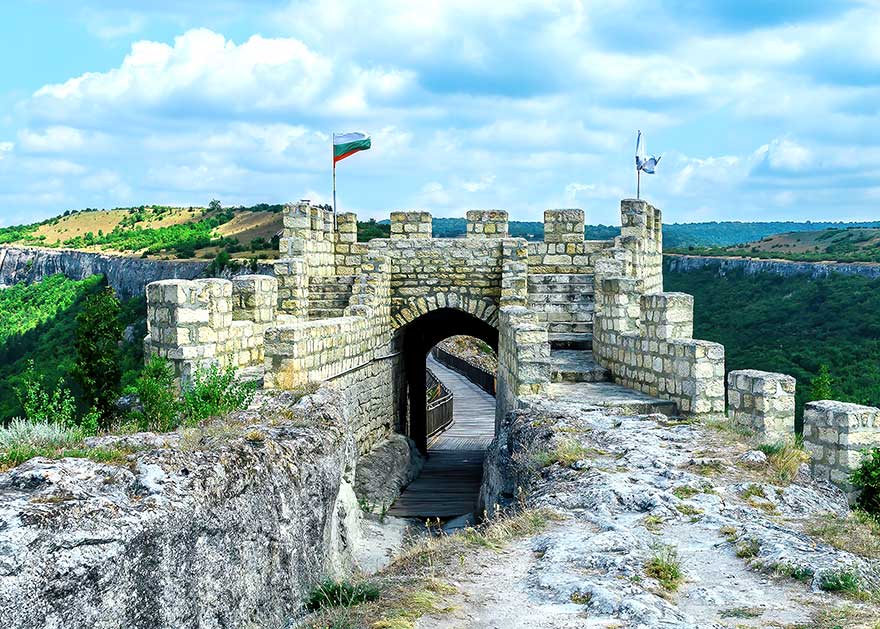
Ovech Fortress is a cliff-top medieval site above the town of Provadia, about 50–53 km west of Varna. Visit it for the long wooden bridge, open views over the Provadia valley, stone gates, church foundations, and the exposed walk along the plateau. It is not a “castle visit” in the enclosed museum sense; it is an outdoor archaeological site with stairs, uneven rock, sun, wind, and a small entry fee. Official sources describe the fortress as lying east of Provadia on the Kaleto plateau, with access by eco path and stairs.
Practical points
- Best transport: Car is easiest. You can also reach Provadia by train or bus from Varna, then walk up from town.
- Walking difficulty: Short but moderate: stairs, uneven stone, exposed paths, and a bridge. Wear shoes with grip.
- Ticket reality: The official Varna tourism portal lists entry at €2.05 for adults and €1.02 for children.
- Listed hours: Varna tourism lists 09:00–17:30, Wednesday–Sunday, closed Monday and Tuesday. Other official tourism material has listed all-year opening as 09:00–18:00, so check before relying on exact hours.
- Accessibility: Not step-free. It is unsuitable for wheelchairs and difficult with pushchairs.
- Best season: Spring and autumn are the most comfortable. Summer has strong sun and more visitors; winter can mean wind, mud, ice, or slippery steps.
The latest ticket and working-time information should be checked with the Provadia Museum / local tourist information before a special trip, especially in winter, on holidays, or after bad weather.
Location and access
On the map, look for Ovech Fortress immediately east of Provadia. From Varna, the drive is usually a straightforward inland detour; from Provadia, follow the local signs towards the fortress. The national tourism portal describes the route from the main street of Provadia, turning left by the school and following the signs.
There are three historic access directions. The northern entrance is the best-known today because of the long bridge connecting the fortress with the neighboring Tabiite plateau. The western approach comes up from the town by a 111-step spiral staircase. The eastern access includes stairs cut into the rock and is described as more convenient for visitors arriving with their own transport.
Public transport is possible but less flexible. Provadia can be reached by bus or train from Varna; after that, the visit requires a short uphill walk to the site.
What do you see at Ovech?
The main visitor experience is the plateau itself. The fortress sits on limestone cliffs, protected naturally by steep rock faces and linked to the nearby Tabiite plateau by a narrow passage. The reconstructed bridge, now the most photographed feature, follows the idea of the old bridge connection and gives the visit its dramatic start.
Inside the site, look for the stone gate, remains of defensive structures, foundations of medieval churches, cisterns, traces of streets and residential buildings, and the famous deep well. The Provadia Museum lists visible remains, including three entrances, church foundations, defensive works, a 79-meter-deep well, cisterns, early Christian tombs, streets, and other structures.
Do not expect a fully rebuilt fortress with furnished rooms. Ovech is most rewarding if you enjoy open archaeological sites, viewpoints, and walking through ruins that still show the shape of a medieval stronghold.
Short historical notes
Ovech was used in several historical periods – from the middle of the 3rd century to the end of the 17th century, with a break between the early 7th century and the 10th century. The fortress appears in records under different names: Provat in Byzantine usage, Ovech in Bulgarian, and Tash Hisar, meaning “stone fortress,” in Ottoman Turkish.
Its strongest period was during the Second Bulgarian Empire, when it served as an important regional military, administrative, economic, and religious center. The site is associated with major medieval events, including the time of Tsar Ivaylo, the campaign of Amadeus VI of Savoy, and the 1444 campaign of Władysław III Jagiełło, better known in Bulgarian history as Vladislav Varnenchik.
In the 14th century, Ovech was also a metropolitan seat, which explains the visible remains of churches and the site’s religious importance. In 2008, the fortress was declared a cultural monument of national importance.
Visitor notes
Plan around one hour for the fortress itself, or longer if you like photography and slow viewpoints. Bring water in summer, avoid the hottest part of the day, and take extra care with children on the bridge, stairs, and cliff-edge paths. After rain, the limestone and steps can be slippery.
The best photos are usually from the bridge, the gate area, and the edges overlooking Provadia. Drone use should not be assumed to be allowed; check local rules and site instructions.
Nearby pairings
Ovech & Provadia-Solnitsata is the strongest historical pairing. Provadia-Solnitsata is described by its official site as the oldest salt-production and urban center in Europe, dating to 5600–4350 BC. It is an active archaeological site, open most of the year when weather permits, with guided tours at set times during busier periods, so call ahead.
Ovech & Pobiti Kamani / Stone Forest is easily accessible by car from Varna. The Stone Forest is west of Varna and can be combined with Provadia for a nature-and-history day rather than a single-site visit.
Ovech + Varna is easiest if you are based on the coast. Leave in the morning, visit Ovech before midday, then return to Varna or continue to one of the inland stops.
Why visit Ovech?
Ovech Fortress is worth visiting for practical, visible reasons: the cliff setting, the bridge, the views, the preserved archaeological outlines, and its role in the history of Provadia and medieval Bulgaria. Keep expectations realistic, check hours before traveling, and treat the site as an exposed outdoor walk rather than a conventional museum stop.