


Bulgarian music is not one sound. It is a whole map.
You can often recognize Bulgarian music before you understand a single Bulgarian word.
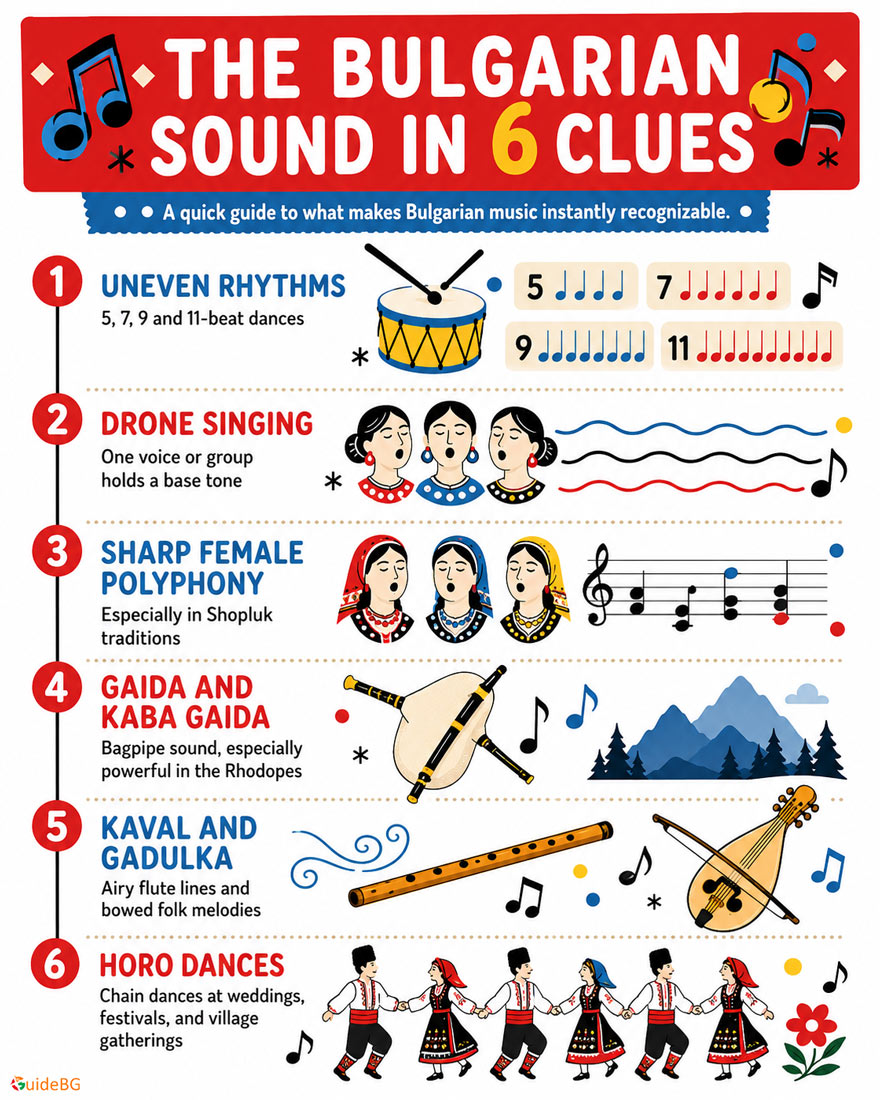
A dance rhythm may feel slightly “crooked” to ears used to Western pop: five, seven, nine, or eleven beats, grouped in ways that make the body move forward and sideways at the same time. A village choir may hold a raw drone while one voice cuts through it like a mountain wind. A bagpipe may sound deep and smoky in the Rhodopes, while a wedding clarinet may race through a melody with the speed of jazz.
That is the first thing to know: Bulgarian music is not one genre. It is a layered sound world shaped by village rituals, Orthodox chant, Ottoman-era urban culture, Roma musicians, state folklore ensembles, socialist pop and rock, post-1989 nightlife, global pop, jazz, hip-hop, and electronic music.
It is old, but not frozen. It is traditional, but rarely simple. And it is still changing.
What makes Bulgarian music sound Bulgarian?
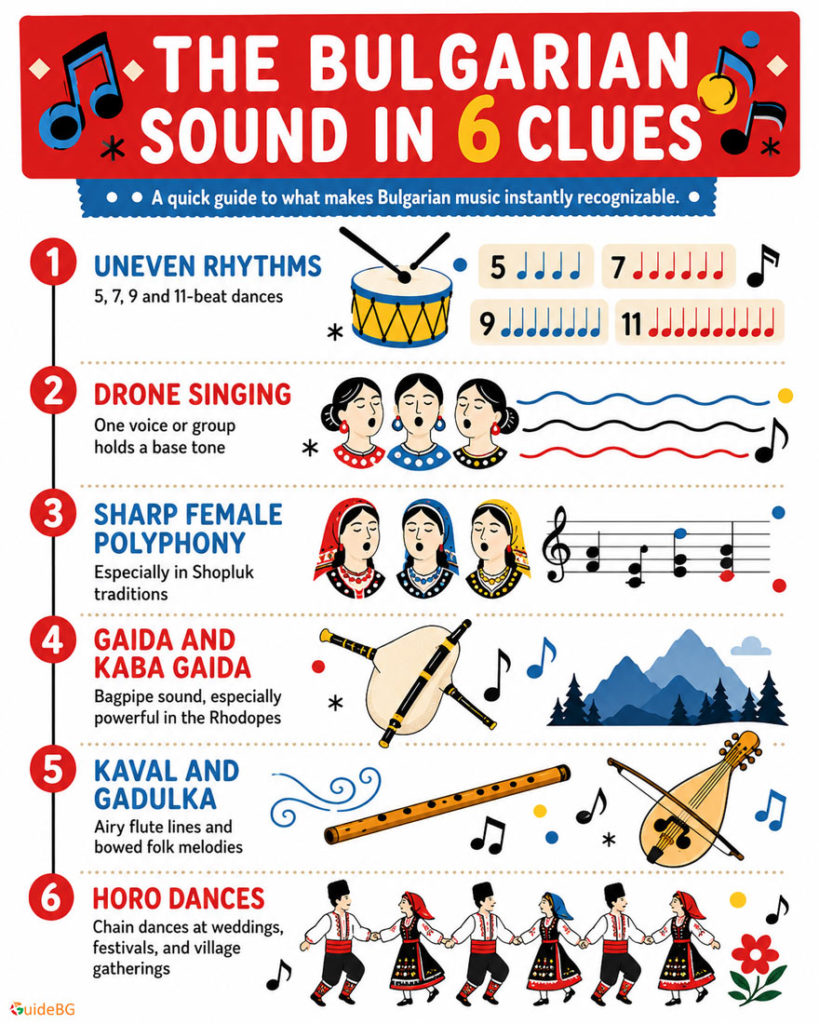
The best-known feature is rhythm. Bulgarian dance music often uses asymmetric meters — rhythms counted in uneven groups such as 5, 7, 9 or 11. Some of the most famous examples include rachenitsa, often felt in seven; paydushko horo, often in five; and kopanitsa, often in eleven. These rhythms are not theoretical curiosities. They are dance forms, social forms, and body memory.
The second feature is the voice. In several Bulgarian folk regions, especially the Shopluk area around Sofia, women’s singing uses strong open-throat projection, drones, and close dissonant harmonies. To outsiders, it can sound almost avant-garde. To Bulgarians, it is a village sound, a ritual sound, a family sound.
The third feature is the instrumentarium: gaida bagpipe, kaba gaida from the Rhodopes, kaval flute, gadulka bowed string instrument, tupan drum, and tambura lute. Later, clarinet, accordion, saxophone, brass, drum kit, and keyboards entered the picture — especially in wedding music and modern folk-pop.
Folk music: Bulgaria’s regional sound worlds
Bulgarian folk music is not the same everywhere. A song from the Rhodopes does not sound like one from Shopluk. A Pirin melody does not behave like a Thracian dance tune. The country is small, but musically dense.
Shopluk, the region around Sofia and western Bulgaria, is famous for sharp, archaic-sounding polyphony. The Bistritsa Babi, or “Bistritsa Grandmothers,” are among the best-known keepers of this tradition. UNESCO recognizes their practice as part of the traditional dances and polyphonic singing of the Shoplouk region, including diaphony, old forms of horo, and the spring ritual lazaruvane.
The Rhodopes are associated with slow, spacious songs and the deep tone of the kaba gaida. This is the musical world many foreigners first encounter through Valya Balkanska. Her performance of “Izlel e Delyo Haydutin” was included on NASA’s Voyager Golden Record, the collection of Earth sounds and music sent into space in 1977. NASA’s own listing identifies the Bulgarian track as “Izlel je Delyo Hagdutin,” sung by Valya Balkanska.
Thrace is known for lyrical melodies, ornamented singing, and powerful dance traditions. Pirin, often linked with the wider Macedonian cultural area, has strong vocal traditions and tambura-based music. Dobrudzha and northern Bulgaria are rich in dance repertoire, while Strandzha connects music with ritual practices, including fire-dancing traditions.
This regional diversity is one reason Bulgarian folk music can feel endless. There is no single “Bulgarian folk style.” There are many Bulgarias inside the music.
One of the best symbols of this living tradition is the National Festival of Bulgarian Folklore in Koprivshtitsa, first held in 1965 and organized roughly every five years. It gathers performers from across the country and has become one of Bulgaria’s most important folklore events.
From village to stage: the great Bulgarian choir sound
In the 20th century, Bulgarian folk music moved from village squares and family rituals onto radio, concert stages, and international records.
This changed the music. Folk songs were collected, arranged, and performed by professional ensembles. Composers and conductors transformed village material into staged choral works. The result was not “pure ancient village music,” but something equally important: a modern Bulgarian folklore art form.
The best-known global example is Le Mystère des Voix Bulgares, the international name associated with recordings of the Bulgarian State Radio and Television Female Vocal Choir. The famous sound combined traditional vocal techniques with professional arrangements, unusual harmonies, and dramatic choral textures. A major reissue in the 1980s helped bring the choir to international audiences, and Le Mystère des Voix Bulgares, Volume II later won a Grammy for Best Traditional Folk Album.
This is important because Bulgarian folklore abroad is often wrapped in words like “mystical” or “ancient.” Some of that reaction is understandable — the sound is astonishing. But the real story is more interesting: the global Bulgarian choir sound is both traditional and modern, rural and institutional, local and international.
Wedding music: Bulgaria’s virtuoso Balkan engine
If choir music is the sound that made Bulgaria famous abroad, wedding music is one of the sounds that explain Bulgaria from the inside.
Bulgarian wedding music evolved into a major modern style during the late socialist and post-socialist periods. It brought together Bulgarian, Roma, Turkish, and Balkan musical elements, often using clarinet, accordion, saxophone, drums, electric bass, and keyboards. The music is fast, ornamented, improvisational, and technically demanding. It can move from a village dance to something close to jazz within minutes.
The central name is Ivo Papazov, often called Ibryama, a clarinet virtuoso whose music helped introduce Bulgarian wedding style to international listeners. In 2005, he won the audience award at the BBC Radio 3 World Music Awards, a sign of how far this local wedding-band language had traveled.
Other key names include accordionist Ibro Lolov, clarinetist Yuri Yunakov, accordionist Petar Ralchev, and many Roma musicians whose role in Bulgarian popular and wedding culture is far larger than many official histories admit.
Wedding music is where “folk” stops being a museum word. It is competitive, loud, emotional, improvised, and alive.
Classical music and opera: European forms, Bulgarian accents
Bulgarian classical music developed through European conservatory traditions, but it often drew on local rhythm, melody and national themes.
The major figure is Pancho Vladigerov. Born in Zurich in 1899 and raised partly in Shumen, he studied in Berlin, became one of Bulgaria’s most important composers, and later taught at the Sofia Music Academy. His works include the famous “Vardar Rhapsody”, the opera “Tsar Kaloyan”, the ballet “Legend of the Lake,” and many orchestral, chamber, and piano works.
Other important names include Dobri Hristov, Petko Staynov, Marin Goleminov, Lyubomir Pipkov, and Parashkev Hadjiev. Together, they helped build a Bulgarian art-music tradition that belongs to Europe but often carries Bulgarian melodic and rhythmic DNA.
Opera also has a strong Bulgarian story, not only through composers but through singers. Bulgaria has produced internationally respected opera voices, and opera remains one of the country’s strongest classical exports.
Popular music before 1990: Estrada, rock, and songs everyone knew
From the 1950s to 1990, Bulgarian popular music developed under socialism. The system restricted some cultural imports, but it also built radio, television, festivals, orchestras, recording institutions, and mass audiences.
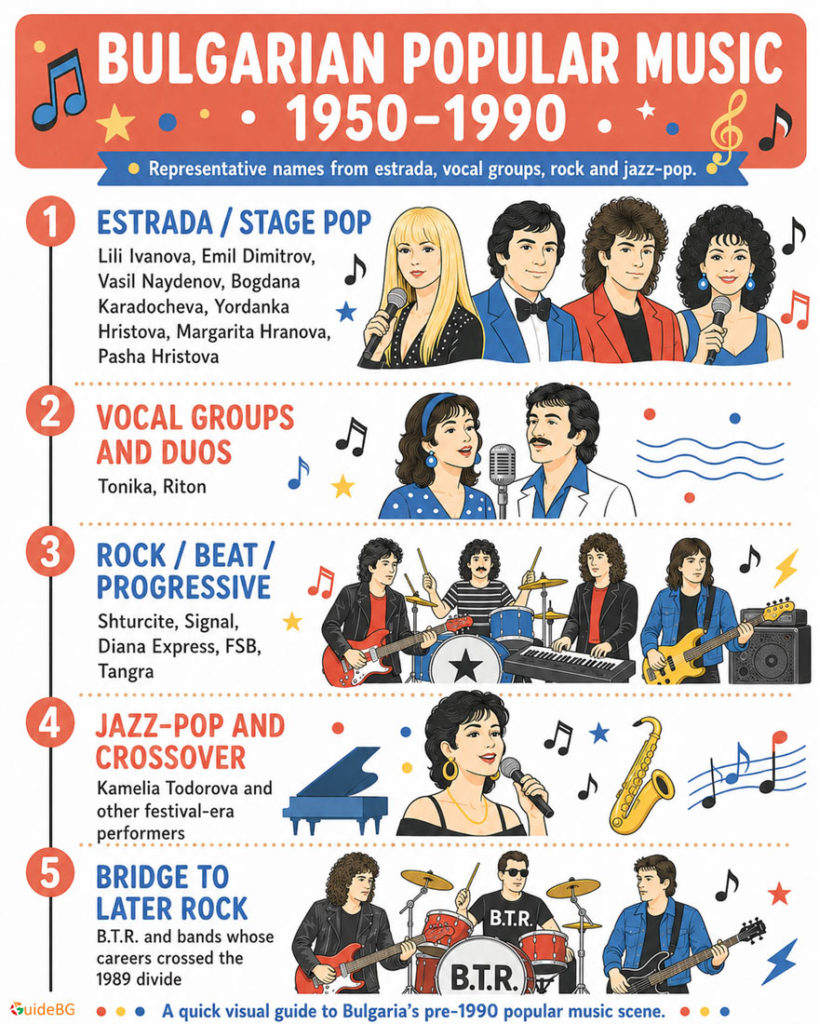
The central pop form was estrada — stage pop, often performed with orchestras and polished arrangements. This was the world of big voices, memorable choruses, and national television fame.
Key names include Lili Ivanova, probably Bulgaria’s most enduring pop icon; Emil Dimitrov, one of the great romantic voices of Bulgarian popular song; Vasil Naydenov, known for elegant pop and instantly recognizable vocals; Bogdana Karadocheva, Yordanka Hristova, Margarita Hranova, Pasha Hristova, Rositsa Kirilova, Kamelia Todorova, Tonika, and Riton.
At the same time, Bulgarian rock was growing. It had to navigate censorship, limited access to Western records, and the expectations of state cultural institutions. But bands still formed, experimented, and built loyal audiences.
Important groups include Shturcite, Signal, Diana Express, FSB, Tangra, and others. Shturcite, formed in Sofia in 1966, moved through beat, progressive rock, and art rock influences, won attention early with “Byala Tishina,” and became one of the defining Bulgarian rock bands of the late socialist period. Bulgarian Rock Archives lists their active period as 1966–2008, which also reminds us that these generations did not simply stop in 1990.
B.T.R. belongs to the bridge between eras: rooted in the period before the full post-1989 music-market explosion, yet strongly visible in the decades after it. This is true for many Bulgarian artists. The political border of 1989 is clear; the musical border is not.
After 1991: new pop, new rock, new media
After 1989, the music environment changed completely. State-controlled culture gave way to private labels, commercial radio, music television, clubs, advertising, cassette markets, CDs, later YouTube, streaming, and social media.
The new period brought a different kind of pop star: more media-driven, more market-oriented, more visually branded, and often more connected to global pop, R&B, dance, and rock production.
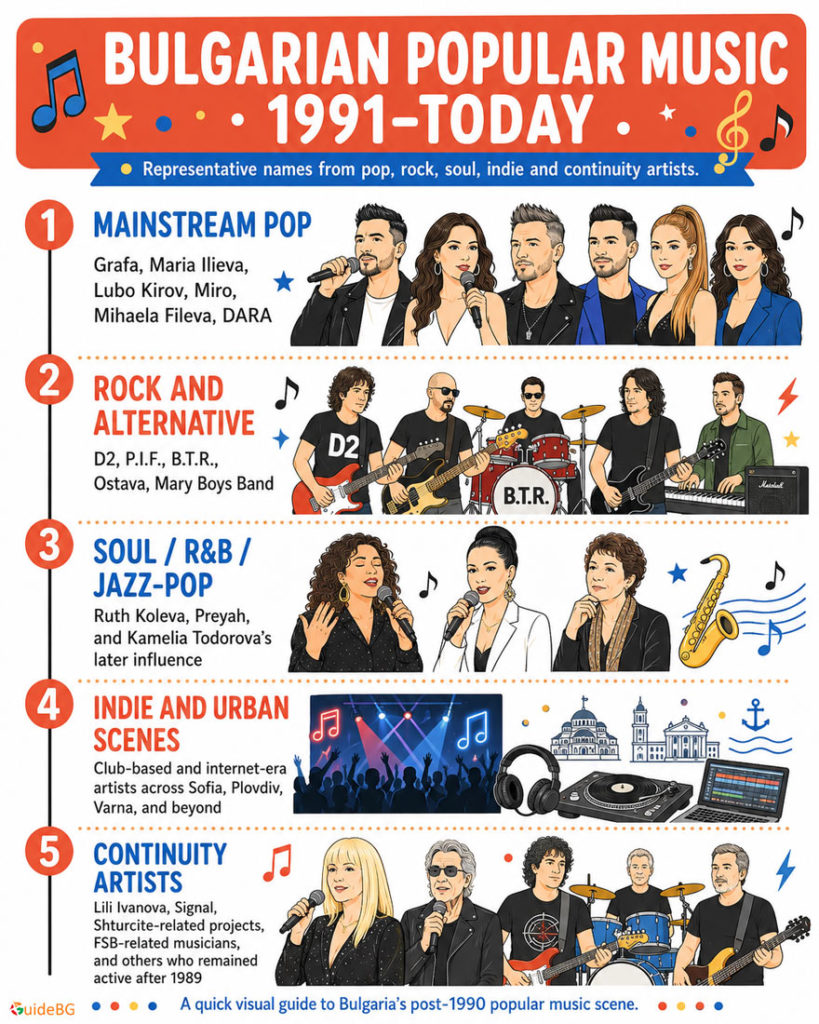
Representative names include Grafa, Maria Ilieva, Lubo Kirov, Miro, D2, P.I.F., Mary Boys Band, B.T.R., Ostava, Doni and Momchil, Ruth Koleva, Mihaela Fileva, DARA, Preyah, and others. Rock and alternative scenes also continued through clubs, festivals, and independent labels, while bands such as D2, P.I.F., Ostava, B.T.R., and Mary Boys Band helped define the post-transition sound for different audiences.
This period should not be described as a clean replacement of the old by the new. Lili Ivanova continued to perform. Older rock bands kept touring. Some socialist-era songs remained part of the Bulgarian collective memory. But the rules had changed: the market was louder, the media faster, and the genres less controlled.
Chalga and pop-folk: the genre Bulgaria argues about
No honest article about Bulgarian music can skip chalga, also called pop-folk.
Chalga became one of the most commercially visible Bulgarian genres after 1989. It mixes Bulgarian, Balkan, Turkish, Greek, Serbian, Romani, Arabic, and dance-pop influences. It is connected to restaurants, clubs, television, weddings, money, desire, migration, gender performance, and post-socialist capitalism.
The genre is controversial. Critics see it as vulgar, commercial, and musically simplified. Fans see it as emotional, direct, danceable, and closer to everyday life than elite culture. Both reactions tell us something about Bulgaria after socialism.
Major names include Gloria, Ivana, Azis, Preslava, Kamelia, Sofi Marinova, Toni Storaro, Desi Slava, Galena, Anelia, and many others. Azis, in particular, became a figure far beyond music because of his visual style, public persona, and challenge to conservative gender expectations.
Chalga is not “the whole of Bulgarian music.” But it is one of the genres through which Bulgarians have argued about taste, class, morality, identity, and modern life.
Bulgarian music today: the borders are collapsing
Today, Bulgarian music is harder to divide into neat boxes.
A pop track may borrow a folk vocal phrase. A jazz musician may play kaval over modern harmony. A club producer may sample old village songs. A rapper may use Balkan rhythm. A wedding band may move between folk, pop-folk, Serbian turbo-folk, Greek laiko and global dance music in one evening.
Artists and projects such as Theodosii Spassov, Oratnitza, Outhentic, Kottarashky, Ruth Koleva, Mihaela Fileva, DARA, Molec, Hayes & Y, and many others show how open the present has become. Some look back to folklore. Some avoid it completely. Some use it as texture, irony, memory, or emotional power.
This is probably the healthiest way to understand Bulgarian music: not as a museum of old songs, and not as a single national style, but as a conversation between village and city, East and West, memory and market, ritual and nightlife.
Where to start listening
A beginner’s path through Bulgarian music could look like this:
- Bistritsa Babi — for Shopluk polyphony and ritual singing
- Valya Balkanska – “Izlel e Delyo Haydutin” — for the Rhodope sound that reached space
- Le Mystère des Voix Bulgares — for the global Bulgarian choir sound
- Ivo Papazov — for wedding music and clarinet virtuosity
- Pancho Vladigerov – “Vardar Rhapsody” — for Bulgarian classical nationalism
- Shturcite, Signal, FSB, Tangra — for socialist-era rock
- Lili Ivanova, Emil Dimitrov, Vasil Naydenov — for classic Bulgarian pop memory
- Grafa, Maria Ilieva, Lubo Kirov, D2, P.I.F., Mary Boys Band — for post-1990 pop and rock
- Azis, Gloria, Preslava, Sofi Marinova — for chalga and pop-folk culture
- Theodosii Spassov, Oratnitza, Kottarashky, Outhentic — for jazz, folk fusion, and modern experiments