

The best bottles of Bulgarian Cabernet Sauvignon Rosé feel shaped. In rosé form, Cabernet gives a little more outline, a little more gastronomic usefulness, and a little more persistence than softer pink styles built only for easy sipping.
In the glass, the Bulgarian style runs from pale salmon and onion-skin tones to brighter raspberry pink. Aromatically, it tends to move through strawberry, raspberry, cherry, white cherry, citrus, blossom, and sometimes a light vanilla or herbal accent. On the palate, the better wines stay dry and juicy, with enough freshness to feel lifted and enough volume to stay convincing at the table.
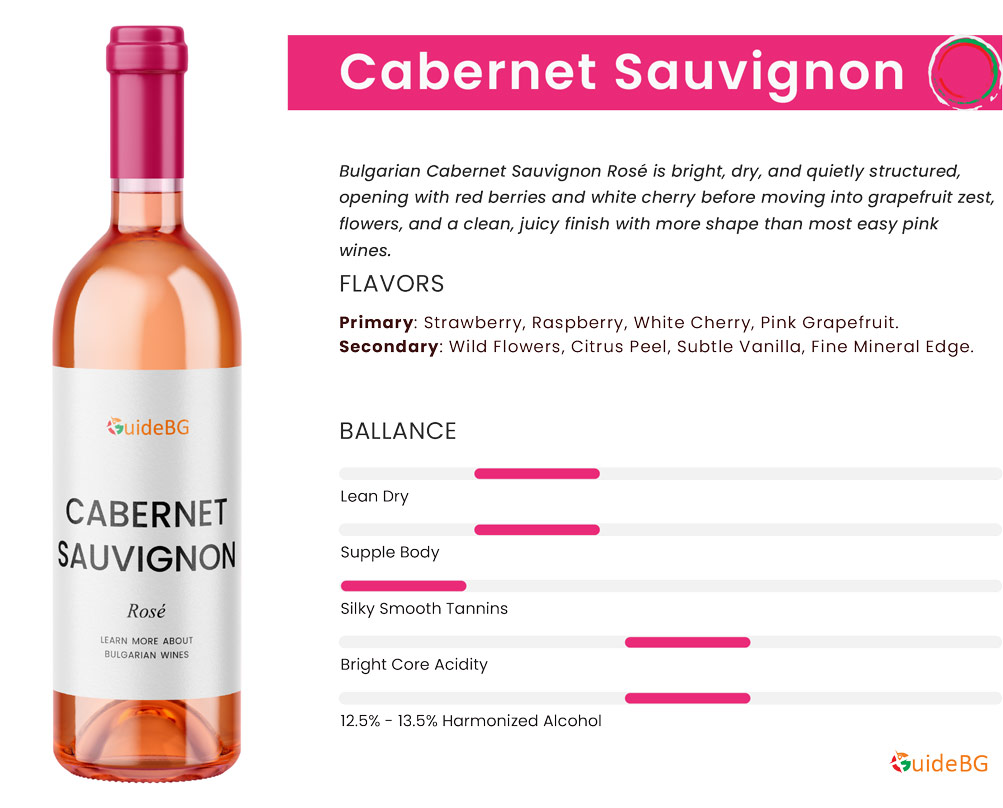
The clearest regional split today is north versus south. In the Danubian Plain, Cabernet rosé reads fresher, lighter, and more linear, with white cherry, grapefruit zest, strawberries, and a cooler finish, as seen in current wines from Ahinora, Bononia, and Burgozone. In the Thracian Lowlands, the style usually broadens a little: more rounded fruit, a little more volume, and a softer, warmer finish, as current examples from Villa Yambol and Katarzyna show. That north–south contrast is an editorial reading from the current evidence rather than a formal legal rosé classification, but it fits the wines very well.
Serving
10-12°C

Aroma white

30 – 60 min

Producer guidance ranges from 8–10°C in the fresher Danubian examples to 11–15°C and even 14–16°C in some fuller southern bottlings. For a national profile, 10–12°C is the cleanest center point: cold enough to sharpen the fruit, warm enough to let the floral and citrus notes show.
Food Pairing
This is a very useful Bulgarian food rosé. It works naturally with fresh salads, soft cheeses, seafood, grilled fish, chicken, pasta, roasted vegetables, egg dishes, and lighter Bulgarian comfort food. It can also stretch a bit further than many delicate rosés, handling mishmash, fried cheese, roast carp, zucchini dishes, and even lighter pork dishes without losing balance.
What to Look For?
Look for a pale salmon to light raspberry color and a nose centered on red berries, white cherry, citrus peel, and flowers. On the palate, the wine should feel dry, supple, and fresh, with more line than sweetness and more clarity than weight. If it tastes confected or flat, it has drifted away from the most convincing Bulgarian register of the style.
Cellaring Potential
Cabernet Sauvignon Rosé in Bulgaria is best treated as a drink-young style. A sensible window is 1–3 years, with the strongest current cue being that leading examples are explicitly positioned as ready to drink now rather than for long-term development.
Blending Partners
When Bulgarian winemakers do blend Cabernet Sauvignon into rosé, the most natural partners are Cabernet Franc, Pinot Noir, and Syrah. Cabernet Franc adds lift and floral detail, Pinot Noir softens the outline and red-fruit profile, and Syrah broadens color and palate volume.
Breeding Context
Cabernet Sauvignon is a classic French Vitis vinifera variety, originating in Bordeaux as a natural crossing between Cabernet Franc and Sauvignon Blanc. In rosé form, it expresses the same genetic backbone through lighter extraction, preserving the grape’s structure and aromatic precision while shifting the focus toward freshness and red-fruit clarity.
Alternative Grapes
If this style speaks to you, move on to Syrah Rosé for a rounder, more fruit-saturated pink, Gamza Rosé for a lighter, brighter northern expression, or Mavrud Rosé for a darker, more structured Bulgarian rosé voice.