


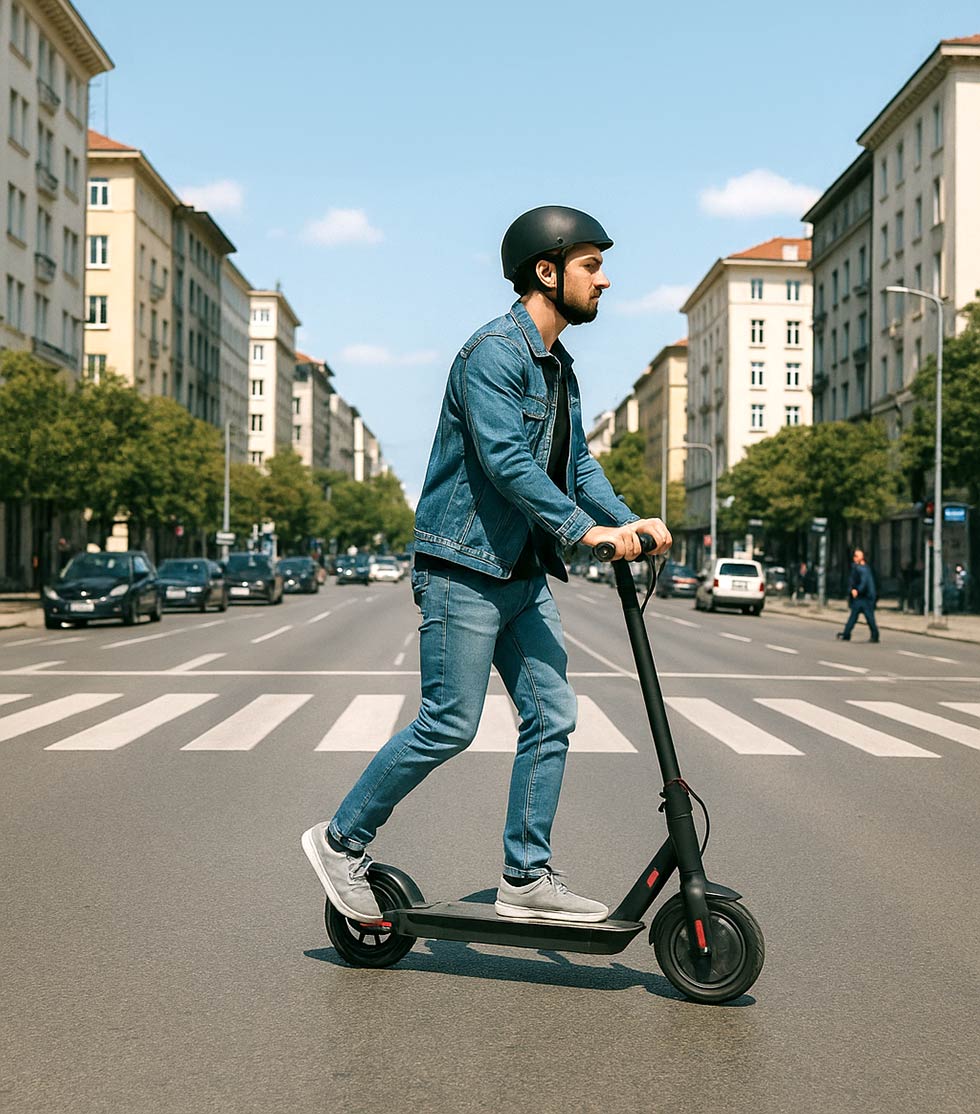
Electric scooters are now part of everyday street life in Bulgaria, but the rules became much stricter in 2025 and 2026. If you remember only the essentials, remember these:
- You must be at least 16 years old.
- A helmet is compulsory for every rider.
- The scooter’s design speed and your riding speed must not exceed 25 km/h.
- Use bicycle infrastructure where available; otherwise, stay close to the right-hand edge of the carriageway.
- Riding during the dark part of the day is prohibited, even if the scooter has lights.
- Do not ride on ordinary pavements or in pedestrian-only areas.
- Dismount and walk across pedestrian crossings.
- Passengers, handheld phones and stunt riding are prohibited.
- The scooter must have compulsory third-party liability insurance and must be registered.
- Municipalities may introduce lower speed limits, parking zones and further local restrictions.
The main national rules are set out in Article 80a of the Bulgarian Road Traffic Act.
How electric scooters became part of Bulgarian city life
In Bulgarian, electric scooters are called “elektricheski trotinetki”. Sofia’s first major shared-scooter service began in August 2019, when about 150 rental scooters appeared in the capital. Private ownership and rental schemes then spread to Plovdiv, Varna, Burgas and other cities.
The Bulgarian News Agency’s report from the 2019 launch shows how quickly scooters moved from novelty to a recognized form of urban transport.
Their attraction is obvious: they are compact, convenient for short trips and produce no exhaust emissions while being ridden. At the same time, careless riding, blocked pavements, underage users, passengers and poor visibility created genuine safety and accessibility problems. Bulgaria’s newer rules are intended to address those problems with a clearer national standard.
What legally counts as an electric scooter?
Bulgarian law uses the term individual electric vehicle, abbreviated as IEPS in Bulgarian. A vehicle falls within this category when it:
- Has one or more electric motors;
- Has a maximum design speed above 6 km/h but no higher than 25 km/h;
- Has an unladen mass of no more than 50 kg; and
- Has no seat, or only a low seat within the measurements stated in the Act.
Most ordinary standing electric scooters fit this definition. Powered mobility wheelchairs used by people with disabilities do not.
A heavier or faster machine, or one with a higher motorcycle-style seat, may fall under a different vehicle regime. That can bring separate requirements for type approval, registration, insurance and a driving license. Limiting a high-performance scooter through an app does not necessarily change its legal design category, so check the manufacturer’s technical documents before using it on a public road.
A driving licence is not required for a vehicle that genuinely qualifies as an individual electric vehicle. Electric bicycles are a separate legal category and should not automatically be treated as scooters.
The main rules at a glance
| Rule | National requirement |
| Minimum age | 16 |
| Maximum riding speed | 25 km/h |
| Maximum design speed | 25 km/h |
| Helmet | Compulsory for every rider |
| Driving licence | Not required for a qualifying individual electric vehicle |
| Passengers | Prohibited |
| Night riding | Prohibited |
| Ordinary pavements | Riding prohibited |
| Pedestrian-only areas | Riding prohibited |
| Bicycle infrastructure | Must be used where available |
| Pedestrian crossings | Dismount and cross on foot |
| Handheld phone | Prohibited |
| Insurance | Compulsory third-party liability insurance required |
| Registration | Riding an unregistered scooter is prohibited |
| Local rules | Municipalities may impose stricter limits and parking rules |
A rental company’s terms may set a higher minimum age or add other conditions. Where the operator’s rule is stricter, follow it as well as the law.
Where can you ride?
Use the bicycle lane or cycle track whenever one is available. If there is no bicycle infrastructure, ride as close as possible to the right-hand edge of the carriageway.
Some cycle tracks run alongside or across a pavement. In that situation, stay inside the marked cycle section. The neighboring pedestrian section is not part of the scooter route.
Electric scooters may not be ridden:
- On roads or streets where the motor-vehicle speed limit is above 50 km/h, unless bicycle infrastructure is provided;
- In an area marked with the B9 ‘No bicycles’ sign;
- In a lane or carriageway reserved for scheduled public transport and marked with the G13 sign;
- On a pavement or another area intended only for pedestrians;
- During the dark part of the day; or
- Anywhere a road sign or local municipal rule prohibits their use.
The 25 km/h limit is a ceiling, not a recommended cruising speed. Slow down when there are pedestrians, poor surfaces, rain, limited visibility or heavy traffic. Municipalities may also set lower local limits, so pay attention to signs, road markings and the rental app’s map.
Pavements and pedestrian crossings
Riding on an ordinary pavement or through a pedestrian-only area is prohibited. When you reach a pedestrian crossing, stop, step off and walk the scooter across. A person pushing a scooter is treated as a pedestrian.
A green pedestrian signal does not give you permission to ride across the crossing. Failing to dismount can result in a EUR 25.56 fine.
Helmets, lights and basic equipment
Every rider must wear a protective helmet. The rule applies to adults and younger riders.
A roadworthy scooter should have:
- Working brakes;
- A mechanical or electronic bell;
- A white or yellow front light; and
- A red rear light.
In fog, heavy rain, smoke or other conditions of reduced visibility, switch on the lights and wear a reflective vest or visible reflective elements on your clothing.
That rule does not create an exception for night-time use. Riding during the dark part of the day remains prohibited, even with good lights and reflective clothing.
Other behavior that is prohibited
A scooter rider may not:
- Carry another person, including a child;
- Ride without holding the handlebars;
- Perform jumps, wheelies or other dangerous maneuvers;
- Use a handheld phone or another device that distracts from riding;
- Tow, push or carry an object that interferes with control or endangers others;
- Ride side by side with another scooter or two-wheeled vehicle;
- Hold onto, or ride dangerously close to, another vehicle;
- Lead an animal;
- Use a public-transport-only lane; or
- Exceed 25 km/h.
Hands-free equipment is not expressly banned, but you must remain fully in control and must not create a danger for other road users.
Where may a scooter be parked?
Park only where scooters are allowed, including any designated scooter bays created by the municipality or rental operator.
Unless a place is specifically set aside for scooter parking, do not leave a scooter:
- In a park or garden;
- In a square;
- On a children’s playground or sports ground;
- On a green area;
- In a pedestrian-only area or on a pavement;
- At the entrance to a metro station or building;
- At a public-transport stop;
- On a pedestrian passageway; or
- In front of an accessibility ramp.
Rental apps often require the scooter to be left in a marked bay and may ask for a photograph. An operator’s parking charge is contractual and is separate from any fine imposed under Bulgarian law.
The national parking ban does not, by itself, ban riding on every route through a park. In practice, however, many park paths are pedestrian-only or covered by local restrictions. Check the signs before riding.
Registration: compulsory, but the procedure is still settling
Since 1 July 2026, the Road Traffic Act has prohibited riding an unregistered individual electric vehicle. The law provides for a national register maintained by the State Road Safety Agency, with municipalities handling applications.
The register is intended to record:
- The owner’s identifying details;
- The scooter’s serial number, make and model;
- Its motor power, maximum design speed and unladen mass;
- The municipality where it was registered; and
- Its registration number.
For an individual owner, the application is linked to the person’s permanent address. For a company or sole trader, it is linked to the registered office.
There is an important practical complication. At the time of this review, the most recent official publication we could identify – dated 26 June 2026 – still described the nationwide registration ordinance as a revised draft undergoing a second consultation. The State Road Safety Agency’s registration update explains that the draft was republished after changes made during the first consultation.
For that reason, do not quote draft registration fees, document lists, or inspection arrangements as final. Before riding, contact your municipality and check the latest State Road Safety Agency guidance. Do not treat a missing form or an unfinished local process as permission to ride an unregistered scooter.
Keep the purchase document, serial number and technical specifications. If the municipality asks to inspect the scooter, confirm how it should be transported there; do not simply ride an unregistered scooter to the inspection point.
What does registration mean for foreign visitors?
The Act does not contain a straightforward general exemption for tourists who bring a privately owned scooter into Bulgaria. At the same time, the registration mechanism is tied to a permanent address or registered office, which creates obvious practical questions for short-term visitors.
Do not assume that a foreign registration sticker, travel-insurance policy or rental agreement automatically meets the Bulgarian requirements. Before using your own scooter on a Bulgarian public road, obtain current guidance from the municipality, the State Road Safety Agency and an insurer that can confirm the required cover.
With a shared or rented scooter, the operator, as the owner, should handle vehicle registration and insurance. The rider is still personally responsible for the age, helmet, speed, daylight, crossing and conduct rules.
Compulsory insurance
A valid compulsory Motor Third-Party Liability policy is required for an electric scooter covered by Article 80a. Travel insurance, health insurance, home insurance or ordinary personal-liability cover is not automatically a substitute.
If you own the scooter, ask the insurer to confirm in writing that the policy satisfies Article 80a(1)(6) of the Road Traffic Act. If you rent, read the operator’s current insurance terms. Operator-provided cover does not protect a rider from traffic fines and may include exclusions or an excess.
Uninsured cases are dealt with under Article 638 of the Insurance Code. The applicable amount depends on ownership, the rider’s status, and whether the offense is repeated.
| Situation | Full statutory amount |
| Individual owner fails to obtain compulsory insurance | EUR 127.82 (BGN 250) |
| Company or sole-trader owner fails to obtain insurance | EUR 1,022.58 (BGN 2,000) |
| Non-owner rides an uninsured vehicle | EUR 204.52 (BGN 400) |
| Repeat offense by an individual owner or non-owner rider | EUR 409.03 (BGN 800) |
| Repeat offense by a company or sole trader | EUR 2,045.17 (BGN 4,000) |
The source provision is Article 638 of the Bulgarian Insurance Code.
Electric-scooter fines in Bulgaria in 2026
Article 183a of the Road Traffic Act sets the main scooter-specific fines. The amounts below are the full statutory penalties for each offense.
The legislation still shows the original amounts in Bulgarian leva. Since Bulgaria adopted the euro on 1 January 2026, public debts are converted at the fixed rate of EUR 1 = BGN 1.95583 and rounded to the nearest euro cent under the Bulgarian euro-conversion rules.
| Full fine | Examples of violations |
| EUR 25.56 (BGN 50) | No helmet; crossing the carriageway contrary to the scooter crossing rule, including riding across a pedestrian crossing instead of walking. |
| EUR 51.13 (BGN 100) | Riding under 16; riding at night; missing lights or reflective clothing in reduced visibility; using a handheld phone; riding on a pavement, in a pedestrian-only area, on a prohibited road or in a bus lane; dangerous maneuvers; riding side by side; holding another vehicle; leading an animal; carrying or towing dangerous objects; prohibited parking. |
| EUR 102.26 (BGN 200) | Failing to use bicycle infrastructure or the right-hand edge of the carriageway; using an unroadworthy scooter or one above the permitted design speed; riding an unregistered scooter; exceeding 25 km/h; carrying a passenger. |
| EUR 255.65 (BGN 500) | A parent, guardian or custodian allows a child under 16 to use an electric scooter on a public road. |
Insurance penalties are separate. More than one sanction can be imposed when a single journey involves several distinct violations. A collision may also create civil liability and, in a serious case, further administrative or criminal consequences.
Alcohol and drugs
The Road Traffic Act’s general rule prohibits the driver of any road vehicle from riding with a blood-alcohol level above 0.5‰ or after using narcotic substances or their analogs.
The standard car DUI penalty table should not simply be copied across to electric scooters, because a qualifying individual electric vehicle is not treated as a motor vehicle for every legal purpose. That does not make intoxicated scooter riding lawful. An accident involving alcohol or drugs can lead to much wider consequences, so the practical rule is simple: do not drink and ride.
Paying or challenging a fine
The tables show the full amounts. The document issued in the individual case determines the payment deadline, account, reduction and appeal route.
- An ordinary paper fiche can generally be paid at 80% within seven days of imposition.
- A penalty decree can generally be paid at 80% within 14 days of service if the fine portion will not be appealed.
- If an electronic fiche is legally used, the usual reduced-payment rule is 70% within 14 days of receipt.
Paying the reduced amount generally makes that fine final. Follow the instructions printed on the document, use an official payment channel, and keep the confirmation. Do not hand cash to a police officer at the roadside.
Renting a scooter
Rental availability, operating areas and prices change frequently, so check the provider’s app before relying on a scooter for a particular journey.
Before you unlock a rental scooter:
- Make sure you meet both the legal and the operator’s minimum age;
- Have a helmet ready;
- Allow enough time to finish the trip before the dark part of the day;
- Check the permitted riding and parking zones;
- Inspect the brakes, tires, handlebars and lights;
- Do not use a scooter that is visibly damaged; and
- Read the operator’s insurance information.
The fact that an app allows a scooter to unlock does not mean it may legally be ridden everywhere shown on the map. Geofencing and operator speed controls can add restrictions, but they cannot replace Bulgarian road law.
Staying safe on Bulgarian streets
Small wheels make scooters particularly sensitive to broken surfaces. Watch for potholes, rough repairs, cobbles, tram rails, drain covers, loose gravel and wet road markings. Also expect car doors, turning vehicles and pedestrians to enter your path with little warning.
Cross tram rails as close to a right angle as conditions safely allow. Slow down well before junctions, crowded areas and damaged surfaces. Keep both hands on the handlebars, avoid hanging bags from them and allow extra stopping distance in the rain.
A helmet is the legal minimum, not complete protection. Closed shoes, gloves and visible clothing are sensible additions.
What scooters mean for Bulgarian cities
Electric scooters can work well for short journeys and first- or last-kilometer connections to public transport. They need less road and parking space than cars and produce no tailpipe emissions while being ridden.
Their wider environmental value depends on how they are manufactured, charged, maintained and collected, and on the journey they replace. Replacing a car or taxi trip brings a clearer benefit than replacing walking or public transport.
For scooters to work well in a city, several things have to come together:
- Continuous, well-designed bicycle infrastructure;
- Safe junctions;
- Predictable enforcement;
- Parking that protects pedestrian and wheelchair access;
- Responsible rider behavior; and
- Clear responsibilities for rental operators and private owners.
Bulgaria’s stricter framework closes many of the gaps in the earlier rules. Its success will depend on a workable registration system, available insurance, consistent municipal implementation and everyday enforcement.
Practical checklist
- Be at least 16 years old.
- Wear a helmet.
- Confirm that the scooter is registered and insured.
- Check that its design speed does not exceed 25 km/h.
- Inspect the brakes, bell, lights, tires and handlebars.
- Ride only during daylight.
- Use bicycle infrastructure where available.
- Otherwise keep close to the right-hand edge of a permitted carriageway.
- Do not ride on pavements or in pedestrian-only areas.
- Dismount at pedestrian crossings.
- Do not carry a passenger.
- Keep your phone away while riding.
- Follow road signs and local restrictions.
- Park only in a permitted or designated place.
Frequently asked questions
What is the maximum speed?
The national maximum is 25 km/h, and the scooter’s design speed must also be no higher than 25 km/h. A municipality may set a lower local limit.
Is a helmet compulsory?
Yes. Every rider must wear one, regardless of age.
Can I ride at night?
No. Riding during the dark part of the day is prohibited. Lights do not create an exception.
Can I ride on the pavement?
Not on an ordinary pedestrian pavement. A properly marked cycle track may run alongside a pavement, but you must stay within the cycle section.
How old must I be?
The national minimum age is 16. A rental operator may require riders to be older.
Do I need a driving license?
Not for a vehicle that legally qualifies as an individual electric vehicle. A faster or heavier machine may fall into another category.
Can two people ride one scooter?
No. Carrying a passenger is prohibited and carries a EUR 102.26 fine.
Must the scooter be registered?
Yes. Riding an unregistered scooter has been prohibited since 1 July 2026. Check the current process with the relevant municipality.
Is insurance compulsory?
Yes. A valid compulsory third-party liability policy is required.
Are driving-license control points deducted?
Article 183a does not attach Bulgarian driving-license control-point deductions to the scooter-specific offenses listed above. Separate consequences may arise if another offense or vehicle category is involved.
Official and supporting sources
- Bulgarian Road Traffic Act
- State Gazette amendment introducing the stricter scooter rules
- Ministry of Interior guidance for electric-scooter riders
- State Road Safety Agency registration-ordinance update
- Insurance Code, Article 638
- Bulgarian euro-conversion legislation
This article provides general information and is not individual legal advice. Bulgarian legislation, local municipal rules, and the official document issued in a particular case take precedence.