

Chardonnay is one of the world’s most recognized white grape varieties, originating in Burgundy and believed to be a cross between Pinot and Gouais Blanc. In Bulgaria, it has become one of the country’s defining international whites, with strong expressions in the Danubian Plain, along the Black Sea, and in selected cooler pockets of the Thracian Lowlands. Bulgarian Chardonnay can be taut and citrusy, broad and creamy, or saline and mineral, depending on terroir and cellar style.
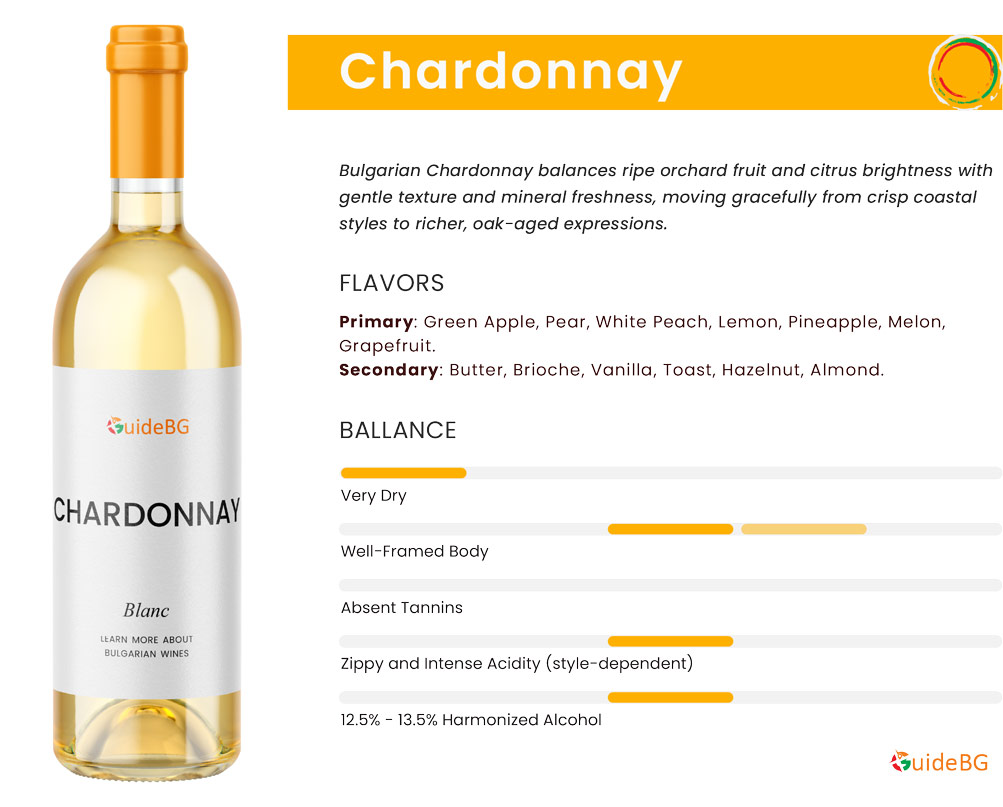
At its best, Bulgarian Chardonnay feels polished rather than loud. The fruit usually leans toward apple, pear, white peach, citrus peel, and sometimes mango or pineapple, while lees work and oak can bring vanilla, hazelnut, butter, toasted bread, and white chocolate. Around Euxinograd and Pomorie, it can show real seaside tension and finesse, while Sungurlare and the Shumen–Preslav belt often deliver a fresher, fruit-led style.
Serving
8-10°C

Aroma white

No decanting

8–10°C for fresh, unoaked styles; 10–12°C for barrel-aged or lees-aged examples. Richer reserve wines simply need a little time in the glass.
Food Pairing
Chardonnay is one of the easiest white wines to place on a Bulgarian table because it can move gracefully from the sea to the farm. Fresher styles are beautiful with grilled white fish, mussels, shrimp, calamari, zucchini, and salads dressed with lemon. Rounder, oak-kissed bottles work wonderfully with roast chicken, turkey fricassee, mushroom risotto, pasta with cream sauce, buttered potatoes, pork loin, and mature yellow cheeses such as kashkaval.
A good Bulgarian Chardonnay should not feel heavy. Even the richer examples need a line of freshness underneath the fruit, like a squeeze of lemon over baked fish or a cool sea breeze cutting through butter and cream.
What to Look For?
Look for a pale lemon to medium-gold color, with aromas of apple, pear, lemon zest, white peach, and sometimes tropical hints. Bulgarian coastal Chardonnay often carries a brisk mineral or lightly saline finish, while fuller styles show vanilla, hazelnut, toast, butter, or baked-apple tones from lees contact and oak. The Dragoevo PDO specification, for example, describes Chardonnay with citrus accents, green apple, mango, and hints of vanilla and nut.
Cellaring Potential
Most Bulgarian Chardonnay is at its brightest in the first 2 to 4 years, when the fruit is vivid, and the acidity still feels energetic. Better barrel-aged or lees-aged examples can hold for 4 to 6 years, developing notes of toasted almond, brioche, honey, and baked orchard fruit. Chardonnay is a grape with ageing potential, but in Bulgaria, the best results come from balance rather than overripeness.
Blending Partners
In Bulgaria, Chardonnay is a natural partner for Dimyat and Sauvignon Blanc. Dimyat can lend lift and local character, while Sauvignon Blanc adds cut, citrus energy, and aromatic brightness. In broader regional cuvées, Chardonnay often serves as the blend’s textural spine.
Breeding Background & Regional Context
Black Sea Coast
This is one of Chardonnay’s strongest homes in Bulgaria. Around Euxinograd and Pomorie, maritime influence stretches the season, preserves acidity, and shapes wines with orchard fruit, citrus, seaside freshness, and a fine mineral thread. The region also supports both sparkling Chardonnay and barrel-aged reserve styles.
Sungurlare / Sub-Balkan East
Here, Chardonnay is usually cleaner, fresher, and more fruit-driven. Expect apple, pineapple, and floral lift, with a more restrained body, though some producers also use barrel fermentation. The valley’s protected position south of the Balkan Mountains helps the grapes ripen evenly without losing their poise.
Danubian Plain and Shumen–Preslav area
Further north, Chardonnay often shows a brighter, straighter profile with green apple, citrus, mango, lively acidity, and a persistent mineral finish. The Dragoevo specification in the Veliki Preslav–Shumen zone describes white wines with citrus, floral, mineral, and fresh characteristics, while broader Danubian Plain overviews place Chardonnay among the region’s key white grapes.
Thracian Lowlands
Chardonnay is less dominant here than in the Black Sea or Danubian zones, but it performs well in cooler pockets and slightly higher sites. In these areas, the wines tend to be riper and broader, sometimes with more tropical fruit and a creamier texture, especially when oak is part of the élevage.
Alternative Grapes
For a similar Bulgarian white with freshness and easy drinkability, try Dimyat. For a more aromatic local expression, reach for Red Misket. If you want a sharper international comparison within Bulgaria, Sauvignon Blanc is the closest stylistic neighbor in today’s white-wine landscape.