

Danubian Plain Gamza’s authority comes from line, not mass. The grape has long been associated with northern Bulgaria, and the Pleven vine institute still describes it as an old local variety historically grown on large areas in the north. In the Danube region, it reads exactly as the landscape suggests: bright ruby, red-fruited, lifted, and quietly savoury.
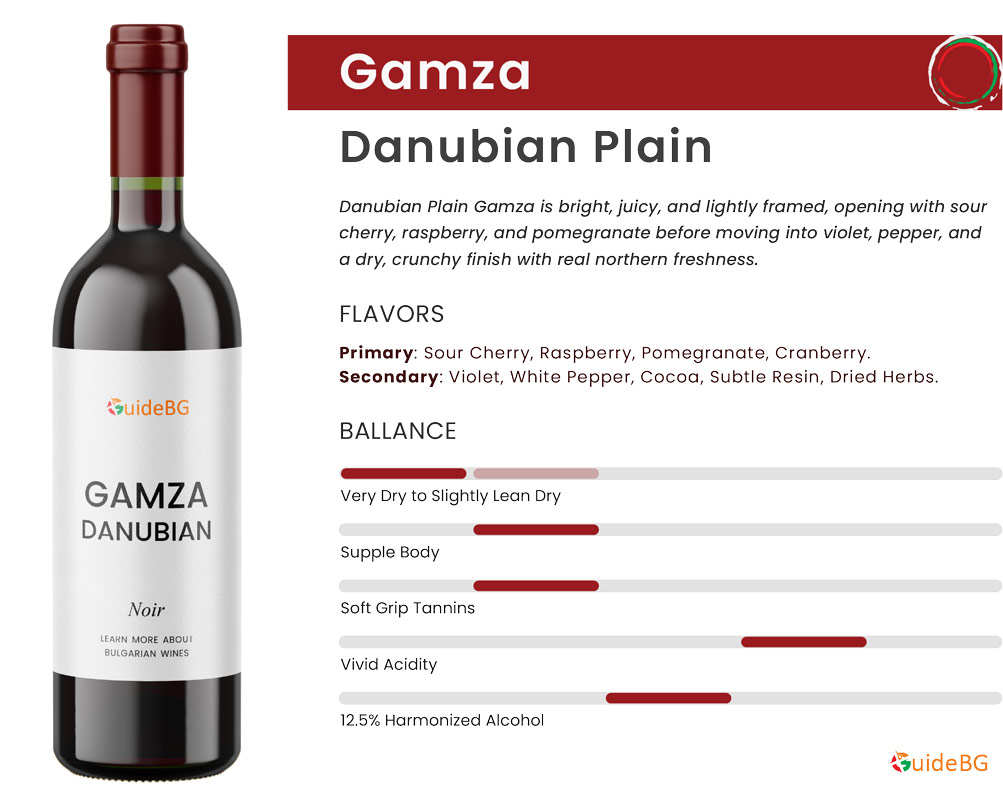
The best bottles show a very particular balance. You get cherry, raspberry, pomegranate, and sometimes cranberry or plum skin first. Then come the quieter details: violets, pepper, a little resinous spice, sometimes cocoa, sometimes a faint herbal or earthy edge. The wines are usually lighter in colour than Bulgaria’s southern reds, and that is part of the charm, not a weakness. Gamza is among the lighter red wines, while current Danubian bottlings from Suhindol, Vidin, and northwest estates keep returning to the same combination of lively acidity, soft tannins, and red-fruit clarity.
In Novo Selo near Vidin, Vidinska Gamza works vineyards on the southeastern Danube slope, with notable day-night amplitude and a mix of alluvial, clay, and limestone soils. Bononia, near Vidin, gives the grape a juicier and more polished frame, even with short barrique ageing. Suhindol keeps the older northern-school expression alive: light on its feet, fragrant, and very easy to drink. Borovitza adds another face of the grape, showing that Gamza can take a little oak, floral nuance, and extra finesse without losing its red-fruited core.
Serving
12-14°C

Standard red

no decanting

Danubian Gamza should be served slightly chilled. The wine temperature between 10 and 12°C is generally recommended because of the wine’s ethereal body, while some winemakers recommend their Danubian Gamza at 14°C. 12–14°C is the right middle ground: cool enough to sharpen the fruit, warm enough to let the spice and floral notes show. Most bottles only need air in the glass; more serious oak-touched examples can take a short splash decant.
Food Pairing
Gamza from the Danubian Plain is more versatile at the table than many darker reds. Official regional pairing material points to lamb liver-sarma, chicken livers in butter, salmon, mackerel, and spinach-and-cheese pie. That makes sense: the wine has enough acidity for fat, enough fruit for salt, and not so much tannin that it overwhelms lighter dishes. It also works very well with grilled pork, fresh sausages, roasted peppers, mushroom dishes, lighter mezze, and mature but not overly aggressive cheeses.
What to Look For?
Look for a bright ruby-to-soft garnet colour, never too opaque. On the nose, the wine should feel red-fruited and lifted: sour cherry, raspberry, pomegranate, violets, and a little pepper or resinous spice. On the palate, the style should be dry, fresh, and supple, with a soft grip rather than force. If the wine feels heavy, thick, or excessively oaked, it has drifted away from the most convincing Danubian register.
Cellaring Potential
Gamza is usually best when its fruit is still vivid. A practical regional window is 2–5 years. Most of the Gamza wines show well young and develop quickly after 1–2 years, while Suhindol examples are already positioned for drinking now, with bottle development up to about 5 years. More polished, structured bottlings from producers such as Bononia can comfortably stretch a little further, but this is still a grape that wins through freshness rather than long, monumental evolution.
Blending Partners
Gamza is perfectly convincing on its own, but in the Danubian Plain, it also blends well with Cabernet Franc and Cabernet Sauvignon. Cabernet Franc adds aromatic lift and a touch more frame; Cabernet Sauvignon adds structure and darker fruit. That is not theoretical — it already appears in current regional cellar practice, including Gamza & Cabernet Franc at Bononia and Cabernet Sauvignon & Gamza in Suhindol.
Regional Context
Gamza is a late-ripening variety. In Pleven, the grapes typically reach ripeness from late September to early October, with sugars around 20–22% and titratable acidity around 6.4–8.4 g/dm³. The vine is highly fertile and easily overloaded, which is exactly why good Danubian Gamza depends on crop discipline. In Novo Selo, producers emphasize slow, even ripening driven by 10–15°C day-night shifts and mixed alluvial, clay, and limestone soils. Those details explain why the best wines stay bright and articulate rather than become diluted.
It is important not to confuse this autochthonous Gamza grown in the Danubian Plain with any modern or experimental interpretations — the original Gamza, often referred to as Danubian Gamza or Gamza from the Danubian Plain, remains an autochthonous Vitis vinifera variety defined by its lighter body, vivid acidity, and distinctly northern Bulgarian character. To see Gamza variation, including cross-breeds, please visit the general Gamza wine profile.
Alternative Grapes
If this northern red style speaks to you, move next to Pamid for an even softer and more rustic Bulgarian red, or to Pinot Noir Danubian Plain for a finer, more floral expression of red-fruit delicacy. Cabernet Sauvignon Danubian Plain makes sense if you want the same regional freshness in a darker, firmer frame. All three sit naturally in the same northern Bulgarian conversation as Gamza. For the grape’s broader identity beyond this regional lens, please visit the general Gamza profile.