

For the grape’s full Bulgarian story, keep the main Mavrud profile as the parent page. This review narrows the lens to the Thracian Lowlands, especially the Rhodope foothills around Asenovgrad, Plovdiv, and Pazardzhik, where Mavrud is most rooted, most convincing, and most clearly itself. This is the regional address that gives the grape its deepest colour, freshest structural line, and most classical ageing shape.
Thracian Lowlands Mavrud is the benchmark regional expression of the grape. The wider Thracian Valley is one of Bulgaria’s warm, fertile red-wine heartlands, and the area around Asenovgrad is repeatedly identified as Mavrud’s birthplace.
What defines the style is not raw power but controlled authority. The fruit is dark and ripe, yet the wine stays upright. Across regional references and producer notes, the same sensory family keeps recurring: blackberries, rosehip, blackcurrant, pepper, tobacco, herbs, earthy tones, cocoa, and a firm, savoury finish. Oak suits Mavrud well here, but the best bottles still taste like grapes and place first.
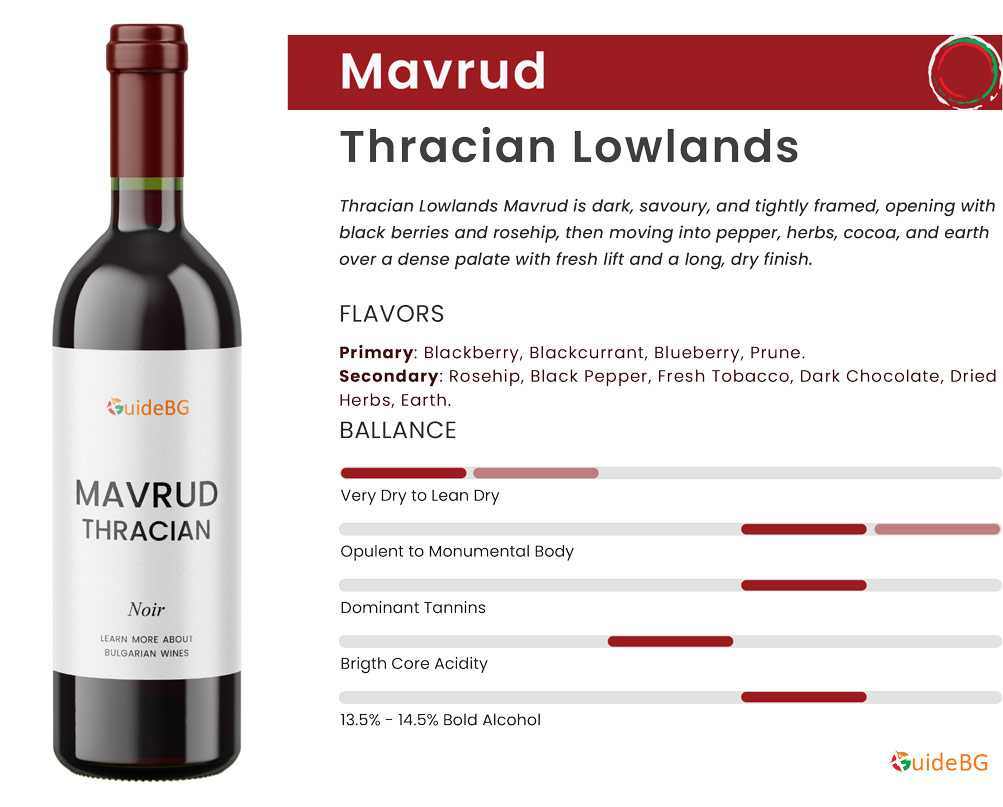
Stylistically, Thracian Mavrud now moves in two successful directions. One is classical and cellar-minded, with longer oak ageing, darker extract, and a broader chocolate-and-spice frame. The other is fresher and more transparent, showing more spice, fruit, herbs, and immediate vineyard character. Both work because Mavrud brings its own backbone: tannin, acidity, and enough phenolic depth to carry serious winemaking.
Serving
17-19°C

Large glass

45-60 min

That is the safest regional window. Current Thracian examples sit around cellar-temperature service, and the denser, oak-shaped wines clearly benefit from air. A decanter helps the black fruit, rosehip, spice, and earthy notes separate from the tannic core.
Food Pairing
This is a natural wine for roast lamb, beef steak, game, kavarma, Rhodope patatnik, mushrooms, smoked meats, and aged Bulgarian cheeses. The wine’s tannic spine loves protein, while its herbal-spicy register sits beautifully beside char, paprika, slow cooking, and earthy dishes.
What to Look For?
Look for a deep ruby-to-garnet colour, a nose built around black fruit, rosehip, pepper, tobacco, herbs, and earth, and a palate that feels dry, dense, and firmly framed rather than soft. In the best bottles, tannin is pronounced yet polished, and the finish stays fresh and savoury rather than turning heavy.
Cellaring Potential
A sensible regional window is 5–10 years, with the strongest cellar selections going longer. That estimate fits both the regional evidence and the grape itself: Mavrud is naturally high in acidity and phenolics, and it is repeatedly described as a variety that improves with age rather than showing everything on release.
Blending Partners
In the Thracian Lowlands, Mavrud blends especially well with Rubin, Cabernet Sauvignon, and Merlot from the Thracian Lowlands. Rubin is the most natural Bulgarian partner, deepening the dark-fruit and spice register; Cabernet Sauvignon adds extra frame and precision; Merlot rounds the mid-palate and softens the edge. Regional cellar practice already shows all three combinations clearly.
Regional Context
Mavrud is a late- to very-late-ripening variety. In the Plovdiv and Asenovgrad zone, it usually reaches technological maturity at the end of September or the beginning of October, after roughly 170–175 days from budding. It is sensitive to winter cold and drought, and fruit quality drops when the vines carry too much crop, which explains why the best Thracian examples come from warm foothill sites with exposure, air movement, and disciplined yield control.
Alternative Grapes
If this regional style speaks to you, move next to Rubin for another dark southern Bulgarian red with a slightly silkier profile, or to Cabernet Sauvignon Thracian Lowlands for a more international cassis-and-cedar frame. Merlot Thracian Lowlands makes sense if you want a rounder, softer version of southern ripeness. For the grape’s broader Bulgarian identity beyond this regional lens, please visit the Bulgarian Mavrud profile.