

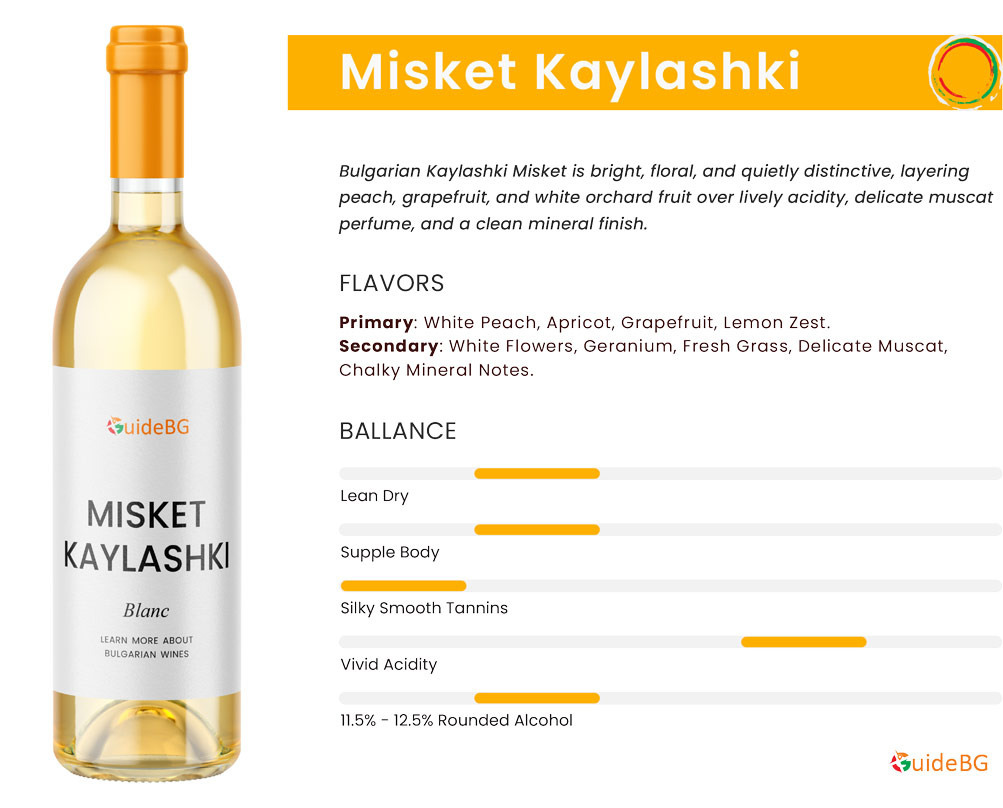
Kaylashki Misket belongs in the Bulgarian misket conversation by aroma, not by ancient lineage. It was bred in Pleven from Misket Hamburg × Seyve Villard 12-375, approved in 1976, and today still makes the most sense in the Danubian Plain, especially around Pleven and the Iskar valley. In the glass, it behaves like a northern Bulgarian aromatic white: straw to pale gold, muscat-floral, citrusy, fresh, and built more around acidity and precision than around weight.
Stylistically, this is not a broad Muscat and not a perfumed Gewürztraminer imitation. It is leaner, brisker, and more northern in posture. The strongest examples move through white flowers, citrus, peach, grapefruit, and a lightly spicy muscat note, then finish dry and lifted rather than lush. That combination is exactly what current bottlings from Gorun, Ahinora, and Haralambievi keep showing in practice.
The grape’s real home is the Danubian Plain, with Pleven as its emotional center. Originally, the grape was grown in Pleven, Vratsa, Veliko Tarnovo, Shumen, Ruse, Burgas, and Sliven, but the current Danube wine map and producer activity make the northern story much more convincing than the southern one. It is now considered one of the emblematic whites of the Pleven region.
Part of its value in north Bulgaria is practical as well as sensory. The variety is described as resistant to ordinary mildew, more resistant to gray rot and low winter temperatures, and capable of producing fresh, fruity white wines. That makes it well-suited to a northern vineyard culture where freshness matters, and resilience is never unwelcome.
Serving
8-10°C

Aroma White

no decanting

Gorun recommends 8–10°C, while broader retail guidance ranges from cold service at 7–13°C. In practice, 8–10°C keeps the wine crisp enough to show its acidity while allowing the floral and muscat notes to open properly.
Food Pairing
Kaylashki Misket is happiest with dishes that are clean, aromatic, and lightly textured. Current pairing notes point toward seafood, baked white fish, goat cheese, fresh salads, white meats, and vegetable dishes, which suit the wine perfectly. In Bulgarian terms, it would be very comfortable with grilled trout, zucchini fritters, fresh goat cheese, spring salads, or lighter Balkan plates where herbs and acidity matter more than fat.
What to Look For?
Look for a pale straw to light golden color and a nose that sits between flowers and citrus: white blossom, geranium, peach, apricot, grapefruit, and a gently muscated top note. On the palate, the wine should feel dry, lively, and precise, with real freshness and a clean finish. If it feels broad, oily, or overly sweet, it has drifted away from the variety’s most convincing register.
Cellaring Potential
This is primarily a drink-young grape. The muscat aroma falls away quickly with age, which is why the wines are best consumed young, even if more serious lees-aged versions can hold a little longer. A sensible window is 1–3 years, with the very best bottles stretching beyond that only if their acidity and winemaking support it.
Blending Partners
Kaylashki Misket blends naturally with Muscat Ottonel, Sauvignon Blanc, and other regional Misket grapes. The logic is already visible in the market: Gorun pairs it with Muscat Ottonel, Haralambievi uses it alongside Sauvignon Blanc in a natural sparkling wine, and regional misket blends use it for freshness and lift. In those blends, it often acts as the acid spine rather than the perfume bomb.
Breeding Background & Regional Context
Kaylashki Misket is officially described as a late-ripening variety, reaching maturity in the second half of September in Pleven. The vines are vigorous and highly fertile, so crop control matters; when overloaded, quality drops. That is one reason the better northern examples feel so much more articulate: producers working windy, airy, chalky, or loess-heavy sites with restrained yields get concentration and freshness at the same time. Gorun’s Pchelina vineyards above the Iskar River are a good current example of that style of interpretation.
The Misket Family
Though it shares the “Misket” name, Misket Kaylashki is not genetically related to other Misket varieties such as Misket Cherven, Misket Varnenski, or Misket Vrachanski. The Misket family in Bulgaria is a stylistic and cultural grouping, not a genetic one — encompassing grapes that are typically light-bodied, floral, and used in dry white wines, whether ancient or modern in origin.
Alternative Grapes
If this style speaks to you, move next to Vrachanski Misket for a more traditional local floral register, Muscat Ottonel for a softer muscat expression, and Riesling for more mineral cut and sharper acidity. Those are the most natural neighboring whites in the northern Bulgarian conversation. This is a sommelier inference based on the current Danube region’s active varietal set and style family.