


Lens overview
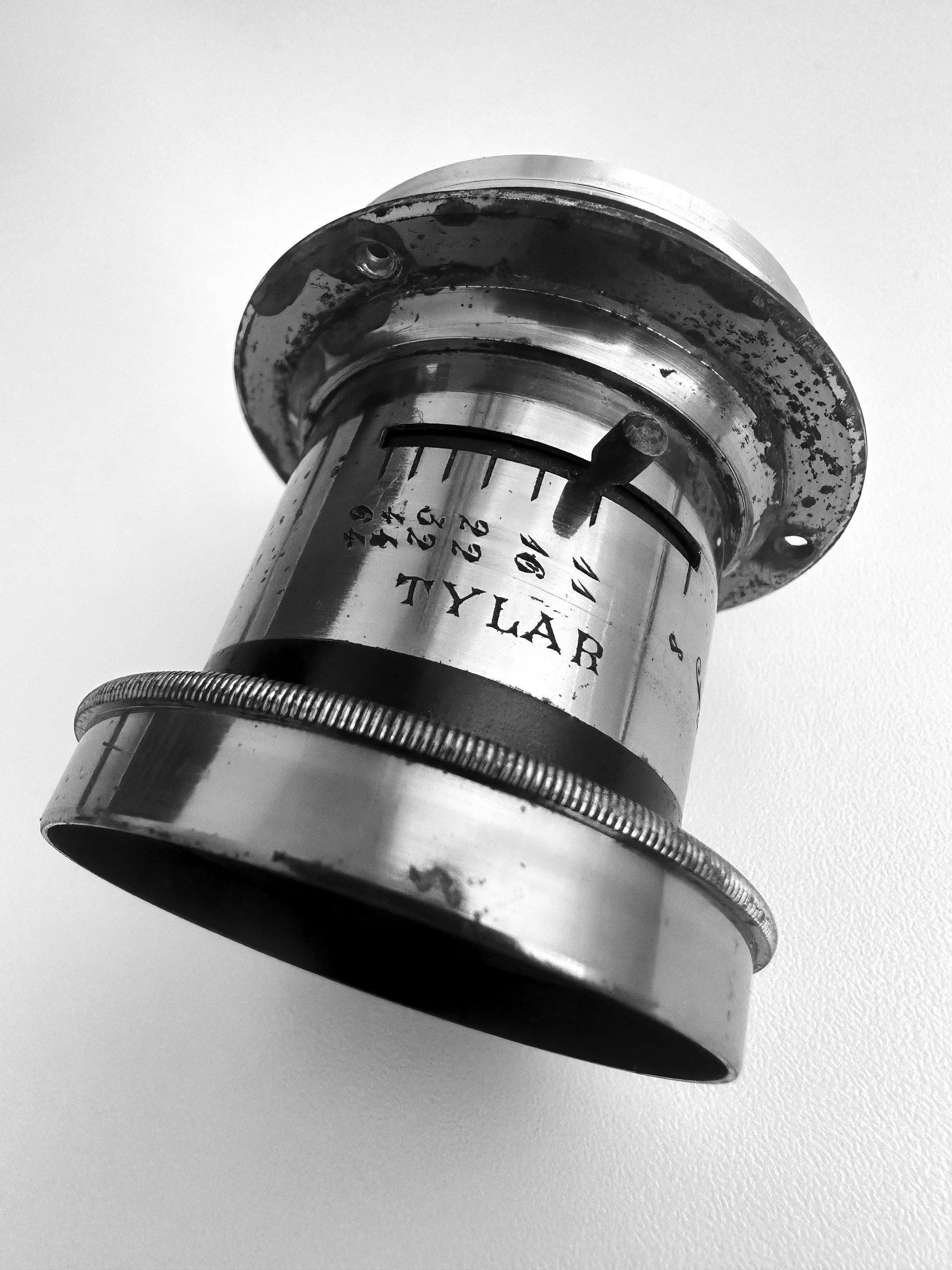
This is an antique brass photographic lens branded “TYLAR”, built for the plate‑camera era. The iris scale runs through f/11, f/16, f/22, f/32, and f/44, and the aperture is controlled via an external lever and pointer, a very characteristic solution for late 19th/early 20th-century lenses meant for use on bellows cameras.
In practical terms, this lens sits in the family most photographers know as Rapid Rectilinear / Aplanat: a symmetrical, general‑purpose design that became the “normal telephoto” of its day, because it was the lens you could use for almost everything if you stopped it down and worked with the light.
Who made it?
“Tylar” here is best read as branding/retail identity, not necessarily the optical manufacturer. William Tylar operated as a photographic and optical supplier in Aston, Birmingham, and period advertising shows Tylar selling Rapid Rectilinear lenses in different plate sizes. In other words, the Tylar name is historically tied to exactly this kind of lens, even if the glass cell itself could have come from a third‑party maker and been sold under Tylar’s banner.
When was it made?
The Rapid Rectilinear/Aplanat concept dates to 1866, introduced independently in near‑parallel by Dallmeyer (Rapid Rectilinear) and Steinheil (Aplanat). This lens is from the mature, mass‑use era of the design, likely from the late 1890s to the 1910s, when iris diaphragms with lever control and flange mounting were commonplace.
Pricing then and now
Tylar advertised Rapid Rectilinear lenses in the early 1890s at prices like 12/6 (12 shillings and six pence) for smaller plate formats and into the 20‑something shillings for larger “whole plate” sizes; real money at the time, but positioned as practical, not elite. Today, values depend almost entirely on size, coverage, condition, and whether it’s adapted to a usable format, such as M42, and whether it’s focusable. Brass Rapid Rectilinears commonly trade in the “collectible but attainable” bracket; Tylar‑retailed examples appear as enthusiast items, with prices often climbing quickly when the lens is digital-full-frame-format-friendly and clean, like this one.
Build and ergonomics
This lens is a reminder that optics used to be machinery.
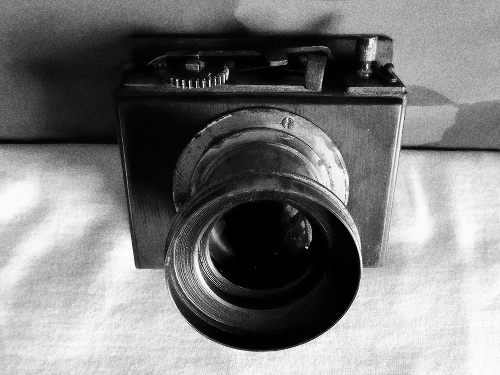
- Material and finish: heavy brass barrel, with blackened sections and a fitted hood (or deep shade) that feels almost mandatory for an uncoated optic; nicely finished.
- Mounting: a flange plate with screw holes suggests it was meant to be fixed to a camera front standard or a lens board. This is not a modern “swap mounts in seconds” lens—this is a lens you install.
- Aperture control: the best part mechanically. The lever‑driven iris is immediate, tactile, and surprisingly precise for something that may be over a century old. The scale shows a practical working range down to f/44, which makes sense: depth of field and coverage mattered more than speed.
- Focusing: there’s no helicoid provided by Tylar. You either focus the way photographers did then, by moving the lens standard on bellows (or by moving the entire camera), or, of course, you can adapt it using a helicoid (as it is done for this particular lens).
Ergonomically, this isn’t “comfortable” like a modern prime; it’s honest. The joy is in the physicality: brass, friction, and the feeling that every adjustment is a decision.
Optical performance
Let’s be clear: judging a Rapid Rectilinear‑type lens by modern standards is like judging a fountain pen by how quickly it sends emails. The performance is real, but it’s expressed differently.
Sharpness
Stopped down, these lenses can be surprisingly crisp in the central field. The design’s reputation was built on delivering straight lines with usable definition, especially for architecture and landscapes, so long as you worked at sensible apertures.
Wide open (often around f/8 for this lens family), sharpness will be soft to moderate, with a gentle lowering of micro‑contrast. By f/16–f/22, detail typically “locks in” and the image starts to look more decisive—particularly in the center and mid‑frame. Edges depend heavily on the lens’s intended format: if you’re pushing coverage, corners will show the era.
Contrast and “modern punch”
Expect lower contrast, especially in bright or backlit scenes. With uncoated glass, contrast is something you build: by shading the lens, controlling stray light, and finishing the image in post if you shoot digitally.
Field character and rendering
The rendering is the reason to use it today. The best way to describe it is:
- highlights feel rounded,
- transitions feel thick,
- and the image has a kind of optical breath that modern corrected lenses often remove.
It can look vintage without trying, not by adding fake grain, but by the way light gathers and spreads.
The beautiful flare
This is where the Tylar lens can be genuinely special. Uncoated optics can produce:
- veiling flare (a glowing wash that lifts shadows),
- soft halos around highlights,
- and occasional internal reflections that look more like atmosphere than artifacts.
It’s easy to call that a flaw—and it is, technically. But creatively, it’s a signature. If you let the light in on purpose, the lens can paint: backlit portraits, window light, and reflective surfaces can look luminous, almost cinematic in a pre‑cinema way.
Chromatic aberration
Compared to modern fast lenses, CA is rarely the main drama here. What you’re more likely to fight is:
- flare haze,
- reduced contrast,
- and edge behavior under coverage stretching.
If you shoot digitally, you can clean small fringes easily—but the “look” of the lens is mostly about light scatter and correction limits, not color error.
Digital adaptation
This lens is usable on digital cameras, but adaptation is the project.
What makes it “not plug‑and‑play”
- no standardized mount (it’s flange/board mounted)
- no focusing ring
The best modern ways to use it
- Mirrorless + bellows + lens board
- Mount the lens on a board (or custom ring), attach the bellows to it, and mount the bellows to your mirrorless body.
- Focus via bellows extension.
- Use your camera’s shutter normally (huge advantage over film plate workflows).
- Lens + custom M42 adapter + Tube + Helicoid
Practical tips that make life easier
- Treat the marked f‑numbers as guidance, not gospel (old scales and iris geometry can be approximate). Use a histogram or bracketing if you are to research.
- Shade aggressively. Your lens already has a deep hood – use it. Add a flag if needed.
- For IBIS bodies: if you can enter the focal length, do so, but you’ll first want to measure it. My initial guess is that the lens is circa 140mm.
Pricing then & now
Then (c. 1880s–1900): Prices depended on size and maker. As context, a Dallmeyer Rapid Rectilinear 19½‑inch (large size) is priced at £15 in late‑19th‑century British price listings; smaller quarter‑plate sizes (like No. 1) were significantly cheaper, but still a serious purchase for a working photographer.
Now (collectors’ market): Values vary with maker, size, condition, and completeness (stops, flange). Recent examples show:
- Small size No. 1 Aplanats by Suter around €299 retail; Dallmeyer small RRs often $200–300.
- Larger or prestigious pieces (e.g., Dallmeyer 15×12 or 18×16) sell for €400–1000+ at auctions; rare Busch Serie D sizes can fetch more.
- Digital adaptation, if ordered, costs €100-€150 (including materials and work).
Historical & collector context
The Rapid Rectilinear/Aplanat design was one of the most important “working photographer” advances of the 19th century because it delivered a key promise: straight lines that stay straight, without the heavy distortion common in earlier designs. It became a default lens type for general plate photography long before “standard lens” became a 35mm concept.
William Tylar and the Birmingham context:
Tylar operated from High Street, Aston, Birmingham, as a photographic supplier and maker/marketer of equipment, including cameras that were commonly fitted with Rapid Rectilinear lenses. That matters: “TYLAR” engraving isn’t random; this brand existed in the exact ecosystem where these lenses were sold, serviced, and used daily.
Collector appeal today is less about chasing optical perfection and more about owning a usable artifact from the transition period before anastigmats fully took over. If the lens is clean and covers a desirable format, it becomes both a collectible and a creative tool.
Impressions – using a Tylar brass lens today
Shooting with a lens like this changes your tempo. It asks you to slow down, not as a romantic concept, but as a mechanical reality. You don’t “grab” focus; you build it. You don’t “control flare”; you negotiate with it. And when it comes together, the images can feel unusually tangible, as if light were a substance rather than just data.
If you enjoy lenses that produce a look rather than a result, this Tylar can be deeply rewarding, especially in side light, window light, and reflective environments where flare and glow become part of the composition.
Modern comparison
Against a modern 50 mm Tessar‑type or a contemporary 50 mm prime, the Aplanat has lower contrast with uncoated glass, more flare, and narrower usable full‑aperture coverage—but it delivers a lovely, rectilinear, period-rendering. For a 19th‑century kit at a manageable size, No. 1 is the brilliant sweet spot.
Sample photos

Verdict — Pros & Cons
Pros
- Authentic Victorian/Edwardian optical character that modern lenses don’t replicate naturally
- Lever‑controlled iris is tactile, practical, and part of the charm
- Stopped down, can deliver surprisingly solid definition for landscapes/architecture
- Beautiful flare potential: veiling glow, halos, atmospheric light scatter
- Strong historical value and a real connection to the Birmingham photographic trade
Cons
- Adaptation is work (lens board, bellows, custom mounting)
- Likely no shutter (depending on how it’s mounted), which complicates some setups
- Lower contrast and flare sensitivity demand careful shading
- Exact specs (focal length, coverage, maker) are often uncertain without measurement
- Not a “one lens for everything” unless you enjoy a slow, methodical process

 brass lens from the plate‑camera era: optical character, flare, digital adaptation)