


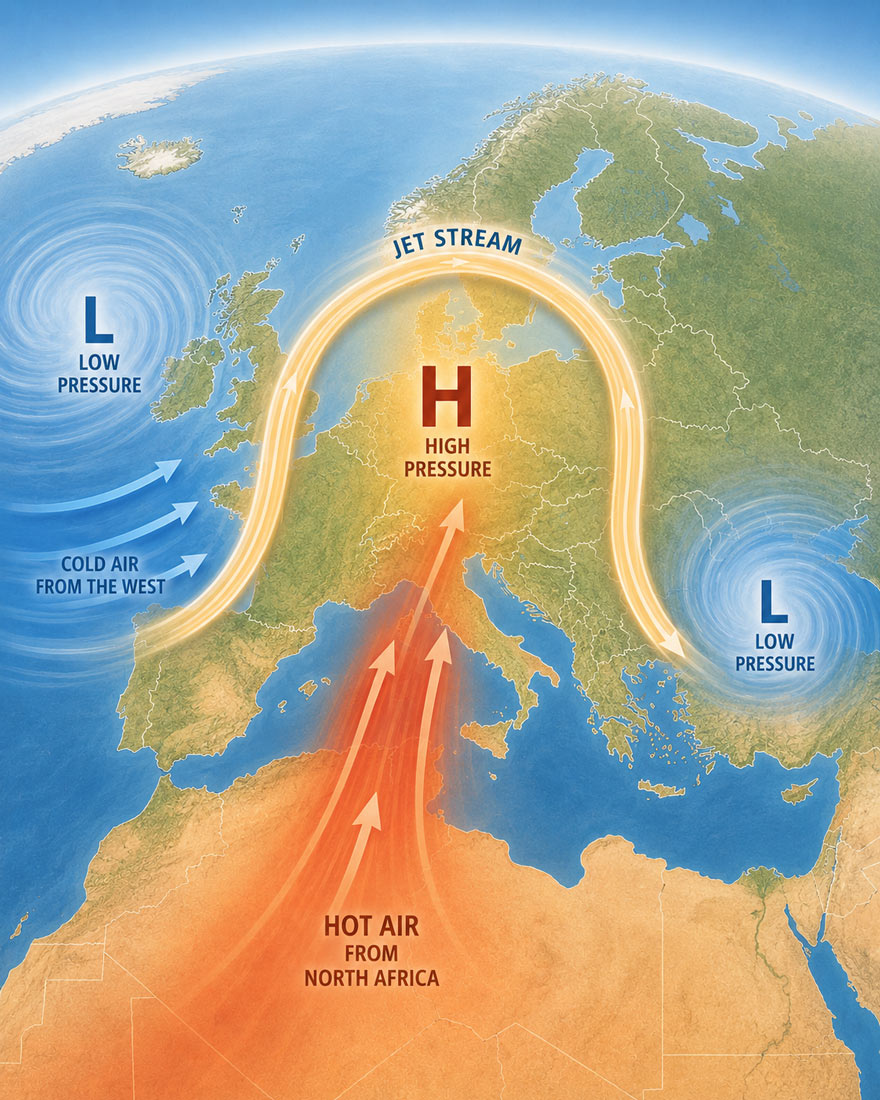
Europe’s latest heatwave is not just “hot weather.” It is a pattern. On weather maps, the jet stream has bent into a large wave resembling the Greek letter Ω. Meteorologists call this an Omega block. For travellers, it feels like something simpler: the weather has stopped moving.
Under normal conditions, the jet stream helps push weather systems from west to east. Atlantic fronts pass through, clouds move on, rain interrupts the heat, and cities cool down. During an Omega block, that flow gets jammed. A ridge of high pressure sits between two lower-pressure systems and becomes stuck. Hot air is pulled north from North Africa, skies stay clear, wind weakens, and the same air mass bakes the same places day after day. Reuters describes the pattern as warm, still air lodged over one region, often for several days and sometimes longer.
This is why the heat feels different. It does not arrive like a short summer spike. It settles.
Phys.org, citing AFP and European weather experts, describes the current setup as an atmospheric traffic jam. A high-pressure ridge drawing heat from North Africa is wedged between lows near Central Europe and off Portugal. The jet stream bends around it, and the locked pattern reinforces itself. If the high pressure stays stable enough, it behaves like a heat dome: sinking air warms as it compresses, clouds struggle to form, rain disappears, and the surface keeps absorbing sunlight.
That science becomes very physical on the ground. Streets radiate heat. Railway platforms shimmer. Stone squares empty by midday. Cities that look perfect in summer light can become exhausting after noon. A blue sky, usually the promise of a good travel day, becomes part of the problem.
Copernicus Sentinel-3 satellite data from 23 June 2026 showed land-surface temperatures above 50°C in parts of central and southern France and northern Spain. These are not air temperatures, but they matter. Land-surface temperature is what roads, rooftops, fields, walls, and pavements are doing. It is the heat that rises back at you while you walk through a city.
The result is a new kind of European summer map. Not only museums, beaches, viewpoints, and restaurants, but also shade, water, air conditioning, train reliability, opening hours, and evening temperatures. Travel planning is changing because the heat is no longer background. It is a condition.
A good itinerary in this weather looks different. Start early. Move slowly. Keep the middle of the day for indoor places. Choose hotels with real cooling, not just “summer charm.” Check local heat alerts before taking long walks, bike rides, or exposed day trips. A shaded street can be more useful than a famous square. A museum can be both culture and climate refuge. A fountain is not only decorative. It is infrastructure.
This is also why old European cities can feel paradoxical in extreme heat. Narrow medieval lanes may offer shade and cooler pockets of air. Wide modern boulevards, glass façades, asphalt, and large open squares can amplify heat. The most beautiful route is not always the smartest one. In a heat dome, the best travel decision is often timing.
The World Meteorological Organization says record-breaking heat has spread across Europe, affecting health, infrastructure, agriculture, ecosystems, and daily life. It reported new or provisional records in several countries, including France, Spain, Germany, the Netherlands, Denmark, Switzerland, Austria, Hungary, Poland, and the Czech Republic. France recorded its hottest day on record on 24 June 2026, while Spain recorded its hottest June days on 23 and 24 June.
The danger is not only the daytime maximum. Night matters. When temperatures stay high after sunset, the body does not recover properly. Hotels without cooling, top-floor apartments, tents, camper vans, and poorly ventilated rooms can become risky. For travellers, this means the question is not just “How hot will it be?” It is also “Will it cool down at night?”
Climate change makes this pattern more severe. Omega blocks are not new, and scientists do not describe them as invented by climate change. The problem is the warmer baseline. When the same blocking pattern forms in a hotter atmosphere, the heat trapped beneath it starts from a higher level and reaches more dangerous extremes. World Weather Attribution reported that temperatures across France, Germany, Italy, Spain, and southern England reached 5–12°C above seasonal averages during the June 2026 heatwave, driven by persistent high pressure and hot air transported from North Africa.
That is the key point: Europe is not simply having a hot week. Europe is experiencing familiar weather mechanics in a changed climate.
For travel, this does not mean avoiding Europe. It means reading Europe differently. The classic summer fantasy still exists: morning markets, train journeys, sea air, old towns, terraces, riversides, late dinners. But the best version of that journey now happens with more awareness. The day has to be edited. Dawn becomes valuable. Midday becomes defensive. Evening becomes the main event.
The Omega Stream is a useful name because it makes the invisible visible. It reminds us that the most important route in Europe this summer may not be a railway line, flight path, or road through the Alps. It may be the route of the jet stream above the continent.
And when that route bends, everything below it changes: how cities feel, how travellers move, how landscapes dry, how infrastructure performs, and how quickly a beautiful summer day can become a health risk.
Europe is still one of the world’s great travel stages. But the script is changing. The modern traveller needs more than a list of sights. They need a heat-aware itinerary, a sense of timing, and respect for the atmosphere above the map.
Related Reads:
- How to Stay Safe in Extreme Heat
- Managing a Heat Stroke
- Flooding in Bulgaria
- BG-ALERT / Emergency Alerts in Bulgaria