


For thousands of years, the Danube carried ships, reshaped islands and deposited layer after layer of mud along Bulgaria’s northern frontier. In July 2026, exceptionally low water revealed something from a much older world.
Near the village of Ryahovo, east of Ruse, a local resident noticed unusually large bones emerging from the shallow riverbed. Specialists from the Regional Museum of History in Ruse were called to the site. What first appeared to be a lower jaw, two tusks and a possible rib soon developed into a more substantial discovery, including a shoulder blade, ribs and additional bone fragments.
The working hypothesis is that the remains belong to a woolly mammoth, Mammuthus primigenius. However, the species, age and original location of the animal have not yet been conclusively established.
The Danube has revealed a mammoth, but it has also posed a puzzle for scientists.
What has actually been discovered?
The remains appeared near Ryahovo on 29 July 2026 after the river receded to an unusually low level. According to Reuters and Bulgarian National Radio, the initial survey identified a lower jaw, two tusks and what appeared to be a rib.
During the recovery operation, museum specialists documented further skeletal material. Some of the animal may still remain beneath the sediment.
There are currently two main explanations for the concentration of bones.
The first is that the mammoth died close to where it was found. The modern riverbed may once have been part of a marshy floodplain where a large animal became trapped, weakened, or died naturally. The dark coloring of some bones may indicate prolonged burial in mud, although color alone cannot determine how the animal died.
The second possibility is that the Danube transported the remains from elsewhere. Museum specialists have suggested that the terrain near Ryahovo may act as a natural collecting point where currents deposit bones, fossil wood, and other heavy material.
The position of the bones, the sediment attached to them, surface damage, and the presence or absence of connecting skeletal parts may eventually help distinguish among these possibilities.
Scientific note: The remains have not yet been directly dated to 10,000 years ago. That figure refers broadly to the final survival of most continental woolly mammoth populations, not to the confirmed age of the Ryahovo animal.
What did the Danube mammoth look like?
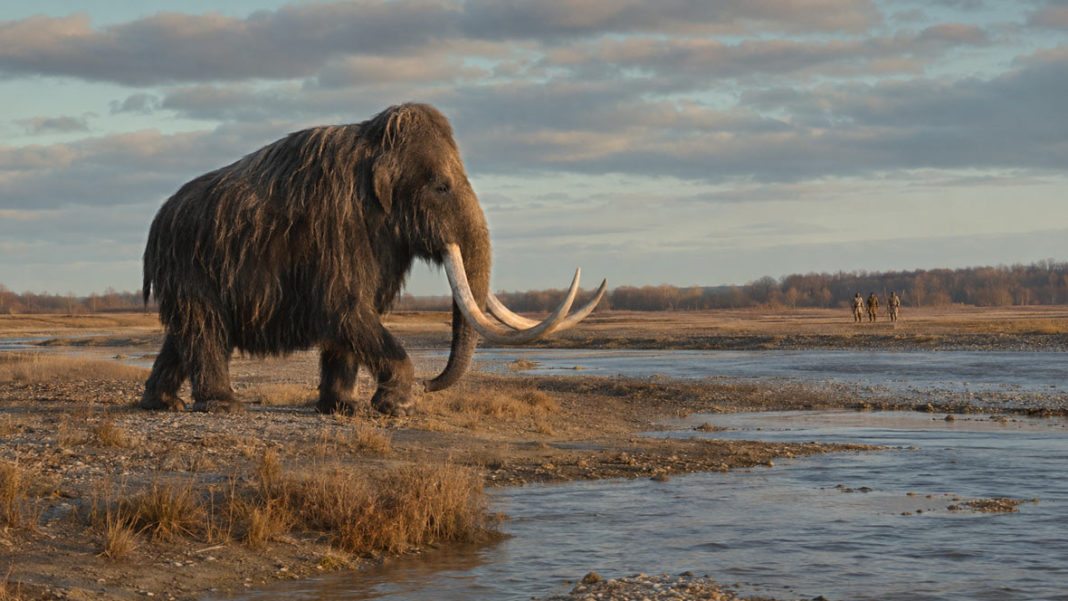
If the identification as a woolly mammoth is confirmed, the animal would have resembled a heavily insulated elephant adapted to cold, dry environments.
A typical adult male stood around three meters at the shoulder and may have weighed four to six tonnes. Females were generally smaller. Some early reports described the Ryahovo animal as nearly five meters tall, but this would be exceptional for a woolly mammoth. No reliable estimate of this individual’s size can be made until the bones are measured and identified.
Its most visible features would have been:
- a high, domed head
- a raised shoulder and strongly sloping back
- small ears and a short tail that reduced heat loss
- a dense undercoat beneath long, coarse guard hairs
- a thick layer of insulating fat
- enormous tusks curving forward, inward and upward in a spiral
The familiar image of a mammoth crossing a permanently frozen white desert is misleading. Woolly mammoths were built for cold, but much of their world was an open, windswept grassland.
According to the Natural History Museum in London, mammoth tusks curved in two dimensions, unlike the more gently curved tusks of living elephants. They may have been used to move vegetation and snow, to compete with rivals, to defend against predators, and to display strength.
The animal’s broad molars were even more important. Their repeated enamel ridges acted like grinding plates, breaking down abrasive grasses, sedges, and herbaceous plants. As the teeth wore out, new molars moved forward from the rear of the jaw. The recovered Ryahovo jaw, which reportedly retains characteristic chewing teeth, may therefore help determine both the species and the animal’s approximate age at death.
The Danube before it was the Danube we know
During the colder stages of the Pleistocene, northern Bulgaria did not look like the agricultural plain seen today.
The landscape was probably a shifting mosaic of open steppe, river channels, exposed sediment, seasonal wetlands and patches of sparse woodland. The climate was colder and generally drier. Grasses, sedges and flowering herbs supported herds of large herbivores.
Mammoths shared this wider Ice Age ecosystem with wild horses, steppe bison, giant deer, woolly rhinoceroses and other cold-adapted animals. Predators such as wolves, cave lions and hyenas followed the herds or scavenged their remains.
It was not an empty wilderness. It was one of the great grazing ecosystems of prehistoric Eurasia, sometimes called the mammoth steppe.
As the last glacial period ended, temperatures rose, forests expanded, and wetlands changed. Open grazing habitat became increasingly fragmented. Most continental woolly mammoth populations disappeared between roughly 14,000 and 10,000 years ago, although isolated island populations survived much longer. The last known mammoths on Wrangel Island in the Arctic persisted until about 4,000 years ago, well into the Bronze Age. The Natural History Museum’s review of mammoth extinction points to a complex combination of habitat change, shrinking populations and human pressure rather than a single cause.
Who were the people living beside these animals?
This depends entirely on the bones’ eventual date.
If the remains prove to be considerably older than 45,000 years, the animal may have lived when Neanderthals still occupied parts of the Balkans. If it belongs to a later period, it would have shared the landscape with Homo sapiens.
Modern humans were present in what is now Bulgaria by approximately 45,000 years ago. Finds from Bacho Kiro Cave include human remains, stone and bone tools, ornaments, and animal bones with evidence of butchery. The dating and identification were established by an international team led by the Max Planck Institute for Evolutionary Anthropology and Bulgarian researchers. These discoveries represent some of the earliest securely dated Upper Paleolithic modern humans in Europe.
By 10,000 years ago, the people living along the Danube were Mesolithic hunter-gatherers, not farmers. Agriculture had not yet become established in present-day Bulgaria.
These communities probably lived in relatively small groups, used finely worked stone, bone and antler tools, made clothing from animal hides and moved between seasonal camps. The river would have supplied fish, waterfowl and edible plants, while the surrounding forests and open areas supported deer, wild boar and aurochs.
The best-studied Mesolithic communities of the Danube come from the Iron Gates region, farther upstream in present-day Serbia and Romania. Archaeology there reveals fishing, hunting, burials, ornament production and increasingly permanent riverside settlement.
Bulgaria’s corresponding Mesolithic record remains surprisingly sparse. Researchers Maria Gurova and Clive Bonsall have argued that comparable communities probably existed along the Bulgarian Lower Danube, but many sites may now lie beneath river sediment, modern floodplains or submerged coastal landscapes. Their study, “Pre-Neolithic in Southeast Europe: a Bulgarian Perspective”, identifies the Lower Danube as one of the most promising areas for future research.
The absence of settlements on a map does not necessarily mean an absence of people. Sometimes it means that the river has hidden them.
Did prehistoric people hunt this mammoth?
There is currently no evidence that humans killed or butchered the Ryahovo animal.
To demonstrate direct human involvement, researchers would look for cut marks, percussion damage from breaking bones, burning, deliberately arranged skeletal parts, nearby stone tools or a projectile embedded in a bone. None of these has been reported yet.
Across Ice Age Europe, however, the relationship between people and mammoths is well documented.
At Kraków Spadzista in Poland, archaeologists found a fragment of a flint projectile embedded in a mammoth rib, providing rare direct evidence of mammoth hunting. At sites across Eastern and Central Europe, people processed mammoth ivory into spear points, tools, ornaments and sculptures. They also arranged large mammoth bones into circular structures, although archaeologists continue to debate whether all of these were dwellings, windbreaks, storage areas or ritual places.
The famous Lion Man sculpture from Germany, carved from mammoth ivory more than 35,000 years ago, shows that the animal entered not only the human economy but also the human imagination.
A mammoth carcass could offer an enormous quantity of meat and fat, together with hide, bone and ivory. Yet hunting a healthy adult would have been extremely dangerous. Prehistoric people almost certainly combined active hunting with the use of animals that had died naturally, become trapped or been weakened by injury.
For the Ryahovo mammoth, natural death in a marsh remains at least as plausible as any encounter with human hunters.
A life story written in bone and ivory
If sufficiently well preserved, the new remains could reveal far more than their age.
The jaw and molars may show the species, approximate age, and degree of tooth wear. Microscopic traces on the enamel could indicate what types of vegetation the mammoth ate.
The tusks are potentially even more informative. Mammoth tusks grew continuously, adding successive layers throughout the animal’s life. Chemical analysis of those layers can reconstruct changes in diet, movement, and environmental conditions. Researchers have compared a mammoth tusk to a lifelong diary because each new layer preserves information from a different period. A major isotope study, supported by the US National Science Foundation, even reconstructed the movements of an individual mammoth over thousands of kilometers.
If usable collagen survives in the Ryahovo bones, radiocarbon analysis could provide a direct date. Stable isotopes could offer clues about diet and landscape. Ancient DNA or proteins might assist with species identification, although long exposure to water and changing temperatures may have damaged the biological material.
Conservation must come first. Waterlogged bones can begin to crack, flake, and deteriorate once exposed to warm, dry air. This is why the remains were moved carefully to the Ruse museum for controlled cleaning and stabilization.
Where can visitors see Bulgaria’s mammoths?
The newly recovered bones are expected to remain at the Ecomuseum with Aquarium in Ruse for conservation and research. They may eventually be placed on public display if their condition allows.
The museum already contains one of Bulgaria’s richest collections of mammoth and mastodon fossils. Its paleontology hall includes a life-size reconstruction of a woolly mammoth and the remarkable lower jaw of Mammuthus rumanus, one of the earliest mammoth species known from Europe. More information is available on the official Ruse museum page.
Visitors can therefore see the new discovery in its wider context: not as an isolated monster from a forgotten age, but as part of a long succession of animals, landscapes and human communities along the Lower Danube.
The river is still writing the story
The most accurate answer to the question “How old is the Danube mammoth?” is, for now, simple: we do not yet know.
It may be 10,000 years old. It may be tens of thousands of years older. It may have died beside an ancient marsh near Ryahovo, or the river may have carried its bones from another part of the Danube basin.
That uncertainty does not diminish the discovery. It is precisely what makes the scientific investigation valuable.
A modern drought lowered the water. A local resident noticed what the river had exposed. Museum specialists recognized the bones. Now a jaw, two tusks, and several dark fragments may help reconstruct an entire lost landscape.