


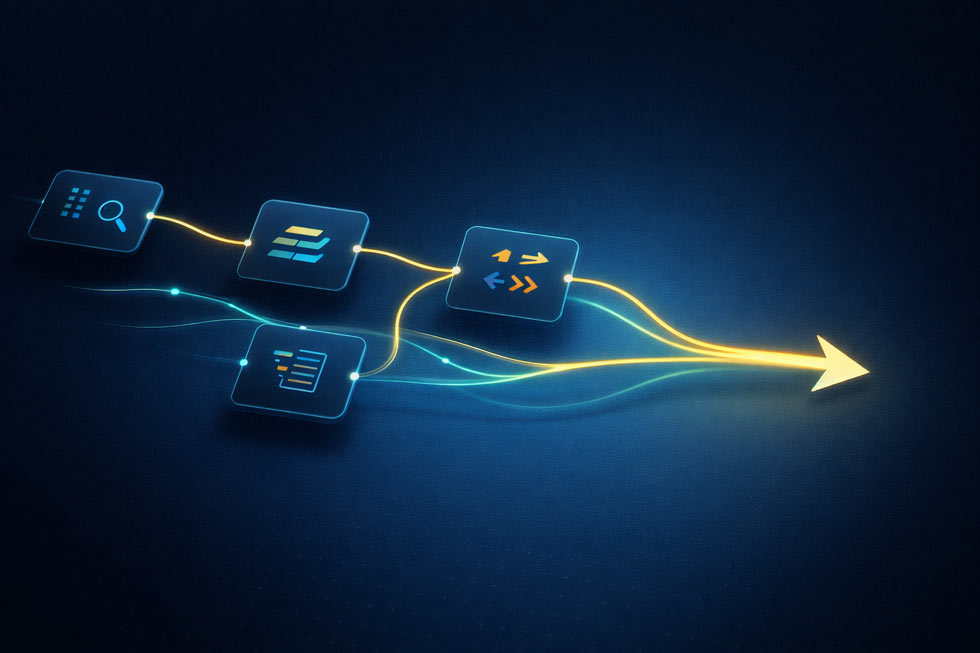
AI is already reshaping how quickly we can search, extract, summarize, and draft—especially in pricing, contracting, HEOR, and market access. The practical shift is not “use an AI tool,” but use AI systems in a deliberate sequence so every output can be traced from evidence → model → decision → update.
This article systematizes how teams are using ChatGPT + Elicit + Gemini together (not as substitutes) and, where relevant, how to integrate alternatives such as PubMed, Rayyan, Covidence, Zotero, Semantic Scholar, Scite, Perplexity, Microsoft Copilot, Claude, LangChain, LlamaIndex, and open-weight Llama models. The goal is an audit-friendly operating model for academic research and decision-grade modelling—not a “prompts” tutorial.
This is explicitly human-led work: humans own the question, scope, assumptions, and accountability; AI accelerates evidence operations and drafting while QC gates and provenance keep the pipeline defensible. Cochrane’s guidance on responsible AI use in evidence synthesis is aligned with this: transparency, human responsibility, and methodological rigor remain non-negotiable.
Unspecified constraints (by design): budget, team size, and platform access. The workflow below is therefore modular: swap tools without breaking the sequence.
Why the sequence matters more than the tool
Most AI disappointment in pharma research stems from a hidden category error: treating retrieval, interpretation, synthesis, and decision-making as a single action. When the same system “finds” evidence, “interprets” it, and “concludes,” errors compound silently (especially with definitions, endpoints, time windows, and subgroup nuance). A sequence forces handoffs and checks.
A clean separation of roles is the simplest guardrail:
- Evidence operations (find/screen/extract with traceability): Elicit, plus structured workflows like Rayyan or Covidence when governance demands two-reviewer screening and extract logs.
- Long-document reading and auditing (guidelines, HTA PDFs, appendices, tables): Gemini’s long-context capabilities are built for sustained reading over large inputs.
- Synthesis, modelling logic, and decision narrative: ChatGPT (including Deep Research when you need multi-source, documented outputs with links/citations).
Provenance in one sentence
Provenance is the documented origin and context of a claim or model input—source, definition, and location (page/table/appendix). If it can’t be traced, it isn’t evidence; it’s an assumption.
Where humans should focus (and what not to optimize)
Humans should focus on
- Decision framing: What is the counterfactual? What policy lever changes what incentives, for whom, and when?
- Assumption discipline: explicit structural choices, scenario boundaries, and uncertainty characterization.
- Stakeholder behavior: payer/provider/patient manufacturer responses (the part models rarely “know” from papers alone).
- Validation and governance: transparency, tests, and decision logs that let others reproduce and challenge conclusions.
Humans should not optimize
- “Perfect prompting” beyond a stable template library (diminishing returns).
- End-to-end automation (“one model does everything”), especially for numeric inputs and policy conclusions.
- Stylistic polishing before the evidence table, parameter log, and scenario logic is stable.
| System | What It Should Do | What It Should Not Do | Human Responsibility at This Stage |
|---|---|---|---|
| Elicit | Find, screen, extract, structure evidence with provenance | Interpret policy implications alone | Define inclusion criteria and relevance boundaries |
| Gemini | Read deeply, clarify definitions, audit long documents; act as red-team reader | Design final policy conclusions | Validate definitions, detect inconsistencies, challenge assumptions |
| ChatGPT | Architect causal logic, structure scenarios, and draft a decision-ready narrative | Invent parameters without provenance | Frame assumptions, define trade-offs, ensure traceability, and governance |
The Evidence → Model → Decision → Update cycle
The cycle below aligns with PRISMA-style transparency for evidence workflows, CHEERS expectations for economic evaluation reporting, and ISPOR modelling guidance that emphasizes transparency and validation.
Stage map with time estimates, tools, QC gates, and rationale
| Stage | Typical time (10-day sprint) | Primary system(s) | Secondary system(s) | Alternatives (swap-in) | Human focus | QC gate + required artifacts | Why this pairing works |
|---|---|---|---|---|---|---|---|
| Protocol freeze (question → PICO/PEO + analysis plan) | 0.5–1.0 day | ChatGPT (Deep Research when needed) | Gemini (read guidelines/constraints) | Microsoft Copilot (tenant docs) | LangChain / LlamaIndex for internal RAG; open-weight Llama for restricted environments | Protocol v1.0 + scope + inclusion/exclusion; versioned | ChatGPT structures reasoning; Gemini checks constraint nuance in long docs |
| Search spec + evidence landscape | 0.5–1.0 day | Elicit (systematic review workflow) | PubMed | Semantic Scholar, Scite | Decide “decision-critical” evidence types; anchor-study test | Search strings + databases + dates (PRISMA-ready) | Elicit accelerates discovery; PubMed ensures biomedical baseline coverage |
| Screening + eligibility adjudication | 1.0–2.0 days | Elicit screening | Human dual-screen sample | Rayyan, Covidence | Resolve inclusion disputes; document reasons | PRISMA-like counts + inclusion/exclusion rationale export | Workflow tools enforce traceability and reduce “silent exclusions.” |
| Extraction + parameter log with provenance | 1.0–2.0 days | Elicit extraction with quotes/tables | Gemini (appendices, tables, long PDFs) | Covidence extraction + privacy posture | Define parameter schema; label assumptions explicitly | Evidence table + parameter log: value, unit, timepoint, definition, page/table/quote | Provenance is built in (quotes/tables) and then audited by a “second reader.” |
| Synthesis (claim → evidence mapping) | 0.5–1.0 day | ChatGPT | Scite / Semantic Scholar (contested claims signals) | Perplexity (fast horizon scan) | Translate evidence into a decision narrative; surface contradictions | Claim-evidence map + uncertainty notes | ChatGPT drafts; citation-context tools flag disputes worth reading |
| Model design + build + validation | 2.0–4.0 days | ChatGPT (spec + scenario logic) | Gemini (definition consistency audit) | LangChain / LlamaIndex for internal RAG ; open-weight Llama for restricted environments | Structural assumptions + behavioral responses + validation tests | ISPOR-style transparency + validation checklist; sensitivity plan | ISPOR–SMDM emphasizes trust via transparency + validation; Gemini helps prevent definition drift |
| Decision pack + monitoring plan | 0.5–1.0 day | ChatGPT (decision narrative) | Human sign-off | Microsoft Copilot (packaging) | Make trade-offs explicit; define monitoring triggers | Decision log + “update triggers” + surveillance cadence | Impact assessment should include monitoring/evaluation planning; decision logs preserve accountability |
Two concrete ex ante policy impact assessment examples
Impact assessment is fundamentally ex ante: define the problem, options, impacts, and how to monitor and evaluate after implementation.
Example one: outcomes-based agreement vs budget cap vs discount for a high-cost specialty therapy
Policy question (ex ante)
A payer is open to reimbursing a high-cost therapy, but uncertainty is high. Should access be granted under: (a) confidential discount, (b) budget cap / price-volume agreement, or (c) outcomes-linked rebate? What option expands access while keeping 3-year net spend inside a risk envelope?
PICO (decision-grade)
Population: reimbursable population as defined by criteria (line of therapy, biomarkers, severity).
Intervention: contract design (discount vs cap vs outcomes-linked rebate).
Comparator: current standard contracting or restricted access.
Outcomes: net spend, treated counts, access time, expected rebate liabilities, and operational feasibility KPIs (measurement lag, disputes).
Data sources (typical)
- Trials and registrational evidence (endpoints, time windows, survival/extrapolation)
- Real-world data feasibility (claims/EHR/registry) for measuring outcome triggers
- Contracting operations constraints (data lag, adjudication costs, audit burden)
Model type
- Budget impact analysis aligned with ISPOR BIA principles (payer perspective; scenario-driven).
- If survival/outcomes are the contract trigger, embed a simple state-transition or partitioned survival component, then validate and disclose in accordance with ISPOR–SMDM transparency/validation expectations.
Outputs
- 3-year net budget impact by contract option and scenario
- “Break-even” discount/cap-level equivalent for outcomes-based terms
- Monitoring plan: which signals, cadence, and decision thresholds for renegotiation
How the AI systems contribute (in sequence)
Elicit: extract trial endpoint definitions and effect measures with provenance to prevent contract triggers from drifting away from the clinical definitions.
Gemini: audit appendices and long documents for subtle definition differences (time windows, censoring, subgroup eligibility) using long context.
ChatGPT: structure the scenario set (discount vs cap vs outcomes-linked), draft the payment function logic, and produce the decision narrative tied to the evidence table and parameter log.
Red team: Gemini (second reader) + a human reviewer validates that the contract definitions, model inputs, and endpoints align.
Example two: biosimilar market access policy with tendering and substitution implications
Policy question (ex ante)
What is the 3-year payer impact of tightening substitution/switching policy and tender design for a biologic class—under realistic uptake, switching friction, and reversion rates? What contracting posture is defensible?
PICO (policy design)
Population: initiators and prevalent users; stable vs eligible-to-switch segments.
Intervention: revised substitution + tender rules (with contracting corridors).
Comparator: status quo policy and tender behavior.
Outcomes: net spend, uptake curve, persistence, access, and operational burden.
Data sources (typical)
- Systematic review of switching/persistence and utilization management impacts
- Local claims volumes and channel mix
- Tender award criteria and historical price corridors
Model type
- Budget impact analysis (ISPOR BIA) with diffusion/uptake component and scenario bands.
Outputs
- Net impact by uptake scenario (“fast,” “base,” “slow”)
- Discount corridor recommendations tied to expected uptake and switching costs
- Post-award monitoring: exception rates, dispute cycle time, switching persistence
How the AI systems contribute (in sequence)
Elicit: structured extraction of switching evidence and persistence endpoints with quotes/tables to support parameter provenance.
ChatGPT: scenario architecture, stakeholder behavior hypotheses (e.g., providers/patients respond to friction), and a stakeholder-ready narrative.
Gemini: audit policy docs/tender specs and confirm operational constraints from long PDFs.
Optional tools: Rayyan/Covidence for controlled screening and documented adjudication when governance requires it.
Governance checklist and SOP template
A credible AI-assisted pipeline is defined by governance, not tooling. This section is designed to be lightweight but review-ready, borrowing the “data integrity” discipline common in regulated environments (ALCOA+).
Governance checklist
Data classification + do-not-upload rules (minimum viable)
Do not upload: confidential net prices and contract terms, non-public payer correspondence, internal forecasts, patient-identifiable or special-category health data, and any proprietary datasets unless your platform and legal controls explicitly allow it.
Platform data controls awareness (examples to operationalize)
- ChatGPT enterprise/business contexts: OpenAI states it does not train on business data by default; consumer accounts have data controls to disable training contributions.
- Gemini Apps: Google notes that conversations may be retained for up to 72 hours, even with activity off (service delivery/safety).
- Covidence: describes LLM usage for extraction with the posture that full-text PDFs are not used to train on or retained for future use.
- Microsoft 365 Copilot: enterprise data protection commitments and auditing/retention features are documented in Microsoft’s official materials.
ALCOA+ audit trail (apply to evidence and models)
Maintain artifacts so work is: attributable, legible, contemporaneous, original, accurate, plus complete, consistent, enduring, and available.
SOP template
Roles (even if one person holds multiple roles)
- Evidence Lead: protocol, screening rules, extraction schema
- Model Lead: model structure, assumptions, validation plan
- Domain Reviewer: clinical/market-access relevance and plausibility
- Governance Owner: tool approval, do-not-upload rules, retention checks
- Independent critic/red team: challenges assumptions and provenance
Required artifacts
- Protocol v1.0+ (scope, PICO, endpoints hierarchies)
- Search specification + dates + PRISMA flow counts
- Evidence table + parameter log with provenance (page/table/quote)
- Model spec + validation tests + sensitivity plan (ISPOR–SMDM expectations)
- Decision pack + monitoring plan (impact assessment includes monitoring)
Decision log fields (minimum)
- Decision statement + date/time + owner
- Evidence basis (links to evidence table rows)
- Assumptions and uncertainty band (what’s sensitive)
- What changed since the last version (and why)
- Impact on outputs and stakeholders
- Next review trigger and cadence
Prompt patterns and critique rules
The goal of prompts here is not cleverness. It is repeatability and separation of responsibilities: generator → critic → human sign-off.
Triangulation rules (the minimum set that actually helps)
- The generator and the critic must be different (e.g., different models/tools or different “mode” and a human reviewer).
- No-new-numbers rule: if a draft introduces a numeric input not present in the parameter log, it is rejected or relabeled as an assumption.
- Citation-context check for pivotal claims: use tools like Scite or Semantic Scholar’s influential citation views to spot contested findings.
- Human sign-off is explicit: the model lead signs the model, the evidence lead signs the evidence base, and the domain reviewer signs plausibility.
Prompt patterns
Protocol freeze (ChatGPT)
Draft a versioned protocol for a payer-facing ex ante impact assessment:
(1) decision question, (2) PICO/PEO, (3) endpoints hierarchy,
(4) inclusion/exclusion criteria, (5) analysis plan (review + modelling),
(6) uncertainty plan, (7) monitoring plan + triggers.
Output in a format suitable for version control.
Extraction schema (ChatGPT → Elicit)
Define the extraction/parameter schema with provenance fields:
value, unit, timepoint, patient segment, endpoint definition, page/table/quote,
and mapping to model parameter ID. Provide a codebook of allowed units.
Long PDF audit (Gemini)
Read as a methods auditor. Extract only:
endpoint definitions, time windows, censoring rules, subgroup definitions,
and any appendix value that would change a model input.
Return each item with a page/table reference.
Red-team challenge (Claude or Gemini)
Assume the decision will be challenged by a payer/HTA committee.
List failure modes (unit errors, population mismatch, extrapolation, double counting).
For each, propose a test and a disclosure sentence.
Ten-day sprint schedule and surveillance cadence
A sprint is valuable because it forces a complete loop and produces a baseline that is then maintained. The ability to plan monitoring and evaluation is central to impact assessment, not optional.
Ten-day sprint (baseline decision pack)
Day 1: Protocol freeze + scenario intent
Day 2: Search spec + evidence map
Days 3–4: Screening + eligibility adjudication (two-reviewer sample)
Days 5–6: Full-text parsing + extraction + parameter log with provenance
Day 7: Synthesis + claim-evidence map + “contested claims” scan
Days 8–9: Model build + validation + sensitivity plan (ISPOR-aligned)
Day 10: Decision pack + decision log + monitoring triggers + cadence
Surveillance cadence (recurring loop)
- Monthly (fast-moving areas): rerun literature signals, update evidence table deltas, and rerun only affected scenarios/modules.
- Quarterly (stable areas): refresh volumes/pricing inputs, recompute core scenarios, update decision log.
- Event-triggered: new pivotal trial/RWE, HTA decision in a key reference market, label expansion, procurement rule change.
Comparative tool snapshot
This table is intentionally short: it supports tool selection without turning the article into a tooling review.
| Tool/system | Literature discovery | Long-doc parsing | Synthesis/drafting | Modelling support | Provenance/auditability | Cost/availability (typical) |
|---|---|---|---|---|---|---|
| ChatGPT (Deep Research) | Medium | Medium | High | High | Medium–High (documented reports with links/citations) | Availability varies by plan/country |
| Elicit | High | Medium | Medium | Medium (parameter harvesting) | High (quotes/tables support extractions) | Commercial plans; guided workflow limits vary |
| Gemini | Medium | High (long context) | Medium | Medium | Medium (depends on your logging) | Retention/settings require review |
| PubMed | High (biomedical index) | N/A | N/A | N/A | High (citation source of record) | Free |
| Rayyan / Covidence | N/A | N/A | N/A | N/A | High for screening governance | Typically subscription for teams (varies) |
| Zotero | N/A | N/A | N/A | N/A | High (reference library integrity) | Free core product |
| Semantic Scholar / Scite | High (discovery + citation context) | N/A | N/A | N/A | Medium (signals; still verify) | Free/paid mix (varies by product) |
| LangChain / LlamaIndex | N/A | Medium | N/A | Medium (RAG over internal corpora) | Medium–High (if you log retrievals) | Open source; infra cost varies |
| Open-weight Llama (restricted environments) | N/A | Medium | Medium | Medium | Medium (you control infra/logs) | License terms apply |
| Microsoft Copilot (tenant) | Medium | Medium | Medium | Low–Medium | Medium–High (enterprise DPA + auditing) | Enterprise licensing (varies) |
| Perplexity | High (fast web scan) | Low–Medium | Medium | Low | Medium (source-linked, still verify) | Free/paid tiers (varies) |
If you’re interested in the KPI angle—how AI is changing what “success” means in market access and commercial strategy—here is a separate article on this subject.