

Pinot Noir is one of the world’s oldest and most terroir-sensitive red grapes, native to Burgundy. French varietal records describe it as best suited to temperate climates and clay-limestone terroirs, with small bunches, small berries, early ripening, and marked sensitivity to heat and disease. That explains why, in Bulgaria, Pinot Noir is most convincing in cooler or better-ventilated sites rather than in the country’s hottest interiors.
In Bulgaria, Pinot Noir works best as a site-sensitive specialty. The most persuasive expressions today seem to come from the Northern Black Sea orbit around Varna, selected Danubian plots along the Danube, the Rhodope foothills near Plovdiv, and the Shivatchevo/Sub-Balkan corridor, where cooler air, limestone influence, or longer ripening seasons help preserve freshness and detail. Pinot Noir is generally light- to medium-bodied, with red berries, cherry, and subtle earthy notes, while Jancis Robinson has highlighted a promising young Pinot Noir in north-east Bulgaria.
At its best, Bulgarian Chardonnay feels polished rather than loud. The fruit usually leans toward apple, pear, white peach, citrus peel, and sometimes mango or pineapple, while lees work and oak can bring vanilla, hazelnut, butter, toasted bread, and white chocolate. Around Euxinograd and Pomorie, it can show real seaside tension and finesse, while Sungurlare and the Shumen–Preslav belt often deliver a fresher, fruit-led style.
Serving
13-15°C

Standard red

No decanting

Serve it at 13–15°C for the most classic expression. That temperature keeps the fruit vivid, the tannins fine, and the wine’s natural poise intact.
Food Pairing
Pinot Noir belongs on the table with dishes that value finesse over sheer power. In Bulgarian terms, it works beautifully with duck, roast chicken, rabbit, grilled trout or salmon, mushroom risotto, mushroom kavarma, pork with herbs, roasted vegetables, and mature yellow cheeses. Its charm lies in the way bright fruit and gentle tannin echo earthy mushrooms, poultry skin, and sweet-savory sauces.
What to Look For?
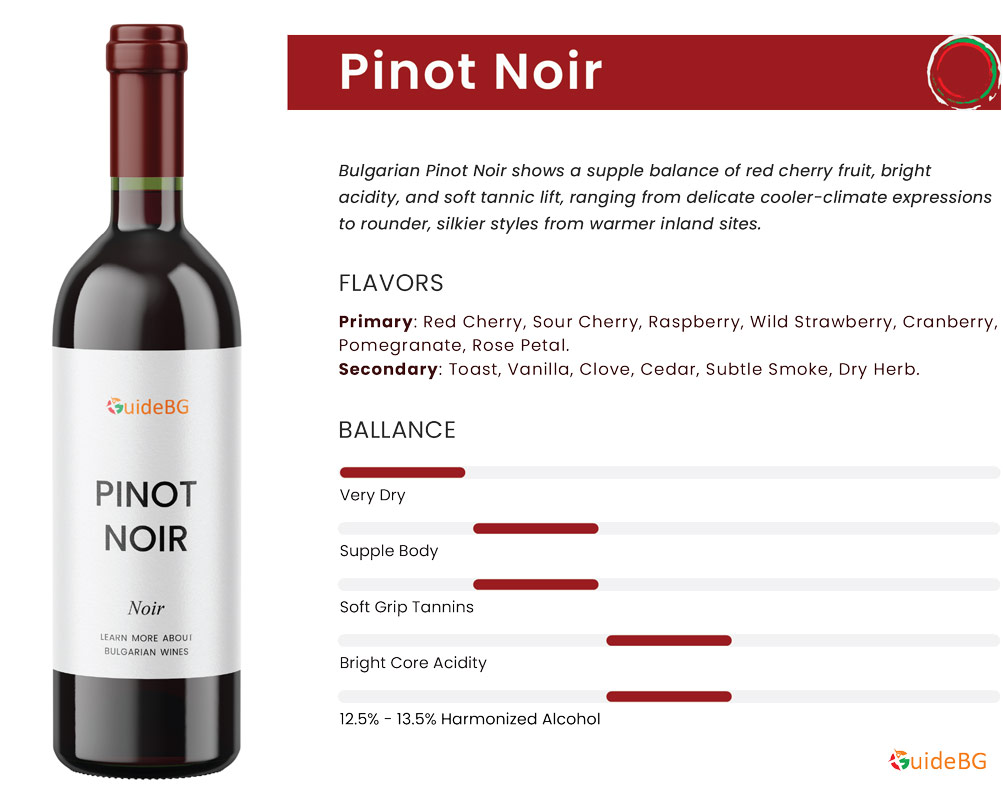
Expect a translucent ruby-to-medium-ruby colour, never an opaque wall of pigment. The nose should lead with red berries and cherry, sometimes with rose petal, peppery spice, dried herbs, or a light earthy note. On the palate, the best Bulgarian examples feel precise and flowing rather than massive, with delicate tannins and freshness carrying the finish. Warmer or oak-aged bottlings can show more black cherry, toast, cocoa, and smoke.
Cellaring Potential
Bulgarian Pinot Noir positions as a medium-term cellar wine. Most fruit-driven bottles are at their most expressive over about 3 to 6 years, while the better structured or barrel-aged examples can evolve further into dried fruit, forest-floor, mushroom, and truffle notes.
Blending Partners
For still red wine, Pinot Noir usually deserves to stand alone. Its beauty is in nuance, not force. In Bulgaria, the most natural partnership is in traditional-method sparkling, where Pinot and Chardonnay can work beautifully together; for still wines, Pinot Noir is more often a varietal statement than a blending engine.
Breeding Background & Regional Context
Northern Black Sea / Varna
This is one of the most promising homes for Bulgarian Pinot Noir. The broader northern Danubian PGI includes the Northern Black Sea coast and is known for fresher, lighter reds, while north-east Bulgaria has already drawn attention for promising Pinot Noir. Odessos, for example, bottles a single-vineyard Pinot Noir from Blaskovo in the Varna region, grown on limestone-sandy soils. In the glass, this is where I would expect the most lifted and fine-lined Bulgarian style: wild strawberry, sour cherry, cranberry, floral lift, and a cooler finish.
Danubian Plain / Danube River
Further west and northwest, cooler plots near the Danube can also suit Pinot Noir. It has been noted that the grape on cooler sites near Vidin, and Château Burgozone explicitly describes the climate along the Danube River in Northern Bulgaria as suitable for Pinot Noir. Here, the style usually broadens slightly: cherry, raspberry, red plum skin, a little spice, and soft but present tannin.
Rhodope Foothills / Plovdiv
Pinot Noir is not the headline act in the Thracian Lowlands, but it can be convincing in more elevated or moderated pockets. In the Plovdiv PDO, Villa Yustina has become a benchmark estate in the Rhodope foothills, producing elegant Pinot Noir alongside Mavrud and Rubin. Compared with northern expressions, these wines can be rounder and a shade darker in fruit, with more black cherry, sweet spice, and occasional oak sweetness, while still keeping Pinot’s silk rather than turning broad-shouldered.
Shivatchevo / Sub-Balkan Southeast
Shivatchevo is especially interesting for Pinot Noir because the region combines a long growing season with retained acidity, thanks to cool air currents from the Balkan Mountains and limestone-rich soils on some sites. Note that Edoardo Miroglio sources Pinot Noir from Shivatchevo. This suggests a style that can carry a little more ripeness and spice than the north, but still with freshness and poise when yields are controlled.
Alternative Grapes
If a reader enjoys Pinot Noir in Bulgaria, the first local grape to suggest is Gamza, which shares that light-footed, red-fruited, high-toned charm. The second is Buket, a Bulgarian crossing of Mavrud and Pinot Noir, offering a more local and slightly more structured take on Pinot-like fragrance.