

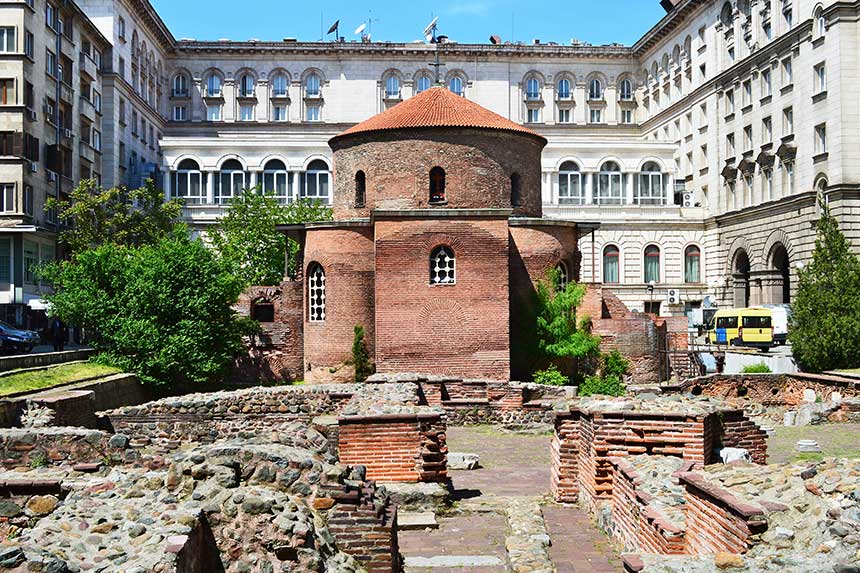
The oldest preserved Roman building in Sofia
Hidden in the courtyard of the Presidency in central Sofia, the Saint George Rotunda is one of the city’s most remarkable historical survivors. It is a small red-brick domed building, surrounded by archaeological remains from ancient Serdica and framed today by modern government buildings.
Official Sofia visitor information describes the rotunda as the most ancient preserved Roman building in the city. It was part of a larger ancient building complex from the time of Emperor Constantine I the Great, at the beginning of the 4th century AD.
This makes the Rotunda of Saint George not only a beautiful landmark, but also one of the clearest places in Sofia where visitors can see the continuity between Roman Serdica, early Christianity, medieval Sredets and the modern Bulgarian capital.
Fact box
- Name: Saint George Rotunda, also known as St. George the Victor Rotunda.
- Location: 2 Dondukov Blvd., in the Presidency courtyard, central Sofia.
- Date: Beginning of the 4th century AD, during the Constantine period.
- Original context: Part of a larger late Roman building complex in ancient Serdica.
- Early Christian use: Accepted by official Sofia visitor material as having served as a baptistery in the Early Christian period.
- Later role: Transformed into a church in the 6th century during the reign of Emperor Justinian I and painted for the first time.
- Current status: Historic Orthodox church and protected landmark, surrounded by open-air archaeological remains.
- Access: Official tourism information describes the site as visitable, free of charge and accessible all year round. The surrounding archaeological remains are listed by Sofia History Museum as open 24 hours and free to access.
Why the rotunda matters
The Saint George Rotunda matters because it is a rare preserved building from Roman Serdica, the ancient city beneath modern Sofia. While many Roman remains in the city survive as foundations, walls, streets or fragments, the rotunda still stands as a complete architectural volume.
The building is also important because of its layered religious history. Official Sofia visitor information states that it is accepted as an early Christian baptistery and that it became a church in the 6th century under Justinian the Great. Several layers of frescoes from different periods were discovered during restoration of the interior, including a 9th-century angel image described by the official Sofia source as exceptional.
The rotunda should not be introduced as a temple of Apollo unless a serious archaeological source is cited. The reliable public heritage sources used here describe a Roman building complex, early Christian baptistery and later church, not a securely identified pagan temple.
From Roman Serdica to Christian Sofia
In the 4th century, Serdica was an important city of the Roman Empire. The rotunda belonged to a larger late antique complex, often associated with the so-called Constantine Quarter of Serdica-Sredets. Sofia History Museum notes that the surrounding remains include part of a former Roman street with sewage, foundations of a large three-nave basilica-like public building, smaller buildings and a structure equipped with a Roman hypocaust heating system.
This context is essential. The Saint George Rotunda was not an isolated monument. It formed part of a prestigious urban zone of late Roman Serdica, later absorbed into the medieval and modern city.
During the Early Christian period, the rotunda is accepted as having served as a baptistery. In the 6th century, during the reign of Justinian I, it was transformed into a church and painted. This is the safer and more accurate story to tell: not a mythology-led transformation from Apollo to museum, but a source-led history from Roman urban building to early Christian baptistery and later church.
Architecture and frescoes
The rotunda is built of red brick and has a compact domed form. Its circular central space, thick walls and late Roman construction make it visually different from most later churches in Sofia. It stands today below the level of the surrounding modern city, which helps visitors understand how much the urban surface of Sofia has risen since antiquity.
Inside, the frescoes are among the most important features. Several painting layers from different periods were found during restoration. One of the most famous surviving fragments is the image of an angel from the 9th century.
The rotunda’s value lies in this combination: Roman architecture, early Christian function, medieval painting and continuous urban memory.
What visitors can see today
Visitors can see the red-brick rotunda itself, the surrounding archaeological remains, fragments of Roman streets and nearby structures from the ancient city. The site is especially striking because it sits in the middle of modern Sofia, only a short walk from the Presidency, the Council of Ministers, the Archaeological Museum, Serdika metro station and St. Nedelya Square.
The open-air remains around the rotunda are managed as part of Sofia’s archaeological heritage. Sofia History Museum describes the surrounding area as including a Roman street with preserved sewage, foundations of a large three-nave building, smaller buildings and a hypocaust-heated structure.
The church interior is small, atmospheric and dimly lit. Visitors should remember that this is not simply a tourist object. It is a historic religious monument, so quiet behaviour, modest dress and respect during services are appropriate.
How to visit
The rotunda is located at 2 Dondukov Blvd., in the Presidency courtyard, in the very centre of Sofia.
It is easy to combine with a walking route through ancient and historic Sofia: Serdika archaeological complex, the Largo, St. Petka Samardzhiyska Church, the Archaeological Museum, St. Nedelya Church, the Sofia History Museum and the St. Sofia Basilica archaeological level.
Official tourism information describes the rotunda as available for visits, free of charge and accessible all year round. Sofia History Museum lists the archaeological remains around the rotunda as open every day, 24 hours, with free entrance.
Because access to the interior may depend on church services or local arrangements, it is best to check on site if you specifically want to enter the church rather than only view the exterior and surrounding ruins.
Why to visit?
Saint George Rotunda is one of the best places to understand Sofia’s layered history in a single view. Roman walls, early Christian memory, medieval frescoes and modern state buildings stand almost on top of one another.
It is not the largest church in Sofia and not the most visible monument from the street, but it may be the most quietly powerful. In a city where ancient Serdica often appears below ground, the Rotunda of Saint George still rises above the ruins as a complete building. That makes it one of the essential stops for anyone interested in Sofia’s Roman, Christian and medieval past.