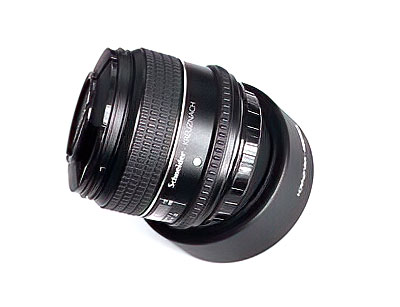


Lens overview
The Schneider‑Kreuznach 80 mm f/2.8 LS is the standard leaf‑shutter prime for the Mamiya/Phase One 645 system. The original LS version debuted in 2009; Phase One later introduced a Blue Ring update and the Mark II (optical redesign) for the XF platform. Core specs (Mk I): 6 elements / 5 groups, f/2.8–22, min focus 0.70 m, 72 mm filter, ≈500 g, AF/MF, flash sync up to 1/1600 s. On 645 digital backs, it gives a 35 mm‑equivalent FoV ≈of 50 mm.
Manufacturing country: built using precision Japanese manufacturing (Phase One/Schneider collaboration).
Pricing — then & now:
- New (2015 launch pricing): €2,490 / $3,290 for the 80 mm LS. Phase One
- Current new/street examples: dealers list around $3,865 (availability varies by region/version).
- Used market (2024–2025): ~$500–1,300 depending on version/condition (older silver‑ring LS at the low end; Blue Ring & Mk II higher).
Build and ergonomics
Solid, professional build with bayonet hood, 72 mm front thread, and a comfortable size/weight for a medium‑format prime (≈500 g for the earlier LS). AF is quiet; MF override is available. The Mark II update increases mass (≈765 g) and revises the optical design (8/6), maintaining the same working ergonomics and 1/1600 s leaf‑shutter sync for strobe‑friendly shooting.
Optical performance
- Sharpness: Excellent central and across‑frame sharpness even near f/2.8 on MF backs; the Mk II emphasizes “bright edge‑to‑edge sharpness”.
- Color & contrast: Neutral color with strong micro‑contrast; coatings are tuned for high‑resolution backs.
- Bokeh: Natural, fine transitions at portrait distances; depth‑of‑field control akin to a 50 mm on full‑frame (when comparing FoV on 645).
- Flare & CA: Well‑controlled for a fast standard prime; hood recommended around hard sources. (Mk II marketing highlights “sensational contrast”.)
- Distortion & vignetting: Very low distortion—the Mk II is positioned as “distortion‑free aesthetic”; mild light fall‑off at maximum aperture.
Digital adaptation
- Native systems: Phase One XF and Mamiya/Phase One 645 DF/DF+ (XF 645 bayonet). Full AF, aperture control, and leaf‑shutter operation up to 1/1600 s.
- Adapting to Mirrorless (Canon RF, Nikon Z, Sony E, L‑mount, Fuji GFX): Mamiya 645 lenses can generally be adapted using an optics-free mechanical adapter. Their approximately 63.3 mm flange focal distance is considerably longer than that of these mirrorless mounts, allowing a correctly manufactured adapter to restore the intended lens-to-sensor spacing and preserve infinity focus. Most combinations require manual focusing and manual or stop-down aperture control. Because M645 and 645 AF lenses differ mechanically and electronically, confirm compatibility and aperture operation for the specific lens and adapter.
- Adapting a lens does not change its physical focal length or f-number. An 80 mm lens remains an 80 mm lens. Use the Lens Equivalence Calculator to compare framing, depth of field, and total light performance across sensor formats.
- Significant limitation: AF and aperture control require a native 645 AF body. The LS 80 has no aperture ring; with a passive adapter, it stays wide open at f/2.8 (some adapters add a stop‑down iris, which darkens and degrades image quality).
- Leaf shutter: cannot be triggered by passive adapters; you’ll use the camera’s focal‑plane shutter on mirrorless.
Historical and collector context
Launched in 2009 for the 645 AF/DF generation, the 80 mm LS quickly became the workhorse portrait/reportage prime thanks to leaf‑shutter sync up to 1/1600 s—hugely valuable for outdoor fill‑flash. The Blue Ring cosmetic update and Mk II optical refresh (2020) modernized contrast and edge performance for 100–150 MP backs. For collectors/shooters, older silver‑ring LS copies are often bargain‑priced; Blue Ring and Mk II carry higher used prices.
Impressions
In day‑to‑day work, this is the one‑lens solution on XF/DF bodies—snappy AF, clean rendering, and strobe flexibility. On mirrorless via passive adapters, it’s MF‑only at f/2.8, still very sharp but without LS benefits—best for portrait and product work where you can compose deliberately.
Sample Photos

Verdict — Pros and Cons
Pros
- Leaf shutter with flash sync up to 1/1600 s—killer for location flash
- Excellent sharpness/contrast; modern coatings; reliable AF on XF/DF bodies
- Low distortion; natural color; versatile 80 mm MF standard (≈50 mm eq on 645)
- Solid build; 72 mm filter; manageable size/weight (Mk I ≈500 g)
- Creamy, exceptional bokeh
Cons
- Aperture/LS don’t work off‑system (passive adapters = f/2.8 fixed, no LS)
- Price remains high; new; Blue Ring/Mk II used prices stay premium
- Mk II is noticeably heavier (~765 g)
- No EXIF information is transferred when converted to Canon RF