

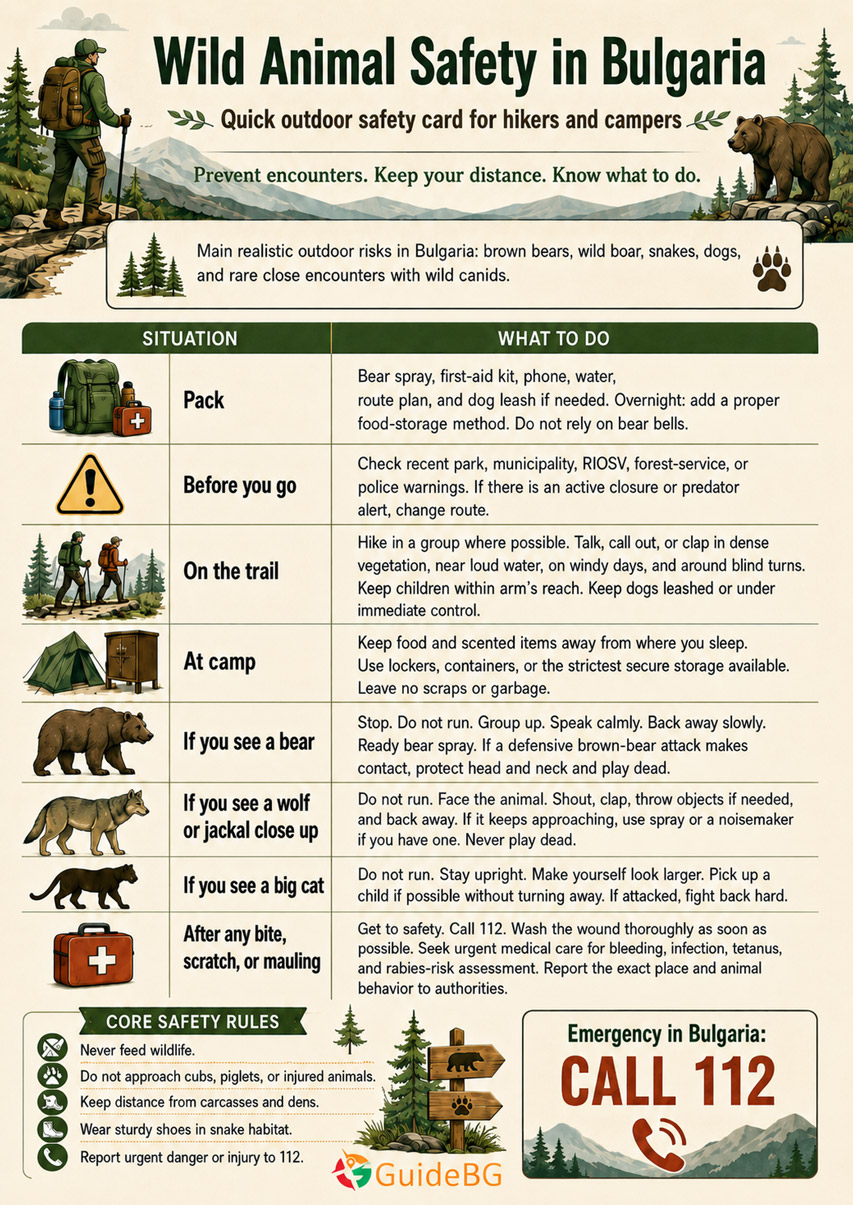
Most wild animal incidents are preventable. In Bulgaria, the realistic outdoor risks are not “monster attacks” but surprise encounters, food attraction, loose dogs, snake bites, wild boar, and rare defensive reactions from bears. Brown bears live in Bulgaria, with an estimated number of around 900–1,200 animals, mainly in mountain forest regions; wild boar, wolves, jackals, and venomous vipers (very rare) also occur in Bulgarian nature.
Reports about a black puma should be treated carefully. The puma, or cougar, is native to the Americas, not Bulgaria. Do not ignore an official warning, but do not plan your mountain safety around rumors of exotic cats.
Before you go
Tell someone your route, expected return time, and emergency plan. Carry a charged phone, power bank, map/GPS, headlamp, whistle, first-aid kit, water, warm layer, rain protection, and any personal medication. In bear areas, keep food and scented items sealed. In remote places, avoid hiking alone, especially at dawn, dusk, or night.
Bear spray is one of the best-studied non-lethal deterrents for bear encounters. It must be carried on the belt or chest strap, not buried in a backpack. A review of bear-spray incidents in Alaska found that it stopped undesirable bear behavior in over 90% of cases, and most users escaped without injury; however, it is not a substitute for prevention.
On the trail
Make your presence known before you enter thick vegetation, blind bends, berry patches, noisy streams, or forest edges where animals may not hear you. Talk normally, clap occasionally, and keep children close, or pick them up. Do not wear headphones in wild terrain. Stay on marked routes when possible.
Never feed wild animals. Do not approach cubs, young boar, carcasses, dens, or animals that appear injured. If you find fresh tracks, strong animal smell, digging, overturned stones, torn beehives, or a carcass, leave the area calmly. Bears are most dangerous when surprised, cornered, defending cubs, or guarding food/carrion.
Dogs may be a practical risk in Bulgaria in certain situations, too. Livestock guardian dogs, such as Karakachan-type dogs, are bred to protect livestock from wolves and bears. Do not run, shout aggressively, or wave trekking poles like weapons unless you are being attacked. Stop, face the dogs, speak firmly, keep poles low as a barrier, move slowly away from the flock, and put the owner/shepherd between you and the dogs if possible.
Camping safely
Cook and eat away from where you sleep. Store food, rubbish, toothpaste, cosmetics, cooking clothes, and pet food in sealed containers, and keep them away from the tent. Do not leave scraps, cans, or packaging outside. A clean camp is one of the strongest protective measures: animals that learn to associate people with food become more dangerous to people and often to themselves.
In an emergency in Bulgaria, call 112. Give your location, nearest trail/road/village, injuries, animal involved, direction of movement, and whether the danger is still present. 112 is the emergency number used in Bulgaria and across the EU.
If you see a bear
Stop. Stay calm. Do not run. Do not climb a tree. Speak in a low voice and slowly back away, keeping the bear in sight without staring aggressively. Make yourself visible. If you are in a group, stand together. Pick up small children immediately.
If the bear has not noticed you, leave quietly. If it has noticed you but is not approaching, give it space and retreat. If it approaches, stand your ground, prepare bear spray if you have it, and continue speaking calmly. Many charges are defensive or bluff charges, but you must be ready.
If contact happens during a defensive encounter, for example, you surprised the bear, there are cubs nearby, or the bear was guarding food – protect your neck and head, lie face down, spread your legs so you are harder to roll over, and stay still until the bear leaves. If the attack continues, or if an animal stalks you, follows you, enters your camp, or appears predatory, fight back with everything available.
Wild boar
Wild boars are common and can injure people, especially if surprised at close range, wounded, cornered, accompanied by piglets, or met at night. Attacks are rare but can be serious, often involving tusk injuries to the legs.
If you meet a boar, do not block their escape route. Back away quietly. Do not step between a sow and piglets. Keep dogs leashed; dogs can provoke boar and bring the danger back to you. If a boar charges, move behind a tree, large rock, or other barrier. Do not try to photograph it at close range.
Wolves and jackals
Wolves and golden jackals occur in Bulgaria, but attacks on people are not a normal risk during hiking. Jackals are known to affect livestock in parts of Bulgaria, while known human attacks in Europe are not typical. Wolf attacks on people in modern Europe are very rare compared with livestock conflicts.
If you see a wolf or jackal, remain calm, stand tall, keep children close, and back away. Do not feed, follow, or attempt to scare it for a photo. If an animal behaves abnormally, for example, approaching people, staggering, excessive salivation, no fear, avoiding contact, and report it.
Snakes
Bulgaria has venomous vipers (very rare), including the nose-horned viper, often described as one of Europe’s medically important venomous snakes. Bites are rarely fatal when treated promptly, but they require medical evaluation.
Wear closed shoes and long trousers in rocky, grassy, and sunny areas. Watch where you put your hands and feet. Do not lift stones or logs blindly. If you see a snake, step back and let it leave. Do not try to kill or catch it.
If bitten: move away from the snake, stay calm, remove rings/watches/tight clothing near the bite, keep the bitten limb still, and seek medical help immediately. Do not cut the wound, suck venom, apply ice, drink alcohol, or use a tight tourniquet.
If you see a “large cat”
First, consider distance, lighting, and mistaken identity. Still, if you see any large, unknown animal, do not approach for photos. Keep children close, face the animal, make yourself look bigger, speak firmly, and back away slowly. Do not run. If a large cat attacks, fight back; big-cat safety guidance differs from defensive bear guidance.
Report credible sightings with exact location, time, photos/video from a safe distance, and direction of movement to local authorities or 112 if there is an immediate public-safety risk.