

Want the whole workbook?
Download the Extended PDF Guide to MYP Design + ATL (with examples, checklists, and sentence starters).
What is MYP Design?
MYP Design is the IB subject where you solve real‑world problems by thinking and working like a designer.
Instead of just making a product, you learn to:
- understand people’s needs
- come up with creative ideas
- build and test prototypes
- reflect and improve your work
You might design apps, posters, products, games, models, or even small robots – but the process is always the same: the Design Cycle.
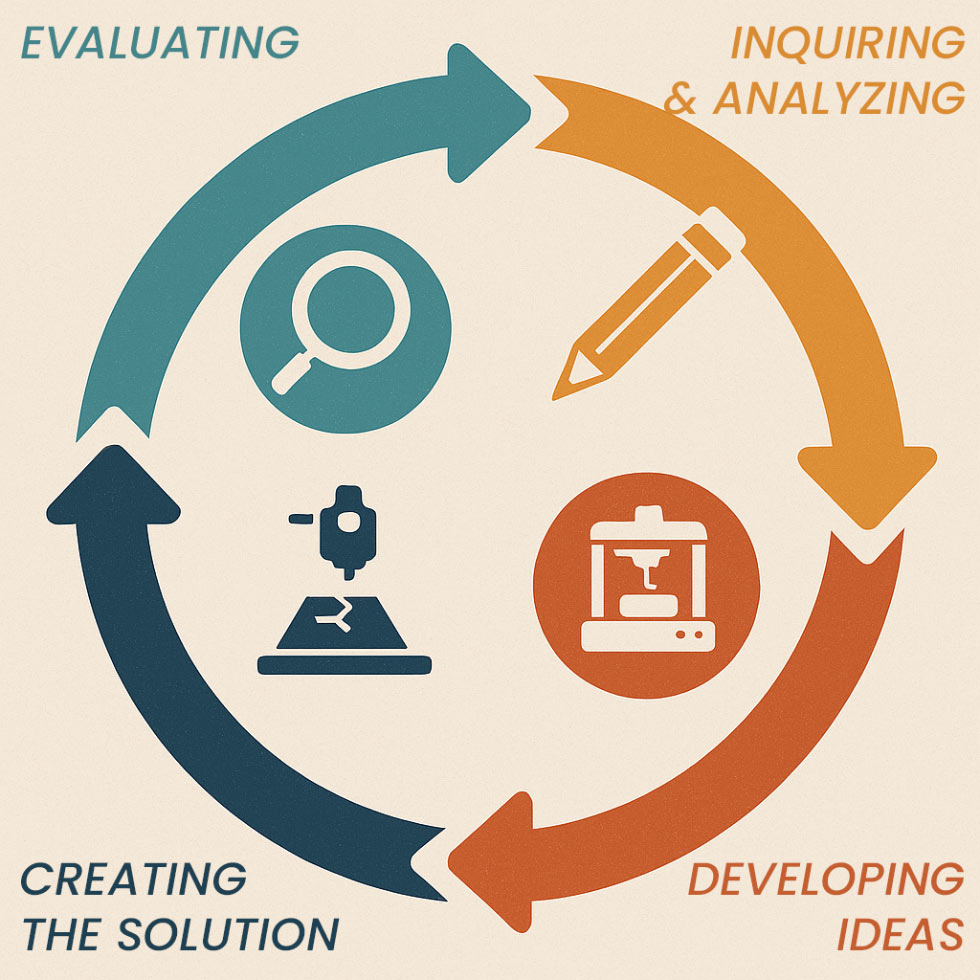
The Design Cycle in 4 Steps (Criteria A–D)
Think of the design cycle as a loop that takes you from problem to solution.
A. Inquiring & Analyzing
You explore the problem.
- Who has this problem?
- Why is a solution needed?
- What already exists? (similar products, apps, systems)
You research, interview users, and write a short design brief explaining what you learned.
B. Developing Ideas
You plan your solution.
- Make a list of requirements (design specifications)
- Sketch several different ideas
- Pick the best idea and draw it in more detail (with measurements/materials)
By the end, you have a clear plan that someone else could understand.
C. Creating the Solution
You build a prototype.
- Follow your plan (or improve it as you go)
- Use tools, software, or materials to create a working model
- Take photos and notes of each step and any changes
The goal: a functional prototype that can be tested, not a “perfect” final product.
D. Evaluating
You test and reflect.
- Test your prototype against your requirements.
- Ask users for feedback
- Decide what worked well and what needs improving
- Suggest realistic next steps or version 2.0
This is where you learn the most – from success and from things that didn’t work.
ATL Skills in Design (Your Superpowers)
In every project, you practice ATL skills:
- Thinking – analyzing problems, comparing ideas, improving designs
- Research – finding information, studying existing solutions, citing sources
- Communication – sketches, diagrams, presentations, design folders
- Self‑Management – planning time, meeting deadlines, organizing files and materials
- Social Skills – working in teams, giving and receiving feedback
Design isn’t just about “being creative” – it’s about learning how to learn and how to work.
Typical MYP Design Projects
Depending on your school, design projects can include:
- Digital design
- Apps, websites, games, UI/UX prototypes
- Animation, video, interactive media
- Product design
- Models and prototypes (lunchboxes, furniture, gadgets)
- 3D printing, laser cutting, crafting
- STEM/robotics
- Simple robots and electronics
- Engineering challenges (bridges, towers, mechanism builds)
Every project still uses the same 4 steps: Inquire → Develop → Create → Evaluate.
Why the Design Folder / Journal Matters
Your design folder (or journal) is your project’s story:
- research notes and links
- user interviews
- sketches and brainstorms
- photos of making
- test results and reflections
You’re graded on both your prototype and your process.
If it’s not in your folder, your teacher can’t see that you did it.
Tip: add minor updates as you go, not all at the end.
Quick “Am I on Track?” Checklist
Before you say “I’m done!”, check:
- I can explain the problem and who my user is
- I brainstormed multiple ideas and chose one for good reasons
- I built a prototype that matches my plan (or I explained changes)
- I have evidence of my process (photos, sketches, notes)
- I tested my solution and collected feedback
- I wrote about how successful it is and how I would improve it next time
If you can tick most of these, you’re doing MYP Design the way IB intends: as a complete design cycle, not just “making something quickly.”
Want the full version?
The Extended PDF Guide to MYP Design includes:
- detailed explanations of Criteria A–D
- a complete sample project (sustainable lunchbox)
- stage‑by‑stage checklists
- ATL skills map
Interesting reads:
- ATL: The Secret Skill Set Behind Every IB Class
- Is Problem-Solving Your Key to Turning Challenges into Opportunities?
- Mastering Science Writing in IB: Lab Reports, Investigations, and Essays
- How to Write an Effective IB I&S Essay (and Use Your ATL Skills)
- IB Drama + ATL: Telling Stories with Your Whole Self

. Learn about the four stages of the MYP design cycle)