

Muscat Ottonel is one of Bulgaria’s gentler aromatic whites. It comes from France and belongs to the Muscat family, but in Bulgaria it usually shows a calmer, drier face than many people expect from Muscat: floral on the nose, juicy in fruit, light to mid-weight on the palate, and refreshingly clean on the finish. Bulgarian Muscat Ottonel is mostly a dry, fragrant, youthful white.
In Bulgaria, Muscat Ottonel can be placed in three natural homes. The Danubian Plain clearly supports it, with the official Danube wine map listing the grape at estates from Novo Selo and Pleven to Magura and Montana. The Black Sea region also gives it a logical home, with the official route page naming Muscat Ottonel among the area’s most presented white grapes. And in the south, Plovdiv Wine Routes says Muscat Ottonel thrives in the broader Western Thrace and Rose Valley landscape alongside other successful aromatic whites. Put together, that suggests a grape that belongs not to one isolated corner of Bulgaria, but to the country’s fresher white-wine zones.
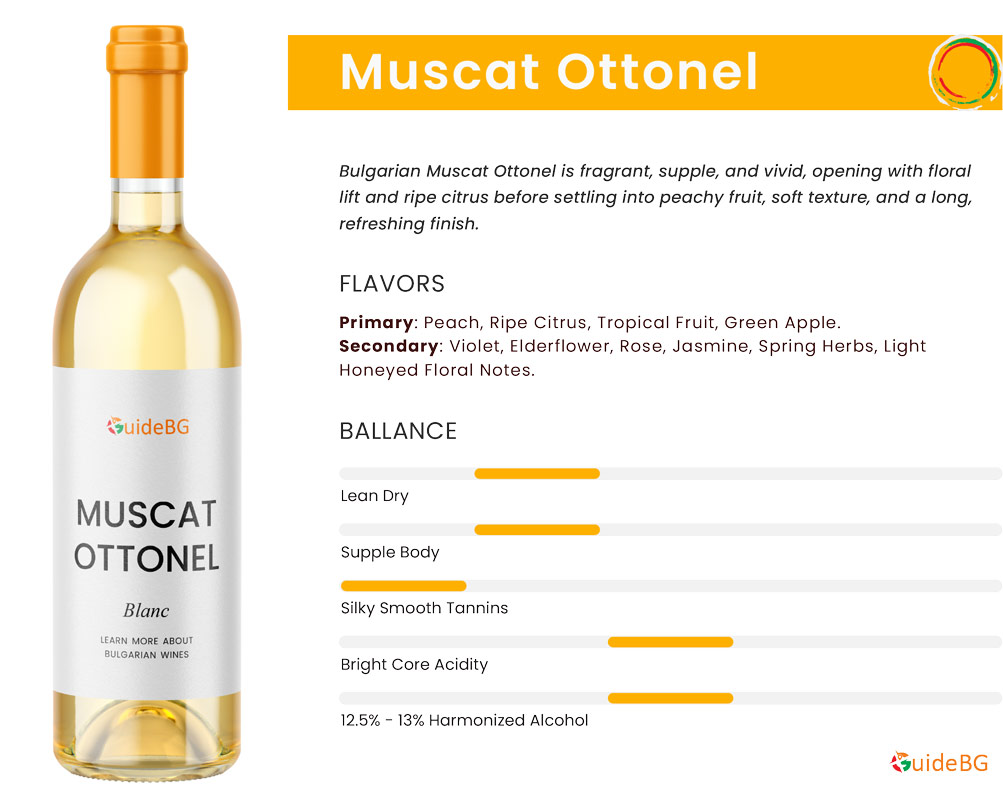
Bulgarian Muscat Ottonel gives you perfume, but not too much. It gives you fruit, but not syrup. It stays charming, drinkable, and modern.
Serving
8-10°C

Aroma white

no decanting

Serve Muscat Ottonel at 8 to 10°C in a standard white wine glass. Some producers recommend a range from 5–6°C to 10–12°C, but still, 8–10°C is the best middle ground because it keeps the wine fresh while allowing the floral and citrus notes to open properly. No decanting needed.
Food Pairing
This wine is happiest with light, aromatic, and clean-textured dishes. Some recommendations point toward salads, seafood, pasta, white meats, light starters, and cheeses. In Bulgaria, you can enjoy it with a fresh shopska salad, zucchini fritters, grilled trout, chicken with herbs, or a light vegetable banitsa.
What to Look For?
Look for a pale straw-to-lemon-green color, then a nose that clearly moves into flowers and ripe citrus: violet, elderflower, rose, blossom, peach, and fresh citrus are all right at home here. On the palate, the wine should feel dry but juicy, with a refreshing finish rather than obvious sweetness.
Cellaring Potential
Most Bulgarian Muscat Ottonel is best enjoyed young, ideally within 1–3 years of release. The wines are fresh, crisp, fragrant, and immediate, and are suitable for early drinking rather than long bottle age.
Blending Partners
Although Muscat Ottonel is often bottled on its own, it also works naturally in Bulgarian blends. Current examples show it paired with Kaylashki Misket for freshness and floral lift, and with Gewürztraminer for a more perfumed and slightly broader aromatic style.
Breeding Background & Regional Context
Muscat Ottonel is a French white grape, listed by UC Davis as Vitis vinifera, and French technical data say it was obtained by Moreau-Robert in the 19th century from a cross between Chasselas and Muscat d’Eisenstadt. Plantgrape also describes it as an early variety with good sugar potential, capable of making aromatic dry and liqueur wines, well adapted to clay-limestone terroirs, though sensitive to coulure, downy mildew, and grey rot.
Danubian Plain
This is one of Viognier’s clearest Bulgarian homes. The grape is among the Danubian Plain’s main white varieties, and producers around Oryahovo describe the Danube hills as offering conditions reminiscent of the Northern Rhône. The style here often leans toward apricot, peach, citrus, white flowers, and a fresher, finer line.
The regional accents are worth noting. In the Danubian Plain, Muscat Ottonel reads fresh, straightforward, and classically dry. Along the Black Sea, it sits comfortably in a maritime white-wine context built around freshness and finesse. In Western Thrace and the Rose Valley, it appears as part of a broader aromatic-white story, sometimes with a slightly fuller or more mineral feel. That last point is an inference from the regional sources rather than a formal legal category, but it aligns well with the evidence.
Alternative Grapes
If this style speaks to you, move next to Tamyanka for a more intense and spicier Muscat expression, then to Vrachanski Misket or Red Misket for a more locally Bulgarian floral register. If you prefer a more opulent aromatic white, go toward Traminer / Gewürztraminer.