

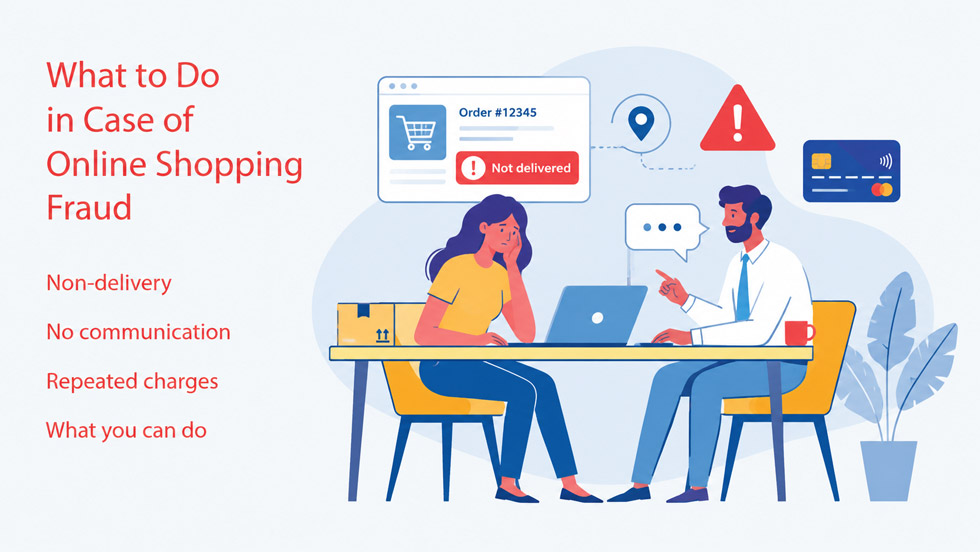
A practical guide for online store purchases in the EU, EEA, Switzerland, and cross-border cases
Online shopping fraud can start as a simple delivery delay. A package does not arrive, the seller stops responding, a tracking number looks suspicious, or a one-time purchase turns into repeated charges. The right response depends on what happened, where you live, where the seller is based, and how you paid.
This guide focuses on purchases from EU stores, EU/EEA-related stores, Swiss consumers buying from EU/EEA stores, and EU consumers buying from stores outside Europe.
First step: define the problem
Do not describe every problem only as “fraud.” Use a precise category. This makes your complaint stronger.
| Problem | What to call it | What to do first |
|---|---|---|
| The product never arrived | Non-delivery of paid goods | Ask the seller for a refund or valid proof of delivery |
| The seller ignores you | No communication / unresolved complaint | Send final written deadline |
| Tracking says delivered, but nothing arrived | Disputed delivery / fake or insufficient tracking | Ask the seller for proof of delivery to your address |
| Wrong or poor-quality item | Item not as described / defective goods | Keep photos and request a refund or replacement |
| Repeated charges | Subscription trap / unauthorized recurring charges | Cancel in writing and dispute the payment |
| Card/payment misuse | Unauthorised transaction | Contact the bank immediately and block the card if needed |
| Fake store or fake company details | Suspected online retail fraud / fake webshop | Report to the payment provider, consumer authority, and police/cybercrime channel |
In the EU, online purchases should normally be delivered within 30 days, unless you agreed otherwise. If the seller fails to deliver, you may cancel and request a refund; if the order was needed for a specific event and arrived too late or not at all, this strengthens the case. Please refer to the EU’s Online Shopping Rights.
Buyer assurance: what gives you the best chance of recovery?
Reporting helps authorities, but it does not always help you recover your money. The best refund routes are usually:
- PayPal claim, card chargeback, bank dispute, or marketplace buyer protection
- Consumer mediation or ECC-Net complaint
- Police/cybercrime report if there are fraud indicators
- Small claims procedure if the amount justifies it
Chargebacks are useful for card payments, but they do not guarantee refunds. Visa advises consumers to contact their card provider, ask for a chargeback or disputed transaction route, and provide evidence.
PayPal Buyer Protection may cover Item Not Received and Significantly Not as Described cases, depending on eligibility. PayPal disputes must be escalated to a claim before they close automatically after 20 days.
Keep communication open with the seller
Yes, it is usually better to keep communication open while also contacting the correct agencies. Many authorities and mediation bodies expect proof that you first contacted the trader.
Send one clear final message:
“I paid for order [number] on [date]. The goods were not delivered / the issue remains unresolved. I request a full refund within 5 business days. If I do not receive a satisfactory response, I will continue the payment dispute and report the matter to the relevant consumer protection and fraud authorities.”
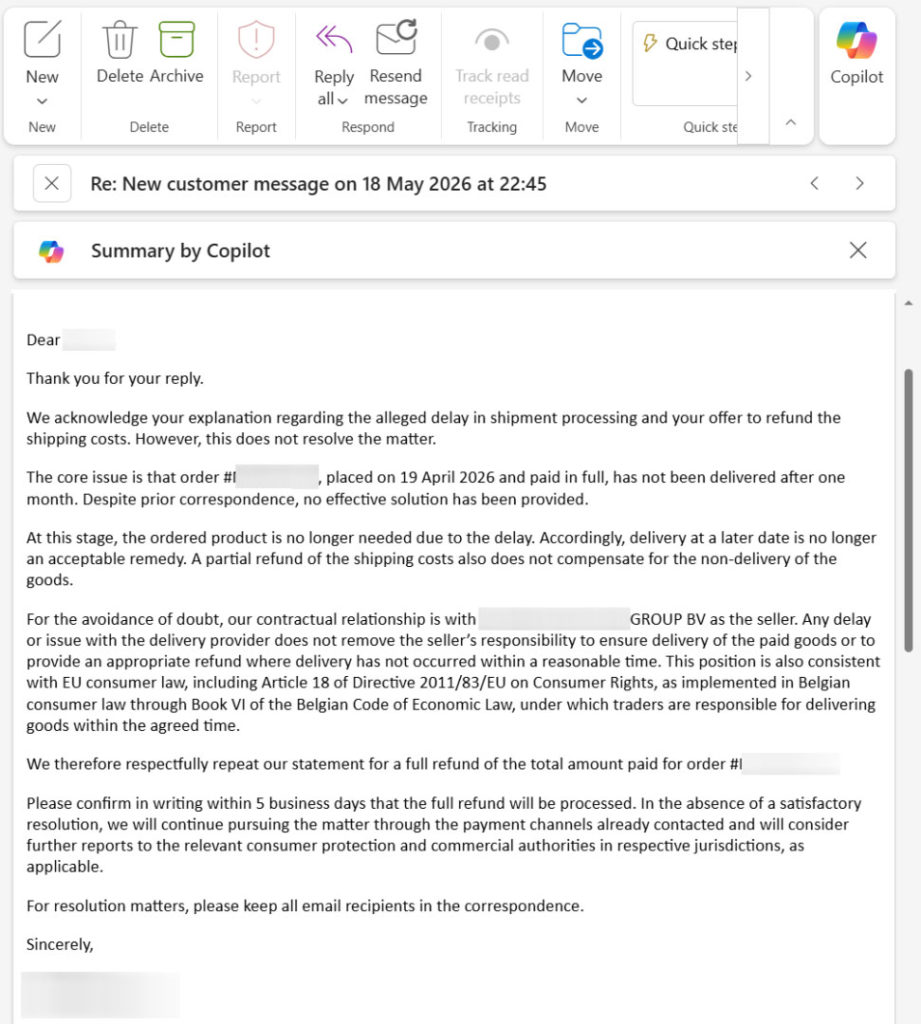
Do not insult, threaten, or exaggerate. Keep it factual. Save every email, screenshot, and tracking page.
If you live in the EU and bought from an EU, Iceland, or Norway store
This is the strongest consumer-protection scenario.
Use this order:
- Contact the seller in writing.
- Open a PayPal, bank, or card dispute.
- Contact the European Consumer Center in your country of residence.
- Report misleading or unfair practices to the seller’s national consumer authority.
- Consider mediation or the European Small Claims Procedure.
ECC-Net helps consumers living in the EU, Iceland, or Norway settle disputes with traders based in another EU country or in Iceland or Norway. You must contact the ECC in the country where you live.
The old EU Online Dispute Resolution platform is closed. It was discontinued on 20 July 2025, so consumers should now use ECC-Net, national consumer bodies, mediation, payment disputes, or court procedures.
For cross-border EU claims up to EUR 5,000, the European Small Claims Procedure may be useful.
If you live in Bulgaria, who to contact?
| Situation | Whom to contact in Bulgaria | Use for |
|---|---|---|
| A Bulgarian resident buying from a trader in another EU country, Norway, or Iceland | ECC Bulgaria | Cross-border consumer disputes, non-delivery, refusal to refund, or unresolved complaints with EU/EEA traders. |
| Problem with a Bulgarian trader or a consumer-law issue in Bulgaria | Commission for Consumer Protection, KZP / CCP Bulgaria | Complaints about Bulgarian businesses, misleading practices, unfair terms, defective goods, or consumer-rights violations. |
| Fake webshop, phishing, stolen card data, identity misuse, or cyber fraud | CERT Bulgaria / cybercrime information route | Cyber incidents, suspicious websites, phishing, online fraud signals, and cases that may involve digital crime. |
| Possible criminal offence | Prosecutor’s Office of the Republic of Bulgaria | Formal reports of suspected crimes. Include your name, contact details, evidence, payment proof, and correspondence. |
| Refund, chargeback, or payment dispute | Your bank, card issuer, PayPal, Revolut, Wise, Klarna, or another payment provider | The most practical route for recovering money after non-delivery, unauthorized charges, repeated billing, or unresolved payment disputes. |
ECC Bulgaria says its service is for Bulgarian residents whose complaint concerns a trader in another EU member state, Norway, or Iceland. It asks for proof of purchase, proof of payment, and correspondence, and asks consumers to send only one email per issue.
KZP / CCP Bulgaria provides an electronic complaint/signal form and a consumer hotline. It is the Bulgarian authority responsible for implementing consumer protection legislation and administering control over the domestic market.
CERT Bulgaria explains that cybercrime includes fraud, forgery, and identity theft committed in cyberspace and refers such matters to the Cybercrime Department at the Ministry of Interior.
The Bulgarian Prosecutor’s Office accepts electronic crime reports but requests identifying information such as name, address, and phone number; otherwise, the report may be treated as anonymous.
If you live in Switzerland and bought from an EU/EEA store
Switzerland is not part of ECC-Net. For Swiss consumers, the practical route is:
- Contact the seller.
- Open a PayPal, card, or bank dispute.
- Report a suspicious webshop to NCSC Switzerland.
- Report unfair practices to SECO if relevant.
- Report financial loss to the police.
- Use econsumer.gov for international cross-border complaints.
The Swiss NCSC lists dubious webshops as cases where goods ordered through a webshop are not delivered or contact details are missing. It recommends contacting the shop, checking payment protection, reporting financial loss to the police, and using the NCSC online form to help identify trends.
Switzerland’s NCSC report portal includes an online criminal complaint category for “Online purchase but did not receive goods,” while noting that the NCSC itself does not accept criminal complaints.
Swiss official guidance says a crime can be reported at any police station or public prosecutor’s office.
If you live in the EU and bought from a store outside Europe
This is harder because enforcement across borders may be limited. Focus first on money recovery:
- PayPal claim or card/bank chargeback.
- Marketplace buyer protection, if bought through a marketplace.
- Local police or cybercrime report if fraud is suspected.
- econsumer.gov for international complaints.
- National consumer authority if the store targets EU consumers.
econsumer.gov is a cross-border consumer complaint tool connected to the International Consumer Protection and Enforcement Network (ICPEN). It helps authorities identify misleading, deceptive, and fraudulent practices across borders.
Shopify-based online stores: what to do
Many independent-looking webshops are built on platforms such as Shopify. This does not automatically mean the store is fraudulent. Shopify is usually the technology provider, not the seller. Shopify states that it provides software and hardware used by merchants and does not sell products directly to consumers.
For a Shopify-based store:
- Contact the store directly first.
- Keep the order confirmation URL from the email.
- Use the same email address you used for the order.
- If there is no response or resolution after 30 days, or if the store appears fraudulent, use Shopify’s Report a merchant form.
- Still open a PayPal, card, or bank dispute. Do not rely on Shopify alone for a refund.
Shopify’s help page says that if you have already tried to contact the store and there has been no response or resolution for at least 30 days, you can use the order-issue form. Shopify also lists report categories, including order issues, spam or malicious practices, illegal activities, and fraud.
If the store sells illegal goods, unsafe products, or counterfeit goods through a platform, EU users can also use the platform’s own illegal-content or illegal-goods reporting mechanism under the Digital Services Act. The DSA requires platforms to provide easy reporting of illegal content, goods, or services and to respond to reports.
How to act, with examples
Example: Bulgarian consumer buys T-shirts from a Belgium-based store
A Bulgarian consumer orders custom T-shirts from a Belgian online T-shirt company. The order costs EUR 80. The goods are not delivered. The seller gives no useful explanation and/or stops answering.
Best approach:
- Send a final refund request to the seller.
- Open or escalate the PayPal/card/bank dispute.
- Contact ECC Bulgaria, because the buyer is in Bulgaria and the trader is in Belgium.
- Report the Belgian trader through ConsumerConnect / FPS Economy Belgium.
- Try the Belgian Consumer Mediation Service if direct resolution failed.
- Report to police/cybercrime channels if there are fraud indicators.
Belgium’s FPS Economy says consumers can report infringements of consumer law and misleading or unfair commercial practices through ConsumerConnect. Reports help the Economic Inspection identify unfair practices, but they do not necessarily resolve individual refund claims.
Belgium’s Consumer Mediation Service requires the consumer to show that they have already tried to resolve the matter with the company.
Important for T-shirts: custom or personalized goods may not be covered by the standard 14-day cooling-off withdrawal period, but that does not remove your rights if the goods are not delivered, defective, or not as ordered. EU guidance lists made-to-order or clearly personalized goods as an exception to the cooling-off period. Read more here.
Example: EU consumer buys T-shirts from a Netherlands-based store
A consumer orders T-shirts from a Dutch online store. Tracking says “delivered,” but the parcel never arrived. The seller says it is the courier’s problem.
Best approach:
- Ask the seller for proof of delivery to your address.
- Ask the seller to investigate with the courier.
- If no proof is provided, request a refund.
- Contact your local ECC (Netherlands) if you live in another EU country, Iceland, or Norway.
- Report suspected fraud to the Dutch Fraud Help Desk or your local police, depending on where you live.
Your European states that the trader is responsible for delivery and must contact the delivery service and prove delivery. According to the law, if the trader cannot prove delivery, they must send an identical item or refund you.
ECC Netherlands also says that if a parcel is marked delivered but not received, the seller is responsible until you receive the order and must refund you if the parcel is not found.
The Dutch Fraud Help Desk accepts reports of scams, attempted fraud, and suspicious activity, but it does not conduct fact-finding investigations. If you are abroad and were scammed by a Dutch company, the Dutch government advises you to report the crime at your local police station, which can then contact the Dutch police.
What to do by case type?
Non-delivery
Ask for either a refund or valid proof of delivery. If the product was needed for an event and is now useless, say so clearly.
Suggested wording:
“The goods were not delivered within the expected or reasonable time. The product is no longer needed because of the delay. I request a full refund.”
No communication
Send one final deadline. Then escalate to the payment provider, ECC, and/or consumer authority.
Suggested wording:
“I have contacted you several times without a satisfactory response. Please confirm refund within 5 business days.”
Fake or insufficient tracking
Ask for proof that the parcel was delivered to your name and address. A tracking number alone may not be enough.
Suggested wording:
“The tracking information does not prove delivery to my address or to me as the recipient. Please provide proof of delivery or issue a refund.”
Repeated charges
Cancel in writing. Screenshot the cancellation attempt. Dispute the charges with your bank or PayPal. Report as a subscription trap or unauthorized recurring charge.
The European Commission warns that subscription traps often present a product as a free trial or low-cost offer while hiding recurring payments in small print.
Counterfeit or unsafe goods
Do not resell or use unsafe goods. Take photos and report to the platform, consumer authority, and product-safety authority.
EU consumers can report product accidents or safety issues through the Consumer Safety Gateway, and the information is forwarded to the relevant national authority.
Unauthorised payment
Contact your bank immediately, block the card if needed, and report to police/cybercrime authorities.
Evidence checklist
Keep one file with:
- Order confirmation
- Invoice or receipt
- Payment proof
- Seller’s legal name, address, VAT/company number
- Website screenshots
- Product page screenshots
- Delivery promise and refund policy
- Tracking number and courier page
- All emails and chat messages
- PayPal/bank/card dispute reference
- Screenshots of similar complaints, if relevant
Where to report: useful institutional links
| Region/case | Agency or platform |
|---|---|
| EU cross-border consumer dispute | European Consumer Centers Network — ECC-Net |
| Bulgaria resident vs EU/Norway/Iceland trader | ECC Bulgaria |
| Bulgarian consumer-law issue | Commission for Consumer Protection — KZP / CCP |
| Bulgarian cybercrime/fraud | Cybercrime Department route via CERT Bulgaria |
| Belgium trader | ConsumerConnect / FPS Economy Belgium |
| Belgian company mediation | Belgian Consumer Mediation Service |
| Belgian Consumer Mediation ServiceThe | Dutch Fraud Help Desk |
| Switzerland’s suspicious webshop | NCSC Switzerland |
| Switzerland’s unfair practices | SECO |
| Switzerland criminal complaint | Police / public prosecutor |
| International cross-border fraud | econsumer.gov / ICPEN |
| EU small claim up to EUR 5,000 | European Small Claims Procedure |
| Shopify store | Shopify “Report an issue with an order” or “Report a merchant.” |
| Unsafe goods in the EU | EU Safety Gate / Consumer Safety Gateway |
Public reviews: Should you warn other consumers?
Public reviews can help other buyers, especially when a webshop has repeated issues with non-delivery, poor communication, or unresolved refund requests. However, reviews should be treated as consumer feedback, not as a replacement for formal complaints, payment disputes, or reports to authorities.
The safest approach is to write only what you can prove: the order date, amount paid, delivery status, communication attempts, the seller’s response, and whether a refund was provided. Avoid emotional language or unsupported accusations. Instead of writing “this is fraud,” use factual wording such as “the order was not delivered,” “the seller did not provide a satisfactory solution,” or “I have reported the matter as suspected online retail fraud/non-delivery.”
The most useful public platforms are usually:
- Google Reviews / Google Maps, if the business has a verified business profile.
- Trustpilot, especially for online shops and web stores. Trustpilot review guidance.
- ScamAdviser is useful when consumers search the domain before buying. Scamadviser report form.
- Shopify’s merchant / Shopify’s order issue forms, if the store appears to use Shopify infrastructure. Shopify help page. How to tell if a store uses a Shopify platform?
- Social media pages, such as Facebook or Instagram, if the seller actively promotes or sells there.
For Shopify-based stores, remember that Shopify is usually the platform provider, not the seller. A Shopify report may help the platform review the merchant, but it is not normally a direct refund route. Continue pursuing the refund through the seller, PayPal, your bank, card issuer, or marketplace/payment provider.
A factual review may look like this:
“I placed order #[number] on [date] and paid [amount]. After [period], the order had not been delivered. I contacted the seller several times. The response did not provide a satisfactory solution or a full refund. Because of the delay, the product was no longer needed. I have requested a full refund and escalated the matter through the relevant payment channels. Based on my experience, I cannot recommend this store unless non-delivery cases are resolved promptly and customers are refunded when goods are not delivered within a reasonable time.”
This type of review is more credible, more useful to other consumers, and less risky than making broad accusations that are difficult to prove.
Final advice
The most accurate approach is to use several channels for different purposes:
- Seller communication creates evidence.
- The payment provider gives the best chance of a refund.
- ECC or mediation helps resolve cross-border consumer disputes.
- Consumer authority helps investigate unfair commercial practices.
- Police or a cybercrime authority is appropriate for suspected criminal fraud.
- Shopify or marketplace reporting helps the platform investigate the merchant.
- econsumer.gov helps authorities detect international patterns.
Keep your wording factual: non-delivery, no communication, disputed tracking, unauthorized recurring charges, suspected fake webshop, misleading commercial practice. This is stronger than emotional accusations and easier for agencies to process.