

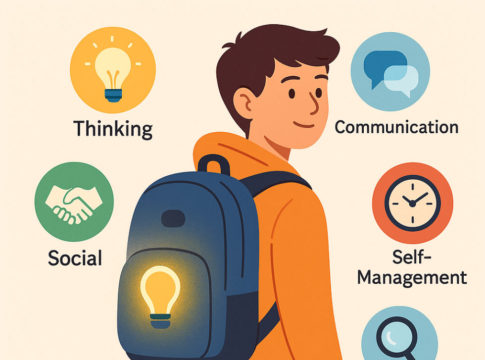
Have you ever felt like school is just: learn this, memorize that, test next week?
The IB (International Baccalaureate) actually wants something more from you: it wants you to learn how to learn.
That’s where ATL comes in.
We will talk about&
- So… what is ATL?
- The 5 ATL Skill Areas (in everyday language)
- 1. Thinking Skills – using your brain, not just your memory
- 2. Communication Skills – getting your message across
- 3. Social Skills – not being “that person” in group work
- 4. Self-Management Skills – handling time, work, and stress
- 5. Research Skills – finding the good stuff, not just “first link on Google”
- Do ATL Skills Affect Your Grades?
- Why Should You Care?
- One Simple Challenge for You
- What ATL Looks Like in My Classes?
- Science Class
- Math Class
- Design Class (Process Design / MYP Design Cycle)
- The PDF version – ATL: The Secret Skill Set Behind Every IB Class
So… what is ATL?
ATL stands for Approaches to Learning.
Think of it as your personal skill pack for surviving (and actually doing well in) school and life.
ATL isn’t a subject like science or math.
You won’t see “ATL” on your timetable.
Instead, ATL is:
- How you organize yourself
- How you think
- How you work with others
- How do you find information
- How you express your ideas
Your teachers are secretly training these skills all the time, through projects, group work, reflections, and class discussions.
Wait, what is MYP, and what is DP?
The 5 ATL Skill Areas (in everyday language)
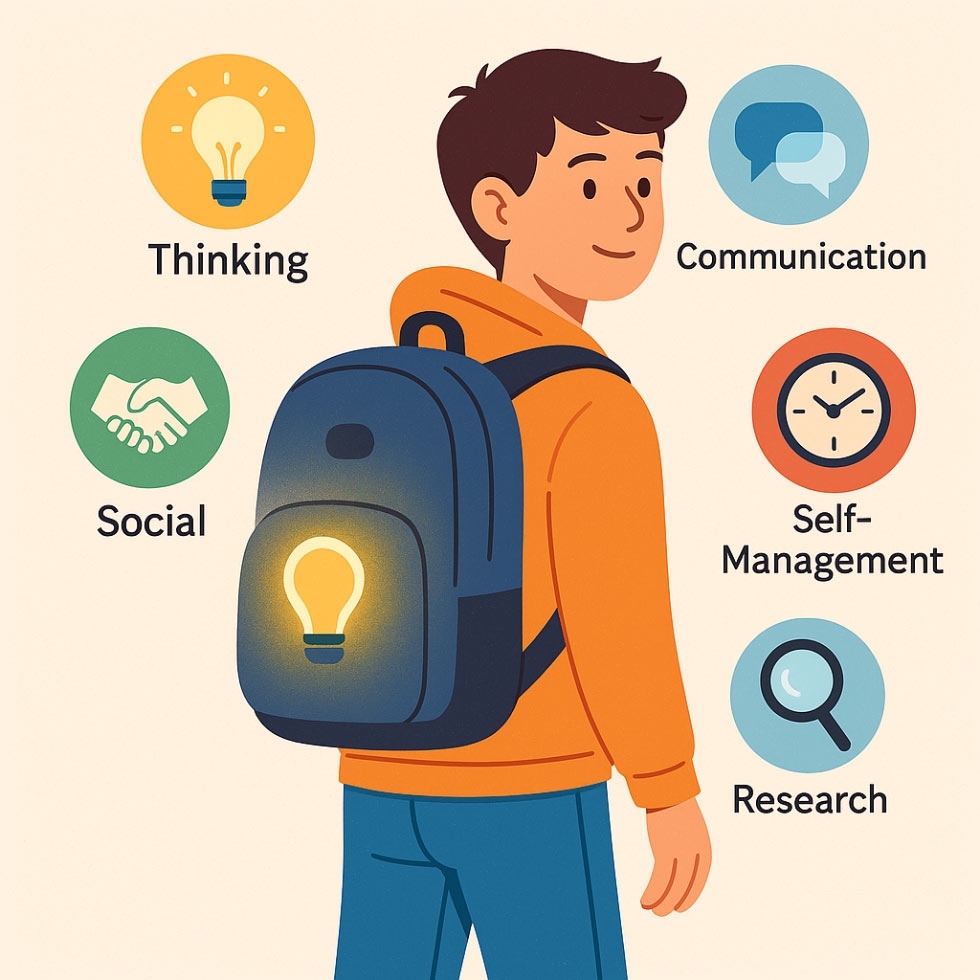
1. Thinking Skills – using your brain, not just your memory
This is about going beyond “copy and paste” thinking.
You use thinking skills when you:
- Ask “why?” instead of just writing what the teacher says
- Compare two ideas, characters, or events
- Solve tricky problems in math or science
- Come up with creative ideas for a project or experiment
Example:
In history, instead of just writing “The war started in 1914,” you ask:
“What actually caused this war? Who wanted it? Who didn’t?”
That’s ATL thinking.
2. Communication Skills – getting your message across
You might be thinking, “I talk all the time; I’ve got this.”
But communication is more than talking.
You use communication skills when you:
- Explain your ideas clearly in class
- Write emails or messages to teachers politely
- Create a presentation that people understand
- Listen to others without interrupting or zoning out
Example:
In a group presentation, you speak clearly, don’t rush, look at the audience, and actually know what’s on your slides instead of reading everything.
3. Social Skills – not being “that person” in group work
Group work can either be excellent or a disaster.
Social skills decide which one.
You use social skills when you:
- Share work fairly in a group
- Respect other people’s ideas, even if you disagree
- Give helpful feedback instead of just criticism
- Stay calm when the group is stressed
Example:
Your group is behind on a project. Instead of blaming everyone, you say:
“Okay, we have two days. I’ll finish the slideshow. Can you handle the script? Can you check the facts?”
That’s ATL social skills in action.
4. Self-Management Skills – handling time, work, and stress
This is a big one at 14–15 years old.
You use self-management skills when you:
- Remember homework and deadlines
- Don’t leave projects until midnight the night before
- Manage distractions (yes, that includes your phone)
- Deal with stress in healthy ways (sleep, breaks, asking for help)
Example:
You’ve got a science test, an English essay, and a PE assessment in the same week.
Instead of panicking, you:
- Plan what to do each day
- Break big tasks into small steps
- Start early (even just 20 minutes a day helps)
That’s ATL helping your future self.
5. Research Skills – finding the good stuff, not just “first link on Google”
Research is more than typing into a search bar.
You use research skills when you:
- Look for reliable sources (not random TikTok “facts”)
- Take notes in your own words
- Keep track of where you got your information
- Ask focused questions like,
“How does social media affect teen mental health?”
instead of just “social media”.
Example:
For a project on climate change, you don’t just copy one website. You:
- Use several sources
- Compare what they say
- Write a bibliography (list of sources)
That’s ATL research.
Do ATL Skills Affect Your Grades?
Yes — just not always directly.
You might not get a grade called “ATL: 7/7,” but:
- ATL affects how well you handle projects and tests
- Teachers often comment on your ATL in reports
- Better ATL = better work, less stress, and usually better grades
When you see comments like:
- “Needs to manage time more effectively”.
- “Communicates ideas clearly”.
- “Works well with others”.
…that’s all ATL!
Why Should You Care?
Because ATL is not just for school.
These skills help you:
- In exams (planning, thinking, managing stress)
- In friendships (communication, social skills)
- In future jobs (teamwork, problem solving, organizing your work)
- In life in general (being independent and responsible)
IB doesn’t just want you to pass tests.
It wants you to become someone who can learn, adapt, think, and handle real life.
One Simple Challenge for You
This week, pick one ATL area to focus on:
- Thinking: Ask “why?” one extra time in every class.
- Communication: Before speaking, ask: “Will this help the group?”
- Social: In group work, be the person who says, “What do you need help with?”
- Self-management: Write all deadlines in one place and check them daily.
- Research: For your next task, use at least two sources and note them down.
Small changes in ATL can make a big difference.
What ATL Looks Like in My Classes?
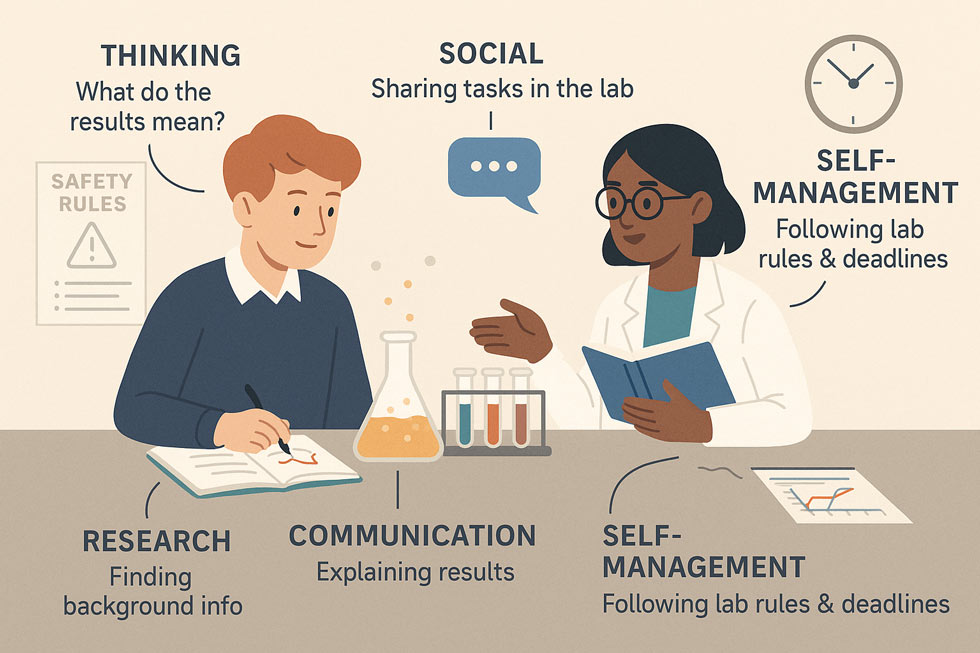
Science Class
Thinking Skills
- Asking “What will happen if…?” and turning that into a hypothesis.
- Looking at your lab results and asking:
“Does this support my hypothesis? Why or why not?” - Spotting patterns in data (e.g., “When temperature increases, reaction speed also increases.”)
Example:
You experiment on how light affects plant growth. You don’t just record numbers; you explain why the plants in the dark grew less.
Communication Skills
- Writing lab reports that another person could follow.
- Labeling diagrams and graphs clearly.
- Explaining experimental results to the class in simple, clear sentences.
Example:
Instead of writing “It went up,” you write:
“As the amount of salt increased, the time taken for the ice to melt decreased.”
Social Skills
- Working safely and fairly in lab groups.
- Sharing equipment without fighting over the “fun” tools.
- Listening to teammates’ ideas about how to improve the experiment.
Example:
You let someone else measure while you record the data, and you switch roles in subsequent trials.
Self-Management Skills
- Bring your notebook, calculator, and lab coat when needed.
- Following safety rules without being reminded.
- Meeting deadlines for lab reports and investigations.
Example:
Your teacher says, “Lab report due Friday.” You start on Tuesday instead of waiting until Thursday night.
Research Skills
- Looking up background information before a practical (e.g., what is osmosis?).
- Using diagrams, textbooks, and reliable websites.
- Citing where you got your information from.
Example:
In your report, you include a short “Research” section and write your sources at the end.
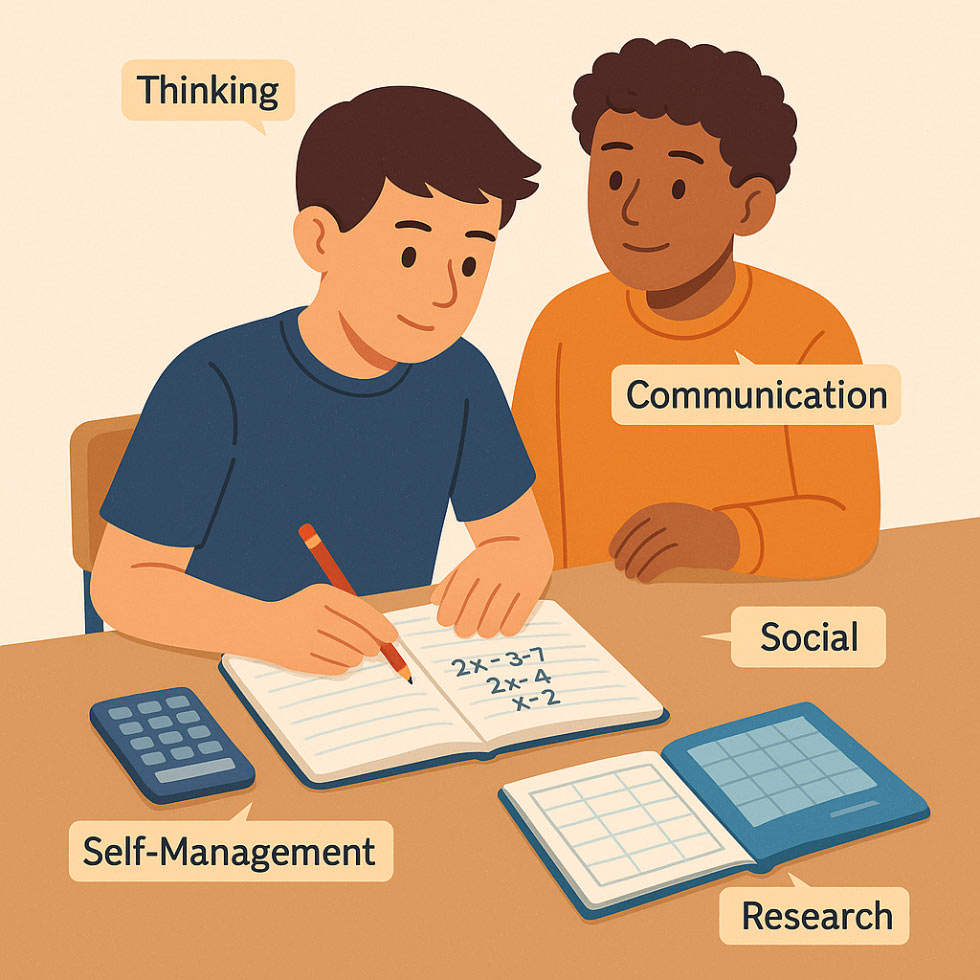
Math Class
Thinking Skills
- Trying different methods to solve the same problem.
- Checking if your answer makes sense (you don’t just trust the calculator).
- Looking for patterns (e.g., how a sequence grows, why a formula works).
Example:
You solve an equation, then plug your answer back in to see if it actually works.
Communication Skills
- Showing your working clearly, step by step.
- Explaining to a classmate how you got an answer.
- Using correct mathematical symbols and units.
Example: Instead of just writing “12,” you show:
4x+3=51⇒4x=48⇒x=12
Social Skills
- Helping a partner without making them feel “dumb.”
- Working together on problem sets or puzzles.
- Respecting different speeds of learning.
Example:
You finish early and help a classmate by giving hints, not the complete answer.
Self-Management Skills
- Practicing regularly, not just before tests.
- Keeping your notes organized so you can revise easily.
- Asking questions when you’re stuck instead of pretending you understand.
Example:
You notice fractions confuse you, so you ask the teacher for one extra example after class.
Research Skills (yes, even in Math!)
- Using digital tools (like graphing apps) to explore functions or data.
- Investigating real-life uses of math (interest rates, distance-time graphs).
- Reading about mathematicians or mathematical ideas when doing projects.
Example:
For a project on statistics, you collect data from your classmates, then research how to present it using graphs.
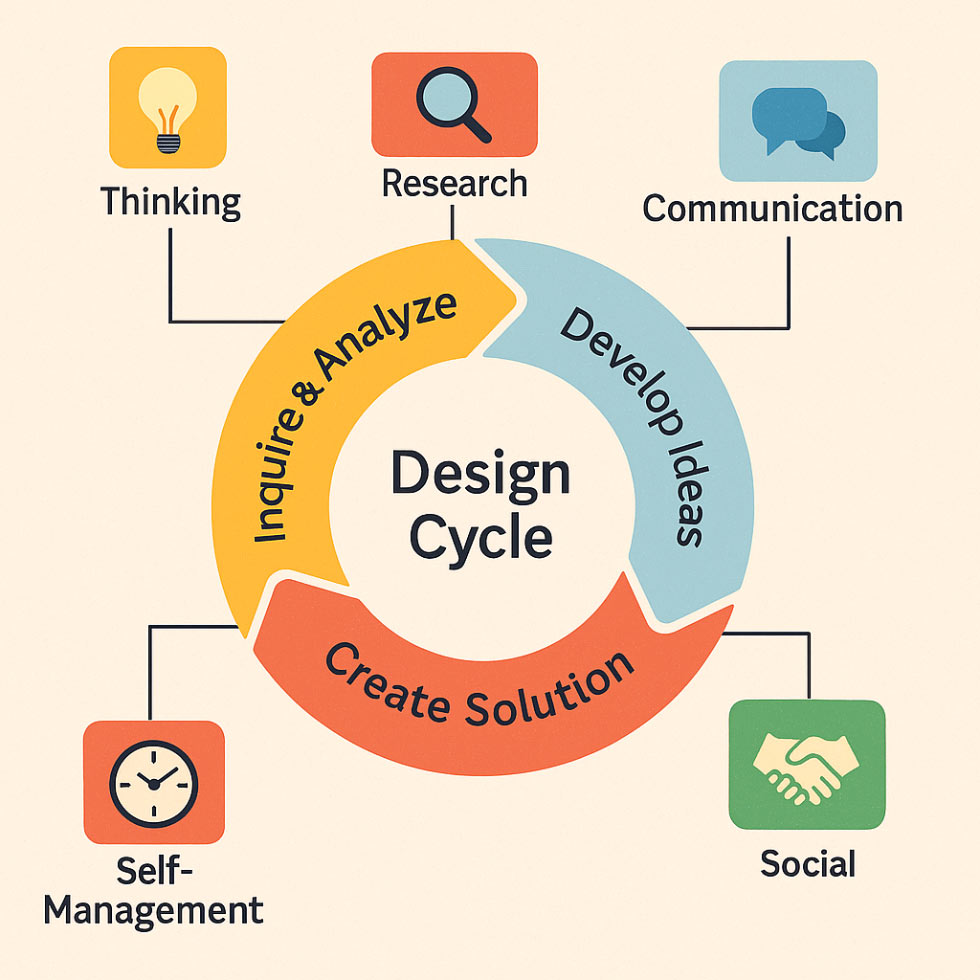
Design Class (Process Design / MYP Design Cycle)
Go to the complete handbook – MYP Design: Solving Real‑World Problems with Creativity and Innovation
In Design, you usually follow a process:
Inquire & Analyze → Develop Ideas → Create Solution → Evaluate
ATL skills are built into every stage.
Research Skills (Inquire & Analyze)
- Finding out what users actually need (surveys, interviews, online research).
- Looking at existing products for inspiration.
- Collecting images, notes, and examples.
Example:
You’re designing a phone holder. You research different designs, ask classmates what annoys them about their current holders, and collect photos.
Thinking Skills (Develop Ideas)
- Brainstorming many different ideas, not just one.
- Comparing designs: “Which is easiest to build? Which is strongest?”
- Solving problems when something doesn’t fit, break, or work.
Example:
Your first design is too weak. You think of ways to reinforce it: thicker material, extra support, a different shape.
Communication Skills (All Stages)
- Sketching your ideas with labels and measurements.
- Creating a design brief that clearly explains your goal.
- Presenting your final product and explaining why it works.
Example:
You show before-and-after sketches and say:
“I changed the angle so it’s more comfortable for the user’s hand.”
Self-Management Skills (Create Solution)
- Planning your time for each stage of the project.
- Bringing materials and keeping your work safe.
- Staying focused in the workshop and following safety rules.
Example:
You know you only have three lessons to build, so you come in knowing exactly what you’ll cut, glue, or 3D print that day.
Social Skills (Evaluate & Improve)
- Asking for feedback from classmates and teachers.
- Accepting criticism without getting defensive.
- Using others’ opinions to improve your design.
Example:
Someone says, “It’s strong but a bit uncomfortable to hold.”
You don’t get annoyed; you add padding or change the shape.
The PDF version – ATL: The Secret Skill Set Behind Every IB Class
The PDF version – ATL: The Secret Skill Set Behind Every IB Class
Interesting reads:
- How to Write an Effective IB I&S Essay (and Use Your ATL Skills)
- Mastering Science Writing in IB: Lab Reports, Investigations, and Essays
- Essential Skills for Children to Thrive in the AI Era
- Bulgaria’s Immigration Stance in the European Context
- Is Problem-Solving Your Key to Turning Challenges into Opportunities?

 means in the IB program, how 14-15-year-old student can build thinking, communication, research, socia)