

Cabernet Franc is one of the most interesting international red grapes in Bulgaria. It originates in France, is officially registered in Bulgaria as a wine grape variety, and is one of the two parents of Cabernet Sauvignon. In Bulgaria, it appears across the Danubian Plain, the Thracian Lowlands, and parts of the Black Sea Coast, where climate and ripeness shift the style from fresher and pepperier to broader and softer.
Note: The profile below is a composite overview of Cabernet Franc as expressed across Bulgaria. It blends the fresher Danubian interpretation with the warmer southern and coastal expressions. The regional Cabernet Franc articles should further sharpen those differences.
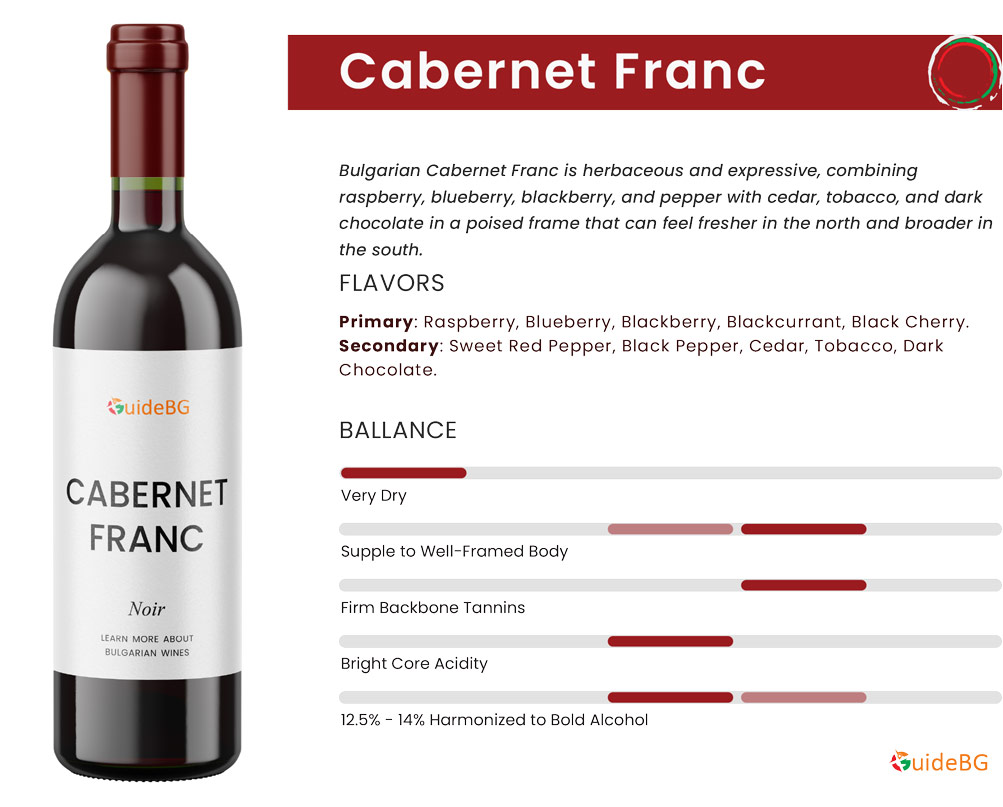
In the glass, Bulgarian Cabernet Franc rarely feels generic. Wines from the Danubian Plain have forest-berry fruit, led by blueberry, with a fruity palate touched by delicate pepper and toasted bread. Southern Black Sea Cabernet Franc turns the grape toward ripe raspberry, blueberry leaf and fruit, chocolate, vanilla, and a fuller, warmer, softer tannic shape. In some cases, even after eight months of oak contact, Cabernet Franc still showed especially intense floral and fruity aromatics.
Serving
15-17°C

Standard red

20 – 40 min

This grape has moderate body, aromatic intensity, and a medium-to-firm tannic profile compared to other Bulgarian examples. Serve Bulgarian Cabernet Franc slightly cooler than a dense Cabernet Sauvignon. A standard red glass works well, and most bottles need only a modest decant: enough to loosen the pepper, cedar, and dark-chocolate register without flattening the grape’s aromatic lift.
Food Pairing
Cabernet Franc is particularly comfortable with Bulgarian food. Its sweet-spice and peppery edge work beautifully with grilled red meats, lamb, mushroom kavarma, herb-rich slow-cooked beef or veal, duck, roasted peppers, and mature yellow cheeses. These wines pair well with traditional grilled and cooked red-meat dishes rich in green herbs.
What to Look For?
Look for a ruby-to-deep ruby-garnet color, sometimes with a violet edge rather than a completely opaque density. Aromatically, the clearest Bulgarian signature sits between raspberry, blueberry, blackberry, blackcurrant, and sweet or black pepper, often followed by cedar, tobacco, dark chocolate, dried herbs, or a light toasted-bread nuance. On the palate, the wine should feel dry and poised: less massive than Cabernet Sauvignon, but usually more architectural than a soft, fruit-led Merlot. With age, air or bottle, leather, cocoa, and savoury spice often become more pronounced.
Cellaring Potential
A sensible national drinking window is about 3–7 years. Bulgarian sommelier commentary places local Cabernet Franc anywhere from 3–4 to 6–7 years, depending on style, while official French cultivar material describes the grape as producing quality aromatic wines with average ageing potential rather than inherently monumental structure. In practice, the better Bulgarian bottles usually develop cedar, tobacco leaf, leather, and cocoa notes, and a calmer tannic grain over time.
Blending Partners
In Bulgaria, Cabernet Franc makes the most sense either on its own or in Bordeaux-minded company. Its clearest partners are Merlot and Cabernet Sauvignon: Merlot softens the center of the palate, while Cabernet Sauvignon adds extra frame and cassis depth. That is partly classical Bordeaux logic, but it is also a grounded Bulgarian inference, since all three grapes are widely present in the country’s main red-wine regions.
Breeding Context
Cabernet Franc matters far beyond its own bottles. DNA evidence showed that Cabernet Sauvignon is the offspring of Cabernet Franc and Sauvignon Blanc, which makes Cabernet Franc one of the most influential classical grapes in modern red-wine history.
Across Bulgaria, Cabernet Franc changes shape more by climate than by doctrine. In the Danubian Plain, the grape tends to read fresher and more peppery, supported by continental conditions and the official Ruse PDO tasting language, which centers on blueberry, pepper, toasted bread, and juicy acidity. In the Thracian Lowlands, where the grape is clearly established in the southern red-wine landscape, warmer conditions push it toward broader fruit, richer body, and softer shoulders. Along the Black Sea Coast, the style can become more aromatic and polished, with ripe raspberry, blueberry, chocolate, vanilla, and rounded tannins, plus the floral-fruity lift seen in the Varna sensory study
Alternative Grapes
If you enjoy Bulgarian Cabernet Franc, start with Merlot for a softer plum-and-cherry profile, move to Cabernet Sauvignon for more cassis, cedar, and structure, and then try Mavrud if you want a more distinctly Bulgarian route into dark fruit, tobacco, earth, and spice. Together, those grapes help frame exactly where Cabernet Franc sits: more aromatic than Cabernet Sauvignon, more savoury than Merlot, and less rugged than Mavrud.