

The Struma Valley is one of Bulgaria’s most distinctive red-wine landscapes. It is a southwestern zone of Mediterranean influence, with warm summers, mild winters, sandy and stony soils, and robust reds with firm tannins, while the broader zoning overview places it within the warm southern Thracian orbit, where international reds also flourish.
Cabernet Sauvignon is not the indigenous headline grape here; that role belongs to the Melnik family, but the valley suits Cabernet remarkably well. Melnik PDO material notes that Cabernet reaches full ripeness in the Struma heat and is often used to add cassis fruit and structural backbone in local blends, while many producers bottle Cabernet as a serious varietal in its own right.
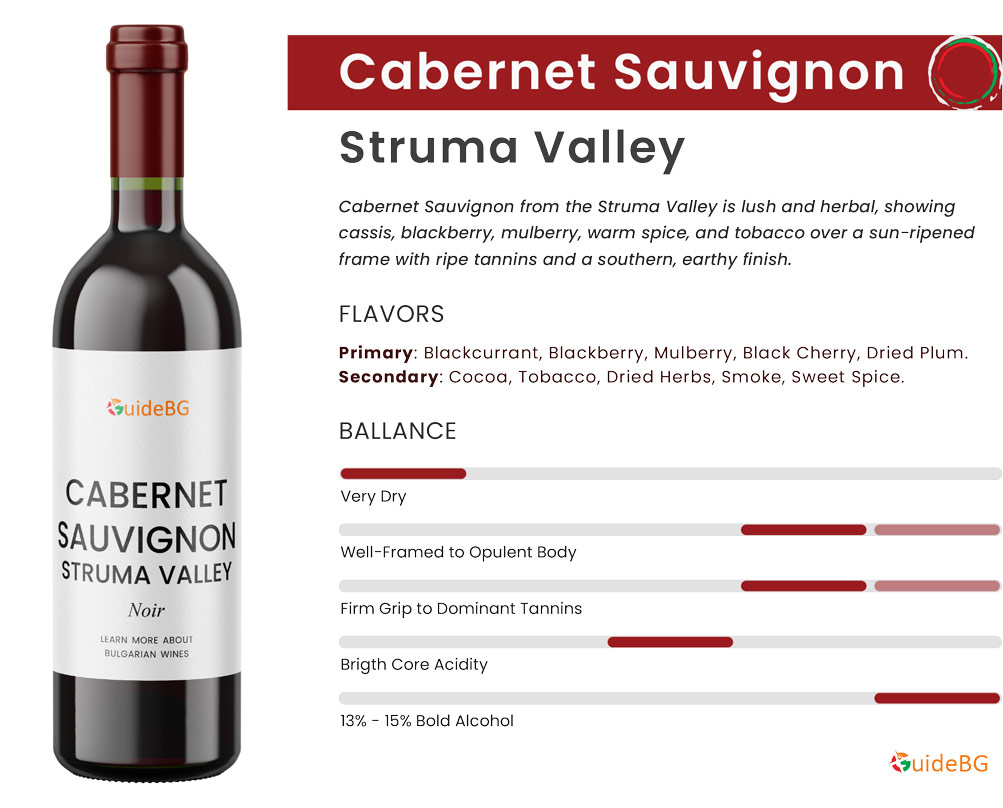
What makes the regional style compelling is that the Cabernet rarely feels anonymous. Struma Cabernet often feels like Cabernet spoken with a Melnik accent: still black-fruited and structured, but warmer, spicier, more herbal, and more earth-tinged than the stricter cassis-and-cedar profile you might expect elsewhere.
Serving
16-18°C

Standard red

30 – 60 min
Cabernet is typically served at 16–18°C, while some Melnik-grown wines are recommended at 18–20°C, with about 1 hour of decanting for their more ambitious reserve bottlings. For the region as a whole, 16–18°C in a large red glass with a moderate decant is the sweet spot: enough air to soften the tannin and let the spice, cocoa, and herbal tones open.
Food Pairing
This is a beautiful match for lamb, veal, game, grilled beef, kapama, chomlek, slow-cooked pork, spicy dishes, and mature cheeses. Classic pairings are lamb, beef, game, and cheese. The Pirin food guide places Syrah– and Cabernet-led Struma reds naturally beside the valley’s slow-cooked mountain dishes and clay-pot classics.
What to Look For?
Look for a deep ruby-to-garnet color and a nose led by blackcurrant, blackberry, mulberry, prune, and black cherry, then shaded by cocoa, tobacco, smoke, dried herbs, and warm oak spice. On the palate, the wine should feel dry, generous, and sun-ripened, with ripe tannins and a finish that turns spicy, herbal, and slightly earthy rather than saline or sharply mineral. The best examples carry warmth without heaviness.
Cellaring Potential
A sound editorial window is about 4–7 years for standard bottlings and 6–10 years for stronger reserve or barrel-aged examples. That range is an inference from the structure described by producers, oak ageing, dense fruit, 14% to 14.5% alcohol, and explicit ageing intent, rather than a formal regional rule, but it fits the valley’s broader reputation for age-worthy reds.
Blending Partners
In the Struma Valley, Cabernet Sauvignon’s most natural partners are Merlot and Cabernet Franc for polish, Syrah for darker spice, and Melnik-family grapes when the goal is a more local accent. Struma Valley Cabernet and Struma Valley Merlot are backbone grapes in regional blends, while Sintica and Orbelia show Cabernet working with Merlot Struma Valley, Cabernet Franc, Syrah (Struma), and Melnik 55 in real producer bottlings. The breeding story of Melnishki Rubin makes the regional logic even clearer: it was created specifically to combine Cabernet’s structure with the spicy, earthy personality of Melnik.
Breeding Context
This is one of Bulgaria’s warmest Cabernet settings – hot, dry summers, mild winters, sandy and stony soils, significant day-night variation, and south-facing vineyards, while Orbelia, Rupel, and Sintica add the detail of Aegean air influence, hilly exposures, natural ventilation, and soils that can include sand, limestone, cinnamonic/alluvial earths, and even volcanic deposits. Together, those conditions explain why Struma Cabernet can be both ripe and aromatic: the fruit reaches full maturity, but the wines still retain enough line to avoid flatness.
Alternative Grapes
If you enjoy this style, start with Melnik 55 for a softer and more obviously local southern red, then move to Broad-Leaved Melnik for more tobacco, pepper, and old-school regional character. Melnishki Rubin and Ruen sit even closer to Cabernet structurally, because both are tied directly to Cabernet in breeding or blending logic while still speaking the Struma dialect.