

The Thracian Lowlands are one of Bulgaria’s defining red-wine landscapes, and Cabernet Sauvignon feels entirely at home here. Bulgarian southern regions have long, dry summers, mild winters, warm autumns, and well-draining soils; Sakar, Stambolovo, and Plovdiv are especially useful reference points for understanding how Cabernet behaves in this inland southern region.
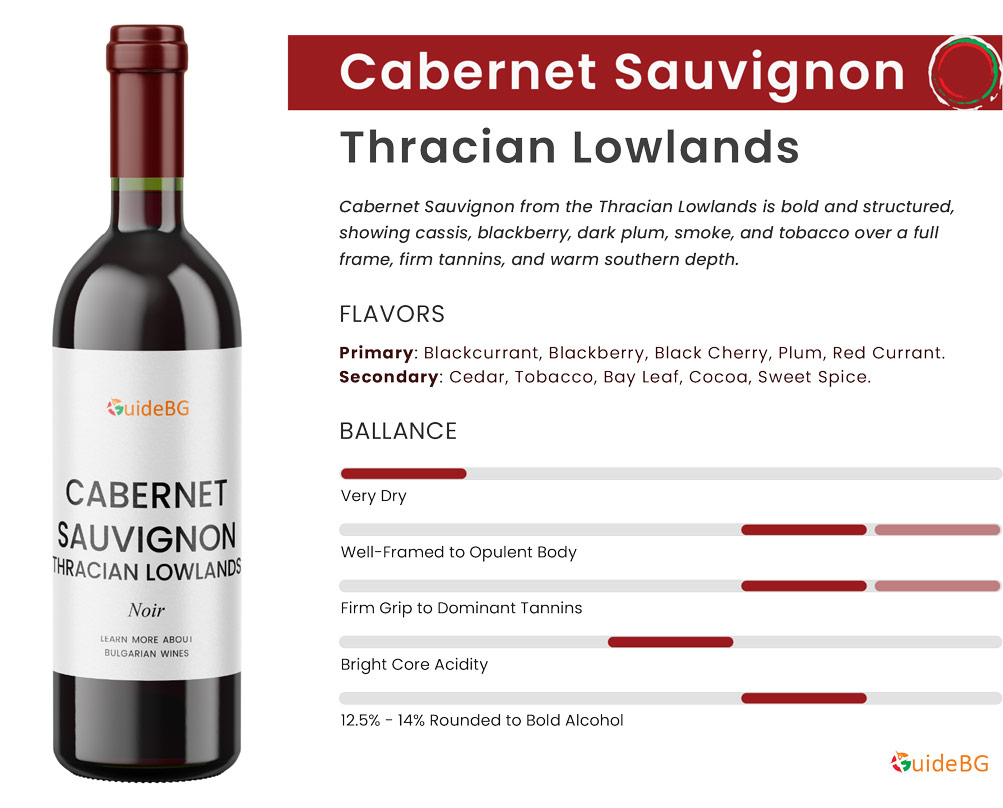
In this warm setting, Cabernet becomes broader, darker, and more authoritative than in Bulgaria’s fresher northern or coastal expressions. Sakar and Stambolovo Cabernet Sauvignons are dark ruby in color, with blackberry and cassis fruit, smoke, pepper, tobacco, cocoa, full body, and firm but ripe tannins, while the general Bulgarian Cabernet overview still keeps blackcurrant, cedar, and strong ageing ability at the center of the grape’s identity.
Serving
16-18°C

Standard red

45 – 60 min

Serve it in a large red glass and give it real air. Younger, fruit-led bottles can get by with a shorter decant, but oak-aged southern examples are happier once the tannins soften and the tobacco, cedar, and cocoa notes unfurl.
Food Pairing
This is a natural partner for grilled ribeye, slow-roasted lamb shoulder, venison stew, kavarma, kapama, smoked aubergine, stuffed peppers with minced meat, and mature sheep cheese. The grape’s tannic spine loves protein, while its dark-fruit and savoury register sits beautifully beside smoke, paprika, char, and slow-cooked sauces.
What to Look For?
Look for a deep ruby-to-garnet color, a nose built around cassis, blackberry, plum, smoke, pepper, tobacco, and cocoa, and a palate that feels full, dry, and firmly framed rather than soft. In the best bottles, the southern warmth gives richness, but acidity still keeps the wine upright, so the finish feels long and structured rather than heavy.
Cellaring Potential
Bulgarian Cabernet Sauvignon is a grape with high ageing potential, and the evidence from Sakar and Stambolovo gives that claim real structural support: ripe fruit, full body, firm tannins, and easy compatibility with oak. A sensible drinking window for serious Thracian Lowlands Cabernet is about 6–10 years, with the strongest oak-raised bottles going longer; with time, expect more tobacco leaf, cedar chest, cocoa, dried black fruit, and a calmer, more suede-like tannic grain. That 6–10-year window is inferred from the structure described in the sources rather than a formal PDO rule.
Blending Partners
In southern Thrace, Cabernet’s most natural partner is Merlot, which rounds the mid-palate and polishes the edges. Sakar region wineries also place Cabernet alongside Cabernet Franc, Syrah (Thracian), and Mavrud, while Stambolovo explicitly points to Cabernet-Merlot and Cabernet-Mavrud directions for fuller, age-worthy reds.
Breeding Context
Cabernet Sauvignon is described in the Haskovo district material as a medium-ripening variety, usually reaching maturity from the middle to the second half of September. In southern Thrace, that sits inside a warm framework: Sakar runs around 4200°C heat accumulation at 150–300 m on leached cinnamon forest and carbonate chernozem soils, Stambolovo around 4000°C at 250–315 m with Rhodope night cooling, and Plovdiv around 3700–4000°C on alluvial soils and chernozem pockets. Together, those conditions explain why the regional style feels ripe, structured, and comfortably oak-friendly.
Alternative Grapes
If you enjoy this style, move first to Thracian Mavrud for a more native and rough-hewn kind of power, or to Thracian Merlot for a softer, rounder southern expression. Sakar Syrah also makes excellent sense if you want another sun-ripened red with black-fruit concentration, spice, and generous texture. For a broader view of the grape, explore Cabernet Sauvignon from the Danubian Plain, the Black Sea Coast, and the Struma Valley, where the style shifts from fresh and vibrant to elegant and saline, and then into lush, herbal expressions.