


A Chance Discovery Unearths an Ancient Treasure
In the fall of 1972, a construction crew on the outskirts of Varna, a city on Bulgaria’s Black Sea coast, accidentally uncovered something glittering in the earth. The workers had stumbled upon an ancient burial ground – a Copper Age necropolis – that turned out to hold an astonishing trove of gold artifacts. As archaeologists rushed in to investigate, they realized they were excavating the oldest gold treasure ever found in human history. Over the next two decades, more than 300 prehistoric graves were systematically unearthed at the site, yielding over 3,000 golden objects dating to around 4600–4300 BC. This incredible find – often dubbed the “Varna gold” – rewrote the history of early civilization, revealing that sophisticated gold craftsmanship and ritual existed in Europe over 6,500 years ago, long before the pyramids of Egypt rose or the royal tombs of Mesopotamia glittered with wealth.
The Varna Necropolis and Its Golden Hoard
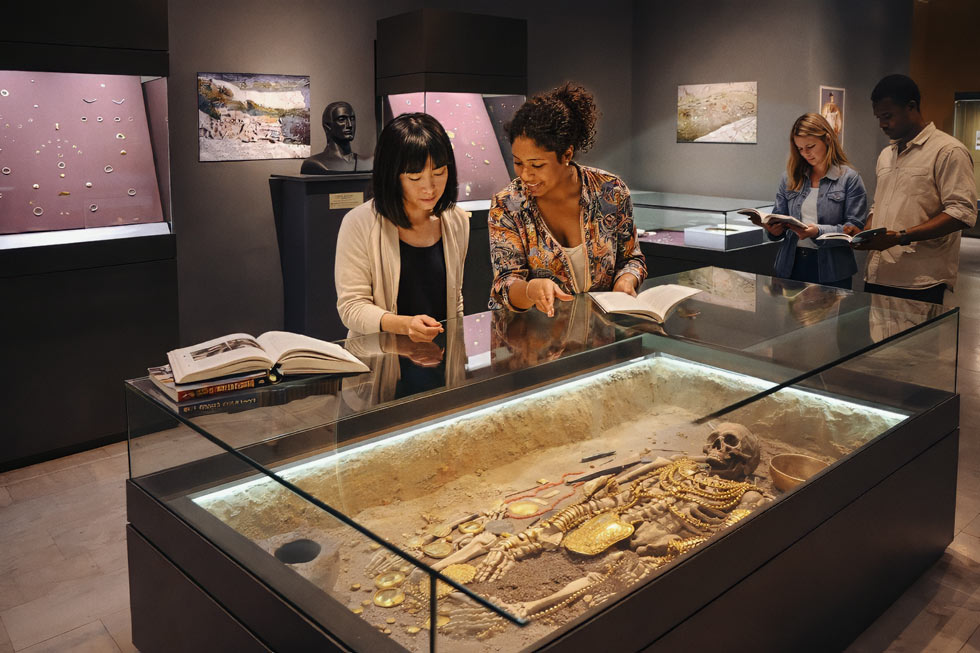
The archaeological site, now known as the Varna Necropolis, proved to be a prehistoric cemetery of a highly developed Copper Age culture. Approximately 294 graves were excavated in an area near Lake Varna, and while many contained only modest offerings, 62 of the burials held remarkable assemblages of valuables – especially finely worked gold ornaments. In total, around 6 kilograms of gold artifacts were recovered from the necropolis, an unprecedented concentration of wealth for that era. One burial in particular stunned researchers: the grave labeled No. 43. Inside lay the skeleton of a man who had been over 60 years old at death, accompanied by an opulent array of grave goods. He wore intricately beaded gold necklaces, heavy pendants and bangles on his arms, and dozens of delicately crafted gold discs sewn onto his clothing. Beneath his folded hands lay a polished stone axe with its wooden handle sheathed in gold, like a scepter of office, with another axe and a long flint blade (a kind of proto-sword) placed nearby. In a striking touch, a gold ornament interpreted as a penis sheath was found by his pelvis – even in death, this elder of Varna was adorned with gold from head to toe.
Grave 43 alone contained nearly one-third of all the gold found at the entire site, indicating that this individual was of extraordinary importance in his community. Three other burials (including some without actual skeletons, so-called cenotaphs) also held exceptional quantities of gold, and together just those few richest graves accounted for well over half of the Varna treasure. Such inequality in the distribution of grave goods immediately suggested that the Varna cemetery was not the resting place of a simple egalitarian society, but rather a stratified one. Most people were interred with few possessions, while a select few – like the man in grave 43 – went to the afterlife laden with riches and symbols of power.
The Oldest Goldsmiths in the World
Scientists dated the Varna burials to the Late Chalcolithic (Copper Age) period, around 4,600–4,200 BC. This makes the Varna gold roughly 1,500 years older than the gold adornments found in the tombs of the Egyptian pharaohs, and nearly two millennia older than the famous golden treasures of the Mesopotamian royal graves at Ur. In fact, according to archaeologists, the total quantity of gold uncovered at Varna exceeds the combined amount of all other gold artifacts known from any contemporary 5th-millennium BC sites around the world – including those in ancient Egypt and the Near East. In other words, the people of Varna were the world’s earliest known goldsmiths on a significant scale. They were casting and hammering gold into jewelry and regalia at a time when most of Europe and the Near East were just beginning to experiment with metalworking. A tiny golden bead found at another Bulgarian site has been claimed to be slightly older, but it is Varna’s cemetery that provides the first clear evidence of humans crafting gold as a major cultural endeavor.
How and why did gold metallurgy appear so early in this corner of Europe? Scholars are still debating the reasons. The mid-5th millennium BC in the Balkans was a time of rapid innovation: the region had rich copper deposits and some of the first mines in Europe, and metalworkers were learning to smelt copper ore and perhaps found native gold in the process. The Varna culture’s homeland also included resources such as rock salt (extracted at nearby Provadiya), which could be traded for exotic goods. Archaeologists have found Mediterranean seashells (Spondylus gaederopus) in Varna graves, which must have come via long-distance exchange networks. All these clues suggest that the Varna community sat at the nexus of trade routes and technological developments. Mastering metal was both an economic boon and a source of social prestige – and nothing advertised prestige quite like the glitter of gold.
A Prehistoric Society of Rank and Ritual
The evidence from the Varna necropolis paints a vivid picture of a society that was far from primitive. These people were among the first in the world to assign special status to certain individuals through material wealth and ceremony. The richly furnished burials at Varna offer some of the earliest material signs of a socially stratified community—where certain individuals clearly held elevated status, power, or ceremonial importance. The arrangement and contents of the graves suggest an early model of structured society, with distinctions in rank already taking shape. The gold ornaments found in the rich graves were likely much more than mere adornments – they were sacred insignia of rank, invested with spiritual or communal meaning. Rather than currency or commerce, gold in Varna seems to have been used to communicate authority, achievement, and connection to the divine. Many of the high-status tombs at the site also contained weapons (such as copper axes and long flint blades) and emblems, such as scepters, suggesting that leadership in this Copper Age culture might have been tied to martial or ritual power. Interestingly, some of the richest graves held no human remains at all – they were empty cenotaphs filled with offerings, possibly serving as ritual provision for chiefs who died elsewhere or as symbolic burials for deities or ancestors. All in all, the Varna discoveries reveal a prehistoric people with complex funeral rites and a markedly stratified community structure for such an early date.
This finding was revolutionary. Before the 1970s, many archaeologists assumed that Europe’s Neolithic and Copper Age societies were relatively egalitarian farming villages. Some even imagined an “Old Europe” civilization led by mother-goddess worship and peaceful female leadership. The Varna gold overturned those notions. Here was undeniable proof that, as early as 4600 BC, a European society had chiefs or kings – likely male – who enjoyed special privilege and were venerated in death with unprecedented wealth. The man in grave 43 of Varna, buried with scepters and golden honors, might be considered Europe’s first known aristocrat or leader-figure. His very existence signals that the seeds of social inequality and ceremonial leadership were sown in Europe long before the classical civilizations of Greece and Rome, or even the Bronze Age Mycenaeans, came onto the scene.
Legacy and Enigma of the Varna Culture
After shining so brilliantly for a few centuries, the Varna culture and its golden age faded from view. By around 4200 BC, the burials at the necropolis ceased. The rich metal-using cultures of the Balkan Copper Age went into decline, and historians are still not entirely sure why. One theory, championed by archaeologist Marija Gimbutas, is that nomadic Indo-European tribes from the steppe infiltrated or invaded the Balkans around 4000 BC, disrupting the local societies with new customs and a more warlike, patriarchal culture. Other researchers point to possible environmental changes or resource exhaustion. Yet the precise cause of the Varna culture’s collapse remains an archaeological mystery. What we do know is that the knowledge of metalworking did not vanish – it spread and evolved. In the ensuing millennia, gold would be worked by Egyptians, Sumerians, Minoans, and countless others, but the people of Varna had led the way.
Today, the treasures from the Varna necropolis stand not only as a national treasure of Bulgaria but as a world treasure illuminating a formative chapter of human civilization. The exquisite artifacts – from the delicate gold beads to the imposing golden scepters – are on display at the Varna Archaeological Museum and occasionally tour internationally, allowing us to marvel at their craftsmanship up close. Cultural travelers who visit Varna can see the famous Grave 43 reassembled in the museum, the ancient skeleton draped in gold as it was found, testifying to a sophisticated culture that flourished here seven millennia ago. The Varna gold discovery has given Bulgaria a unique place on the map of prehistory: it is the land of Europe’s first goldsmiths and arguably one of the birthplaces of the social elite in human society.
In uncovering Varna’s ancient legacy, we gain more than just dazzling artifacts to admire – we gain a profound insight into the rise of hierarchy, craftsmanship, and ritual in the human story. Varna’s first gold shows that even in the distant prehistoric past, Europeans were innovators and visionaries, capable of creating objects of immense beauty and symbolism. The cemetery by the Black Sea shores reminds us that the drive to honor leaders, to differentiate social status, and to imbue metal with meaning are deeply rooted traditions, reaching back to the very dawn of organized society.
Citations and references: Download all sources, including Elicit summaries.