

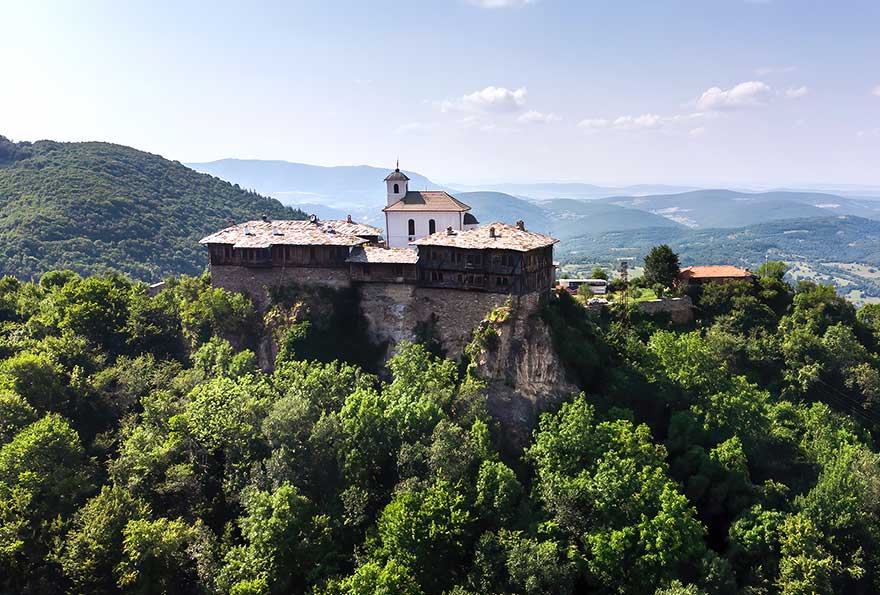
Glozhene Monastery, officially dedicated to St. George the Victorious, is one of the most memorable monastery visits in northern Bulgaria. It stands on a rocky height in the Teteven Balkan, above forested slopes and open views, and from a distance it has the compact silhouette of a small mountain fortress. Unlike many Bulgarian monasteries hidden in valleys, Glozhene is exposed, elevated, and easy to recognize from the surrounding roads. The Bulgarian Patriarchate describes it as a monastery in the northern part of central Stara Planina, built on a height and resembling a castle from afar.
Quick visitor facts
- Monastery type: Active Bulgarian Orthodox male monastery in the Lovech Diocese
- Best for: Monastery architecture, mountain views, Orthodox heritage, quiet cultural stop
- Typical visit time: Around 1 hour is enough for the church, courtyard, viewpoints, and small museum areas
- Main access: By car from the Hemus motorway / Yablanitsa side, via Malak Izvor, then up to the monastery. On foot: A path from Glozhene village is described by local tourism sources as roughly a one-hour walk, with a steep climb
- Feast day: 6 May, St. George’s Day
- Note: This is a working monastery, not only a monument. Dress and behave accordingly.
The monastery is open to visitors, but it remains a religious site. Bulgaria’s official tourism portal lists it as an active male monastery and gives seasonal visiting hours: May–September: 08:00–21:00; October–April: 08:00–18:00. Hours, access to rooms, and services can change on feast days, during repairs, or in bad weather, so check locally before a special trip.
Where is Glozhene Monastery?
Glozhene Monastery is near the village of Glozhene in Teteven Municipality, Lovech Province. It is most easily reached from northern Bulgaria and the Hemus motorway corridor. Local tourism information gives approximate distances of about 100 km from Sofia, 85 km from Pleven, and 144 km from Veliko Tarnovo.
For drivers, the usual approach is to leave the Hemus motorway near Yablanitsa, pass through Malak Izvor, and continue up to the monastery. The final section is scenic but should be driven carefully: local visitor guidance notes that the last kilometers between Malak Izvor and the monastery are narrow in places and not in perfect road condition. There is parking close to the monastery, although a small parking fee may be charged at busy times.
Public transport is less convenient. Travelers without a car can reach the wider Teteven–Glozhene area by bus and then arrange a taxi or walk from Glozhene village. Local tourism sources describe the footpath from Glozhene village to the monastery as taking about an hour at a normal pace, but the climb is steep due to the altitude difference.
A short, careful history
Many accounts of Glozhene Monastery begin with a medieval legend. According to church tradition, the monastery is connected with Prince Georgi Glozh, who settled in the area during the time of Tsar Ivan Asen II and brought with him an icon of St. George. The same tradition says that the icon repeatedly disappeared from the first monastery site and was found on the hill above the village, which was interpreted as a sign to move the monastery there.
That story is important to the monastery’s identity, but it should be presented as tradition rather than as documented construction history. Teteven Municipality offers a more cautious historical reading: the present cliff-top monastery is more securely dated to the 17th–18th centuries, and the site visible today includes later buildings and rebuilding. The old church was badly affected by the earthquakes of 1904 and 1913, while the church visitors see today is a twentieth-century replacement.
The monastery also became a cultural and educational center during the Bulgarian National Revival. Monks connected with Glozhene supported schools and religious learning in nearby settlements, including Malak Izvor and Lovech, and the monastery preserved books, liturgical texts, and seals associated with its history.
Glozhene is also linked with Bulgaria’s revolutionary period. Teteven Municipality records that one of its abbots, Hadzhi Evtimiy Simeonov of Sopot, was trusted by Vasil Levski and that Levski found shelter at the monastery. Local visitor sources also point to preserved places associated with Levski and with Vasil Drumev, later known as Kliment Tarnovski, who was confined at the monastery in the 1890s.
What to see today?
The strongest impression comes before you enter: the monastery sits on a rocky terrace, with steep slopes and wide views towards the Teteven Balkan. The approach passes through a stone entrance area, and the enclosed courtyard opens onto a small church, residential wings, wooden galleries, stonework, and viewpoints.
Inside the church, the most important features for visitors are the icon of St. George the Victorious and the preserved wood-carved iconostasis brought from the older church. Local tourism information notes that parts of the iconostasis and icons were saved after the earlier church was damaged, and that the revered icon of St. George remains one of the monastery’s central objects.
The monastery buildings are not a single medieval survival. The monks’ residential quarters were built in 1858 on the site of older structures, while the present church replaced the older church after earthquake damage. This layered history is part of the value of the place: Glozhene is both a religious site and a record of rebuilding, memory, and local devotion.
Visitors can also look for the room associated with Vasil Drumev/Kliment Tarnovski and ask locally about the monastery’s Levski associations. Access to rooms can vary, so do not assume that every interior space is open on every visit.
Religious-use guidance
Glozhene Monastery is not an abandoned monument. It is listed by the Bulgarian Patriarchate under the Lovech Diocese, and the Patriarchate names Hieromonk Nektariy as the monastery’s serving cleric. The monastery’s feast day is 6 May, when Orthodox Christians celebrate St. George.
Visitors should dress modestly, keep their voices low, and avoid treating the church as a photo backdrop. As a practical rule, cover shoulders and knees, remove hats inside the church, silence phones, do not photograph services, and do not enter residential or closed areas. The published visitor rules for Rila Monastery give a useful model for etiquette at Bulgarian Orthodox monasteries: no improper attire, no noise, no indoor photography in restricted spaces, and no access to residential floors.
If a service is underway, stand quietly near the back, let worshippers pass, and avoid moving around with a camera. Lighting a candle or entering the church is welcome when done respectfully, but the rhythm of the monastery comes first.
How long to spend?
Most travelers can see the monastery in 45–90 minutes. Local tourism guidance suggests about 60 minutes for a standard visit, enough time for the courtyard, church, photos from the viewpoints, and a brief look at the open historic rooms.
Stay longer if you come for prayer, photography, a quieter weekday visit or a meal at the monastery guest area when it is operating. Weekends can be busier, and the atmosphere is calmer on weekdays outside major holidays.
Best time to visit
Spring and autumn are especially good for the road, views, and surrounding forest. Summer is convenient because of the longer listed opening hours, but midday can be busy and hot. Winter visits are possible, but the mountain road should be treated with caution in rain, snow, or ice.
For photography, the monastery’s best angles are often from the road and the nearby viewpoints rather than inside the courtyard. Drone use should not be assumed to be acceptable around a working monastery; ask locally and follow Bulgarian aviation rules.
Nearby pairing suggestions
Glozhene Monastery & Teteven
This is the simplest half-day or full-day plan. Visit the monastery, then continue to Teteven for the Historical Museum, founded in 1911 and featuring archaeology, ethnography, and Bulgarian Revival sections.
Glozhene Monastery & Glozhene Waterfall
For a short nature stop, local Teteven tourism guidance points visitors to Glozhene Waterfall near the village of Glozhene, on the road towards Teteven.
Glozhene Monastery & Saeva Dupka Cave
This is a strong day-trip combination from the Yablanitsa side. Saeva Dupka, near Brestnitsa, is one of Bulgaria’s developed show caves, with five galleries and standard visiting hours listed by Bulgaria’s official tourism portal.
Glozhene Monastery & Zlatna Panega Springs
If you prefer water and karst landscapes, pair the monastery with the Zlatna Panega Springs near the village of Zlatna Panega. The springs are known for their pale blue-green water and are accessible by a short footpath from the parking area.
Why visit?
Glozhene Monastery is worth visiting for its setting, not for exaggerated stories. Its appeal is concrete: a working Orthodox monastery, a dramatic rocky site, a small church with a preserved iconostasis, links to Bulgaria’s religious and revolutionary history, and some of the best monastery views in the Teteven Balkan.