

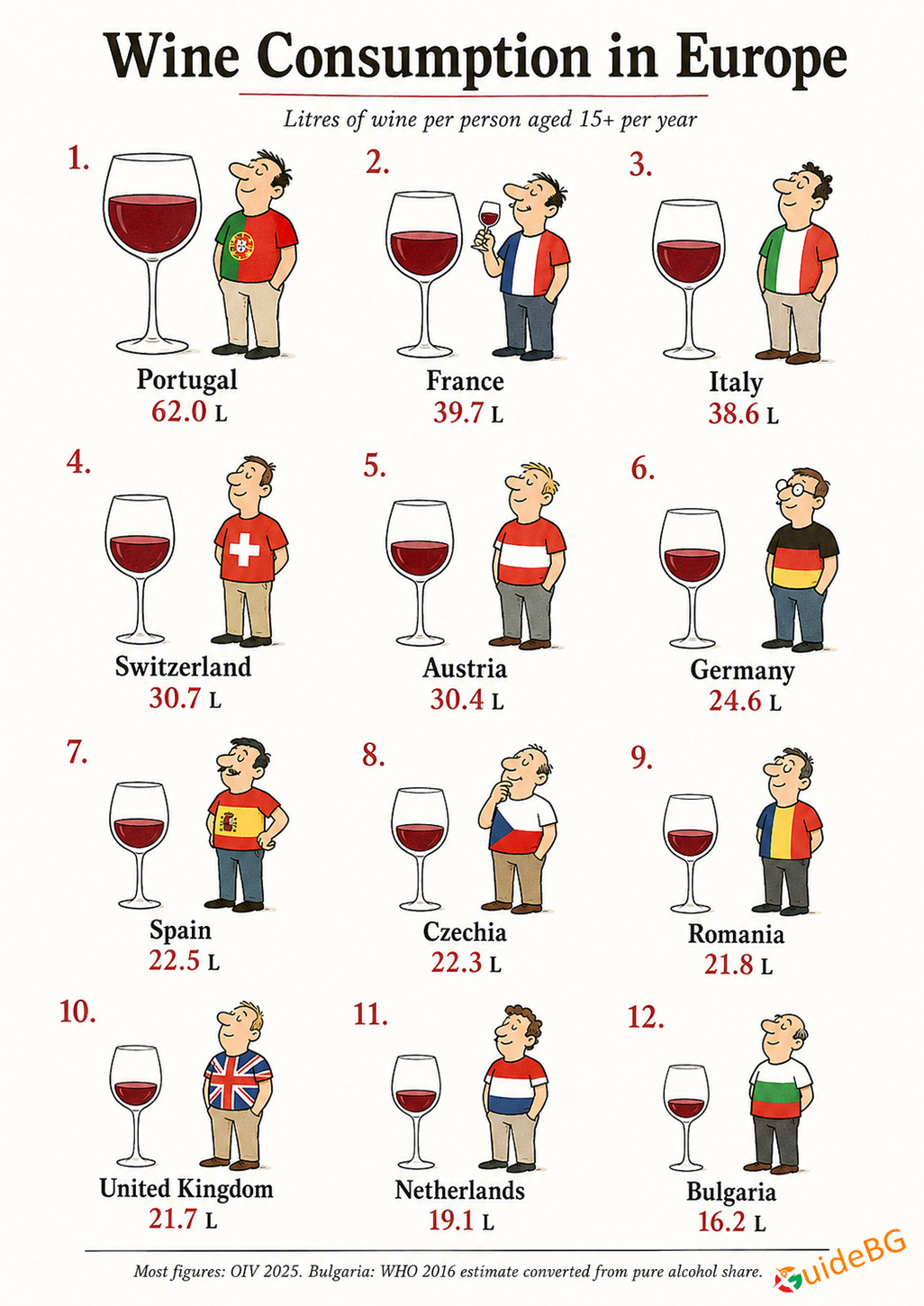
Europe has always had a special relationship with wine. In some countries, it is a drink. In others, it is part of lunch, dinner, family history, local pride, and sometimes national identity. The numbers show this very clearly.
Portugal sits at the top of Europe’s wine table, with around 62 liters of wine per person aged 15+ per year. France and Italy follow, which surprises almost nobody. In both countries, wine often feels less like a product and more like a cultural language, spoken fluently with cheese, pasta, bread, olive oil, and long conversations.
Switzerland and Austria also rank high, while Germany, Spain, Czechia, Romania, the United Kingdom, and the Netherlands remain important wine-consuming countries. The picture is not only about quantity. It is also about lifestyle. Wine in Europe is connected to food, travel, rural landscapes, festivals, restaurants, and everyday rituals.
And then comes Bulgaria.
Bulgaria’s estimated figure is much lower, at roughly 16 liters per adult per year, based on older WHO alcohol consumption data converted to wine equivalents. Officially, this places Bulgaria far below Portugal, France, and Italy. Unofficially, we may need to raise one eyebrow and refill the glass before accepting the number too seriously.
Anyone who has visited a Bulgarian family table, a village cellar, a harvest-time gathering, or a homemade wine corner knows that some wine may live outside neat statistical boxes. Bulgaria may look modest in the data, but its wine culture is anything but small. From Melnik and the Thracian Lowlands to the Danubian Plain and the Black Sea Coast, wine remains deeply tied to hospitality, food, landscape, and local identity.
So the serious conclusion is simple: Europe still loves wine, even as habits change. The funny Bulgarian conclusion is even simpler: officially modest, culturally very present, and probably undercounted somewhere near the cellar.