

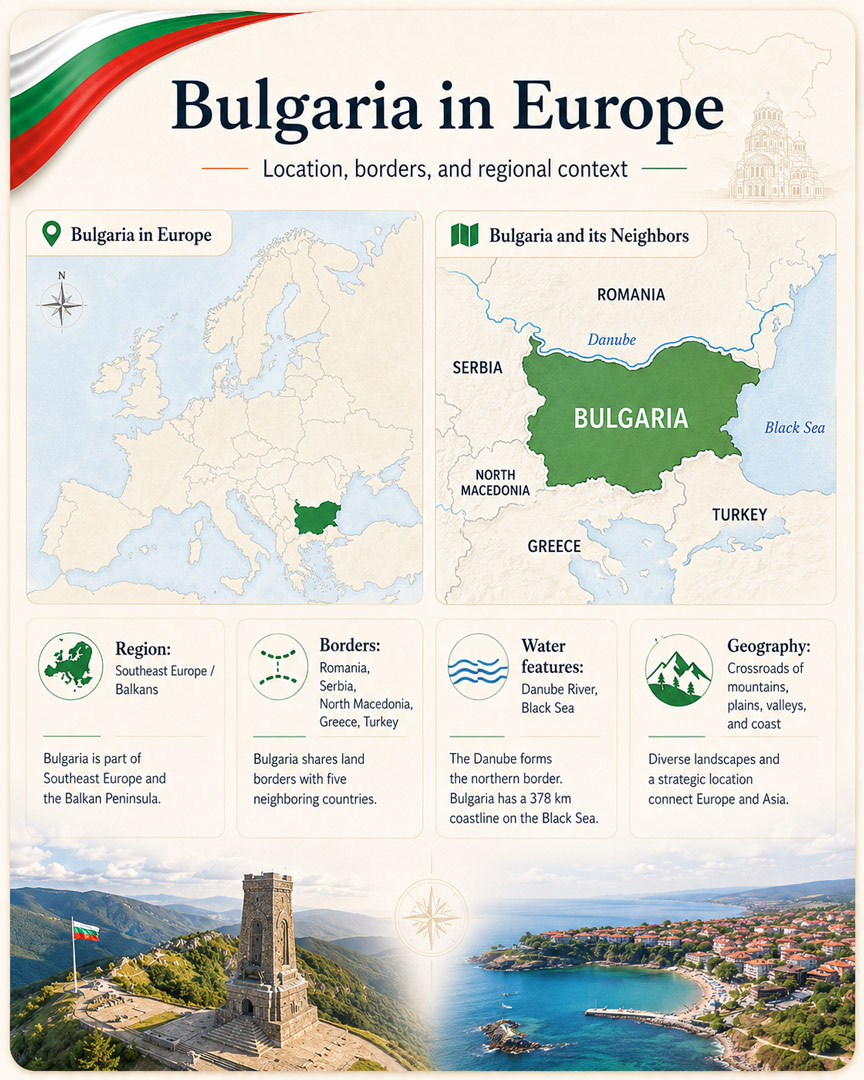
Bulgaria is a country in Southeast Europe, set on the eastern side of the Balkan Peninsula, where the Danube, the Black Sea, the mountains, and the old land routes between Europe and Asia meet. It borders Romania, Serbia, North Macedonia, Greece, and Turkey, with the Black Sea forming its eastern edge.
But Bulgaria is not only a point on the map. It is a country of ancient gold, Thracian tombs, Roman cities, medieval fortresses, Orthodox monasteries, Ottoman-era towns, small villages, Black Sea ports, rose fields, wine regions, and modern European life.
For first-time visitors, Bulgaria can be surprising. It is compact enough for a road trip, old enough to feel layered at almost every turn, and varied enough to move from capital-city boulevards to alpine lakes, from Roman mosaics to beach towns, from monastery courtyards to wine valleys.
Bulgaria at a Glance
Bulgaria’s capital is Sofia, its official language is Bulgarian, and it has been a member of the European Union since 1 January 2007. Bulgaria became part of the euro area on 1 January 2026, and the euro is now the country’s currency.
Bulgaria is also part of the Schengen Area. Air and sea border controls were first lifted in 2024, and Bulgaria became fully integrated after checks at internal land borders were lifted from 1 January 2025.
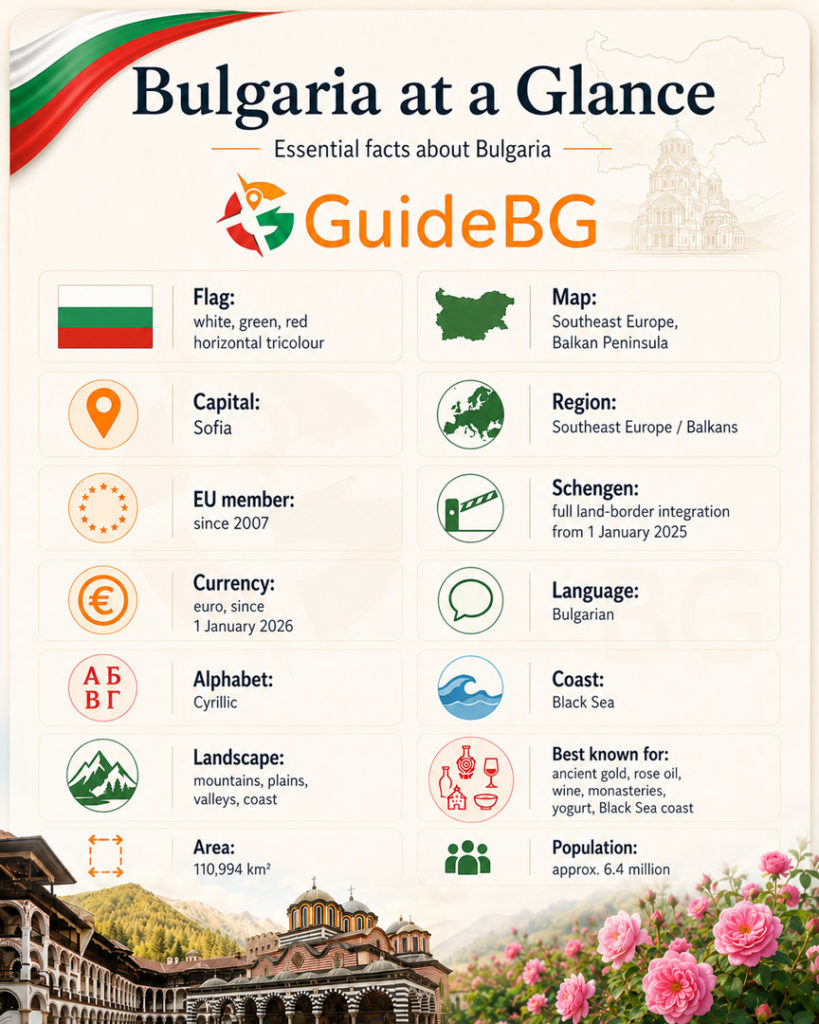
| Quick country facts | Bulgaria |
|---|---|
| Official name | Republic of Bulgaria |
| Capital | Sofia |
| Region | Southeast Europe / Balkans |
| Coast | Black Sea |
| Main river border | Danube |
| Language | Bulgarian |
| Alphabet | Cyrillic |
| EU member | Yes, since 2007 |
| Schengen | Yes |
| Currency | Euro |
| Good for | History, road trips, wine, food, mountains, monasteries, Black Sea travel |
Where Is Bulgaria?
Bulgaria is located in Southeast Europe, in the eastern part of the Balkan Peninsula. To the north, the Danube separates much of Bulgaria from Romania. To the east lies the Black Sea. To the south are Greece and Turkey, while Serbia and North Macedonia border Bulgaria to the west and southwest.
This position helps explain Bulgaria’s character. It is European, Balkan, Black Sea, Danubian, Orthodox, Slavic, and historically connected to the routes between Central Europe, the Aegean, Anatolia, and the Near East.
That mix is one of the reasons Bulgaria feels so layered. A single journey can take you from Roman remains to Ottoman bridges, from Revival-period towns to Soviet-era monuments, from vineyards to Orthodox monasteries, and from mountain passes to seaside streets.
Is Bulgaria a European Country?
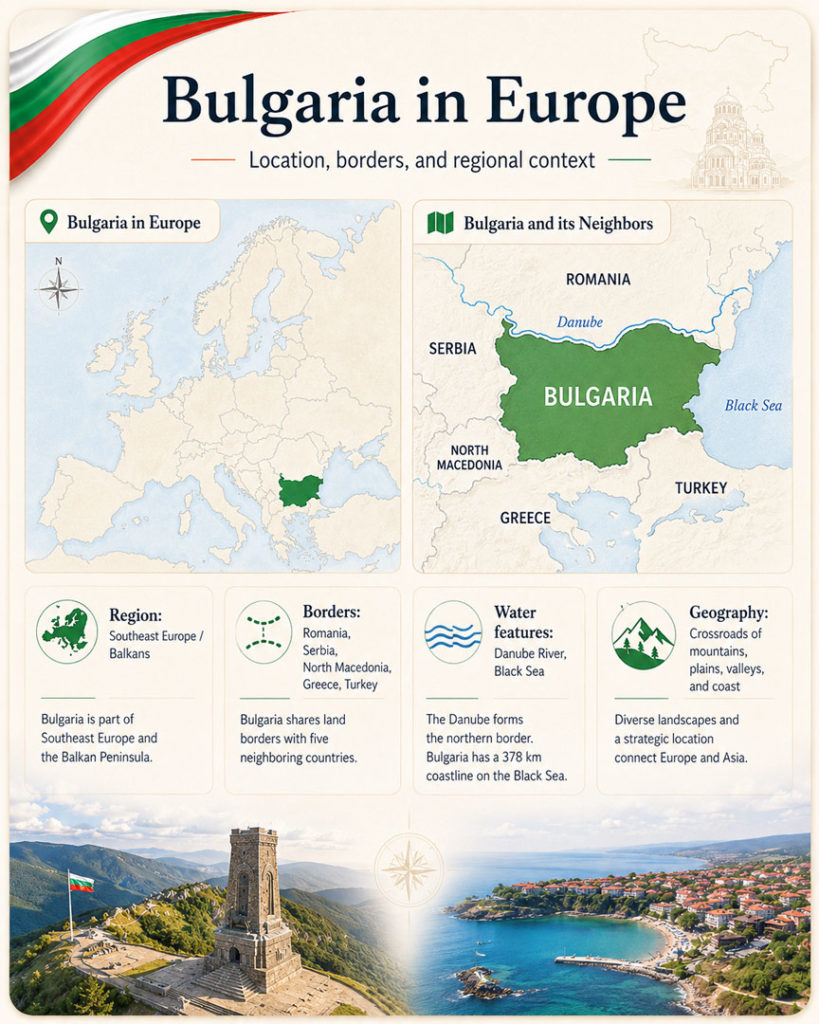
Yes. Bulgaria is geographically in Europe and politically part of the European Union. It joined the EU in 2007, is now in the Schengen Area, and has used the euro since 2026.
But the better answer is this: Bulgaria is a European country with a Balkan soul and a deep historical memory.
Its culture has been shaped by Thracians, Greeks, Romans, Byzantines, Slavs, Bulgars, Ottomans, Orthodox Christianity, the National Revival, socialism, and modern EU integration. That is why Bulgaria is difficult to summarize in one label. It is not only “Eastern Europe,” not only “the Balkans,” and not only “a cheap travel destination.” It is a crossroads country.
What Is Bulgaria Known For?
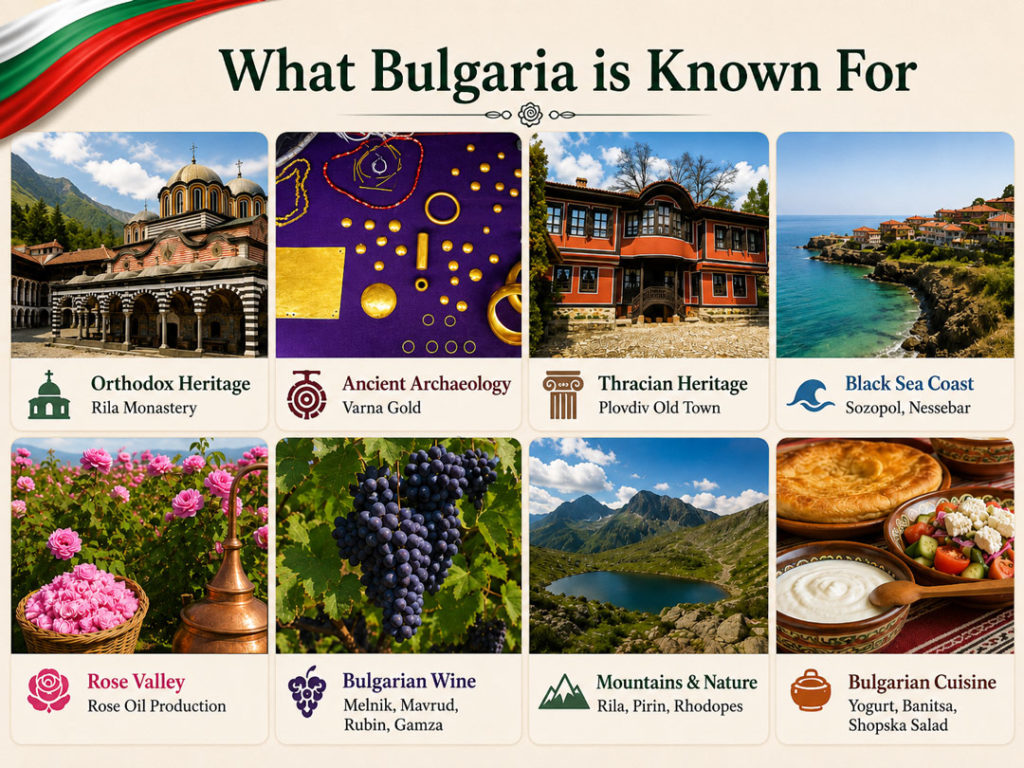
Bulgaria is known for many things, but several themes recur.
Ancient gold and archaeology
Bulgaria has some of Europe’s most important prehistoric and ancient sites. The Varna Culture and Varna Necropolis are especially important because they are linked with some of the earliest worked gold in the world.
Thracian heritage
The Thracians left tombs, sanctuaries, treasures, and legends across Bulgarian lands. Their presence is one reason Bulgaria’s ancient history feels so rich and distinctive.
Orthodox monasteries
Bulgaria’s monasteries are among its most powerful cultural symbols. Rila Monastery is the most famous, set in the Rila Mountains and closely connected with Bulgarian spiritual and national identity.
Mountains and nature
Bulgaria has a striking amount of mountain scenery for a relatively compact country. Rila, Pirin, the Rhodopes, the Balkan Mountains, Vitosha, Strandzha, and Sakar all offer different landscapes and moods. The Seven Rila Lakes are one of the best-known natural symbols.
Black Sea coast
The Bulgarian Black Sea coast combines beaches, seaside cities, ancient towns, fishing villages, resorts, ports, and archaeological sites. Varna and Burgas are the major coastal cities, while Nessebar, Sozopol, Balchik, and other towns add layers of history and atmosphere.
Wine
Bulgaria has a long wine tradition, indigenous grape varieties, and several distinctive wine regions.
Roses and rose oil
Bulgaria is strongly associated with rose oil and the Rose Valley’s Rose Picking Festivals, especially around Kazanlak and the Sub-Balkan region.
Food and yogurt
Bulgaria is famous for shopska salad, banitsa, yogurt, grilled meats, mountain dairy, Black Sea fish, stuffed vine leaves, and regional dishes.
A Short History of Bulgaria
Bulgaria’s history is not a straight line. It is a layered story of civilizations, migrations, empires, revivals, and reinventions.
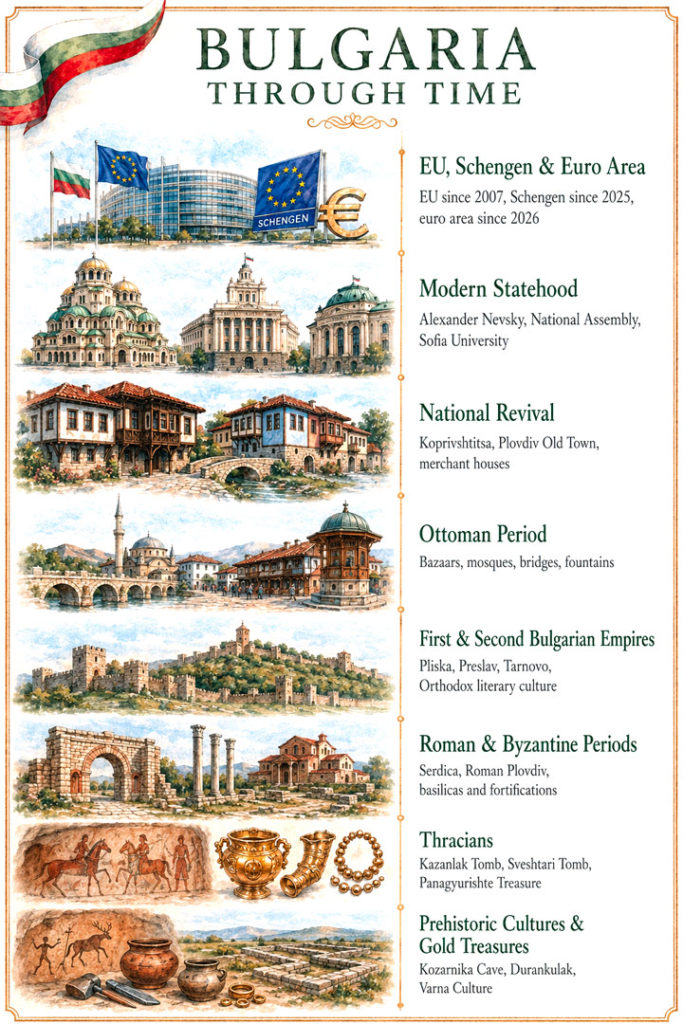
Long before the modern Bulgarian state, the lands of today’s Bulgaria were home to prehistoric communities, including cultures associated with early metallurgy and gold. Later came Thracian societies, Greek colonies on the Black Sea, Roman cities and roads, and Byzantine influence.
The medieval Bulgarian states became major powers in Southeast Europe, leaving behind fortresses, churches, manuscripts, and cultural traditions. Bulgaria’s medieval history is one reason the country remains deeply connected to Orthodox Christianity and the Cyrillic cultural world.
After centuries under Ottoman rule, the Bulgarian National Revival helped rebuild language, education, church identity, architecture, and political consciousness. Modern Bulgaria emerged in the late nineteenth century, endured wars, monarchy, and communism, and eventually joined the EU, the Schengen Area, and the euro area.
Bulgaria’s Geography: A Small Country With Many Landscapes
One of Bulgaria’s biggest surprises is how quickly the landscape changes.
Sofia sits in the west, close to Vitosha Mountain and within reach of Rila, monasteries, ski areas, and historic towns. Plovdiv lies in the Thracian Lowlands, surrounded by hills, vineyards, Roman remains, and old trade routes. Varna and Burgas open the country toward the Black Sea. The Danube Plain stretches across the north, while the Rhodopes create a softer, more mystical mountain world in the south.
Rila and Pirin feel alpine and dramatic. The Rhodopes feel musical, forested, and village-based. The Black Sea coast feels open and maritime. The Rose Valley feels seasonal and symbolic. The Struma Valley around Melnik feels warm, wine-oriented, and almost Mediterranean.
This variety is what makes Bulgaria especially good for road trips. You can build routes around culture, monasteries, wine, food, mountains, beaches, or archaeology, and often combine several in a single journey.
Bulgaria’s Cities: Sofia, Plovdiv, Varna, and Beyond
Bulgaria’s cities each show a different side of the country.
Sofia is the capital and the main arrival point for many visitors. It combines Roman remains, Orthodox churches, Ottoman traces, socialist-era architecture, modern business districts, museums, parks, and the backdrop of Vitosha Mountain. GuideBG has a Sofia destination page and Sofia-related city content.
Plovdiv is one of Bulgaria’s most atmospheric cities, famous for its Old Town, Roman heritage, hills, artistic neighborhoods, and long urban continuity. It is ideal for readers interested in culture, food, architecture, and slow city travel.
Varna is the major city of the northern Black Sea coast. It connects seaside life with archaeology, museums, beaches, gardens, and the story of ancient gold. GuideBG already has a Varna page and Varna Culture content that should be linked here.
Burgas is the gateway to the southern coast, including Sozopol, Nessebar, Pomorie, and the Strandzha region.
Beyond these cities, Bulgaria’s smaller towns often leave the strongest impression: Koprivshtitsa, Melnik, Tryavna, Veliko Tarnovo, Bansko, Kazanlak, Balchik, Sozopol, and many more.
Bulgarian Culture: Language, Alphabet, Food, Faith, and Everyday Life
Bulgarian culture is built from many layers: Slavic language, Cyrillic script, Orthodox Christianity, Balkan hospitality, rural traditions, urban modernity, and a strong sense of historical memory.
The Bulgarian language uses the Cyrillic alphabet, which is one of the first things visitors notice on signs, menus, and road markers. Learning even a few words helps: “zdraveyte” for hello, “blagodarya” for thank you, and “dobar den” for good day.
Food is central to everyday life. Breakfast might mean banitsa. Summer might mean shopska salad, grilled vegetables, fresh yogurt, and tarator cold soup. Mountain regions are known for dairy, beans, potatoes, herbs, and slow-cooked dishes. The Black Sea adds fish and seafood. Wine and rakia are part of the broader food culture, though wine deserves special attention because Bulgaria’s wine regions and local grape varieties are increasingly appealing to many visitors.
What are the Cultural Do’s and Don’ts in Bulgaria?
Bulgaria as a Travel Country
It is good for first-time European travelers who want culture without only visiting the most obvious destinations. It is good for road trippers because the country is compact but varied. It is good for families because many cities, beaches, parks, and nature routes are accessible. It is good for history lovers, as archaeology and architecture are evident almost everywhere. It is good for wine travelers because the country has distinctive regions and grape varieties. It is good for mountain travelers because Rila, Pirin, the Rhodopes, and Vitosha offer very different experiences.
Bulgaria is also a country where practical planning matters. Roads, seasons, airport choice, local transport, taxis, public holidays, beach timing, ski timing, and mountain weather can change the experience.
Start Exploring Bulgaria
Use this country guide as a starting point. Then go deeper into the parts of Bulgaria that interest you most.
Explore history and archaeology
Explore culture and destinations
Plan your trip
- Bulgaria Trip Cost Calculator
- Your Visit in Bulgaria – A to Z Guide
- Visiting by Plane
- Driving in Bulgaria
- Renting a Car in Bulgaria
- How to Order a Taxi in Bulgaria
Explore food and wine
FAQ About Bulgaria
Bulgaria is located in Southeast Europe, on the eastern side of the Balkan Peninsula. It borders Romania, Serbia, North Macedonia, Greece, and Turkey, and has a coastline on the Black Sea.
Yes. Bulgaria has been a member of the European Union since 1 January 2007.
Yes. Bulgaria is part of the Schengen Area. It became fully integrated after internal land-border checks were lifted from 1 January 2025.
Bulgaria uses the euro. The country joined the euro area on 1 January 2026.
Bulgaria is known for ancient archaeology, the Varna gold, Thracian heritage, Orthodox monasteries, the Black Sea coast, mountains, rose oil, wine, yogurt, and historic cities such as Sofia, Plovdiv, Varna, and Veliko Tarnovo.
Bulgarian is the official language. It is written in the Cyrillic alphabet.