

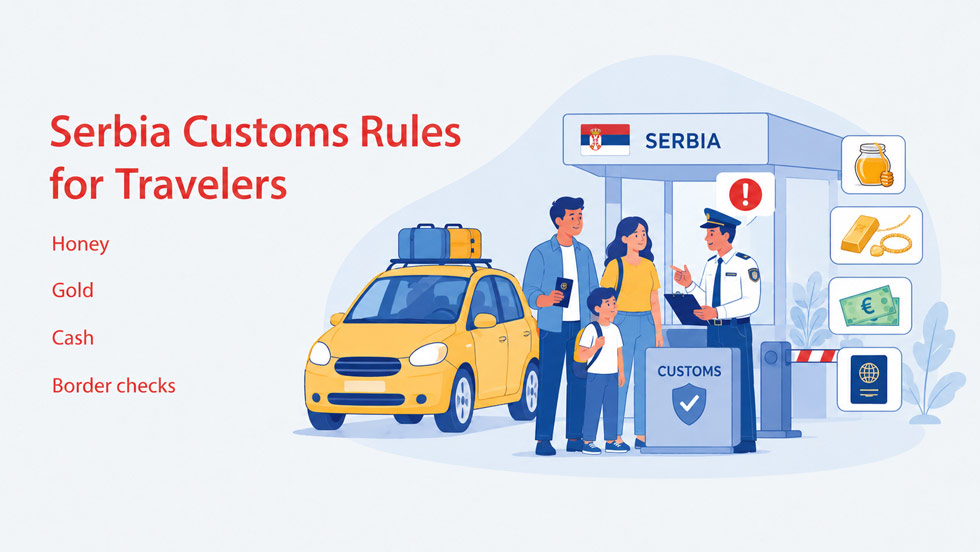
Traveling through Serbia is common for people driving between the EU, Bulgaria, Turkey, Greece, Western Europe, and the Balkans. Many travelers are surprised when Serbian customs officers ask about seemingly ordinary items: cigarettes, honey, alcohol, jewelry, gold, cash, food, tools, or new goods bought abroad.
The key point is simple: Serbia is not in the EU customs area. When you enter Serbia, even for transit, you are entering a separate customs territory. Serbian border authorities can inspect your vehicle, luggage, and personal goods.
“Personal use” does not automatically mean “free to carry without limits.” Customs officers look at the type, quantity, value, packaging, and purpose of the goods.
The golden rule: declare when in doubt
If you are carrying something valuable, unusual, restricted, or above normal travel quantities, declare it or ask the customs officer before crossing.
If you use the green lane (where available) or say “nothing to declare,” customs may treat that as a formal statement.
Important passenger limits
| Category | Published Serbian rule | Practical reading |
|---|---|---|
| Tobacco | 50 cigarettes, 25 cigarillos, 10 cigars, 50 g tobacco, or a suitable combination. Related products such as vapes/nicotine pouches may be carried in personal-use quantities; snus is prohibited. | Stay strictly within the stated quantities. Extra cartons, resale-style quantities, or hidden tobacco are high-risk. |
| Alcohol | 1 liter of spirits or 1 liter of sparkling/liqueur wine or a suitable combination, plus 1 liter of other wine. Beer is not precisely quantified, but must clearly be for personal use. | Keep bottles reasonable, preferably sealed, and avoid “gifting quantities” unless you are ready to declare them. |
| Cash | You may bring in as much money as you want, but any amount of EUR 10,000 or more must be declared. The rule applies per person, including children. Taking out more than EUR 10,000 is restricted and depends on residence status and supporting receipts/forms. | Declare at entry, keep the certified form, and do not assume a previous declaration remains valid after a side trip to a neighboring country. |
| Honey and food | Food must be in reasonable personal-use quantities and in original packaging. Food of animal origin is limited to 1 kg. Honey is not named separately in the public English guidance. | Treat honey conservatively as falling within the 1 kg animal-origin cap unless you have official clarification. Avoid bulk jars, unpacked food, or multiple “gift” bags. |
| Jewellery / precious metals | No numeric public allowance. Personal jewelry may be worn, but “a lot” of jewelry or valuables in luggage must be declared; the safest practice is to declare all valuables. Investment gold bars/plates may require a permit; some investment gold coins do not. | Carry receipts/photos if possible, wear only ordinary personal items, and declare high-value pieces or investment gold. |
| Medicines | Up to 15 days’ regular therapy without medical opinion; up to 6 months may require ministry approval, especially for controlled psychoactive substances or amounts above one pack of 30 doses. | Keep medicines in their original packaging, with a prescription or a doctor’s note if you are carrying more than a short course. |
| Plants | Small quantities without a phytosanitary certificate are permitted only if they originate in an EU country and remain within the published quantity limits. | Bulgarian/EU-origin plants are easier to argue within the exemption. Non-EU-origin plants are riskier unless you have certificates. |
Why travelers are often surprised
Many travelers think customs rules apply only to commercial importers. That is not correct.
Serbian border checks can feel strict because authorities can enforce rules on goods that ordinary travelers see as harmless:
- several cartons of cigarettes;
- many jars of honey;
- bottles of alcohol;
- gold jewelry bought abroad;
- cash split between bags;
- boxed electronics;
- car parts, tools, or metal items;
- food carried across several borders.
The question is not only “Is this for personal use?” The question is also: Is it within the allowed quantity, value, and category for passenger traffic?
Cigarettes and tobacco: do not carry extra cartons
Cigarettes are one of the most common problems at Balkan borders. Tobacco products are excise goods, and customs authorities often check them carefully.
For travelers, the safest practical rule is:
Do not carry more than the current Serbian passenger allowance. Do not assume that one carton per person is acceptable.
If you carry several cartons, even for relatives or personal use, customs may treat the goods as undeclared or above allowance.
Alcohol: small quantities only
Alcohol is also controlled. A bottle or a small personal quantity may be fine, but larger amounts can create problems.
Risk increases if:
- you carry several bottles.
- bottles are unopened and repeated;
- the quantity looks like resale or gifting;
- you cannot explain the purpose;
- the alcohol is combined with other controlled goods, such as cigarettes.
Honey, meat, dairy, and food products
Food is a special category because customs may also involve veterinary or food-safety rules.
Travelers often ask about honey because it feels like a harmless personal item. However, honey is an animal-derived product and may attract checks, especially if carried in multiple jars or without clear packaging.
Practical advice:
- carry only small personal quantities;
- keep original packaging where possible;
- avoid carrying meat and dairy products across borders;
- do not carry large quantities of honey, cheese, sausages, or homemade food;
- check both Serbian rules and the rules of the next country you enter.
This is especially important if you are traveling from Serbia back into the EU, for example, into Bulgaria, Hungary, Croatia, or Romania. EU border rules for food of animal origin can be stricter than travelers expect.
Gold, jewelry, and precious metals
Gold and jewelry are a frequent source of border disputes.
Ordinary personal jewelry worn during travel is usually different from:
- gold bars;
- investment gold;
- gold coins;
- scrap gold;
- many jewelry items;
- newly purchased jewelry;
- jewelry with tags or invoices;
- items carried for someone else.
If the value is significant, declare it and carry proof of ownership or purchase. If you enter Serbia with valuable jewelry or equipment and plan to leave with it, a declaration can help prove that you did not buy it in Serbia or import it illegally.
Cash: the EUR 10,000 rule
Travelers carrying large amounts of cash should be careful. Serbia follows the common rule that cash above EUR 10,000 or equivalent must be declared.
This includes foreign currency and may include other monetary instruments.
Practical advice:
- declare cash above the threshold;
- keep the stamped declaration document;
- do not split cash between bags to avoid declaration;
- know that officers may ask about the origin and purpose of the money;
- if you entered Serbia with declared cash, keep the document for exit.
Medicines
For normal medication, carry only what you need for the trip and keep it in its original packaging.
For prescription or controlled medicines:
- carry a prescription;
- carry a doctor’s note if possible;
- avoid large quantities;
- check rules before traveling with strong painkillers, sedatives, psychiatric medication, or controlled substances.
Traveling by car: what customs may inspect
At land borders, customs officers may inspect:
- luggage;
- glove compartment;
- roof box;
- boot/trunk;
- under seats;
- spare wheel area;
- toolboxes;
- food bags;
- personal bags;
- documents and receipts.
This does not mean you did something wrong. It means customs officers are checking whether goods should be declared, taxed, restricted, or seized.
Transit through Serbia: still subject to customs
Many travelers say, “But I am only passing through Serbia.”
That may be true, but it does not mean customs rules disappear. When you enter Serbia, you enter Serbian customs territory. If you carry controlled, valuable, or excessive goods, customs can still check them.
For normal personal luggage, transit is usually simple. Problems usually arise with:
- too many cigarettes;
- food products;
- alcohol;
- cash;
- gold or jewelry;
- new goods;
- commercial-looking quantities;
- goods carried for others.
What to do if customs stops you
Stay calm and keep the discussion factual.
Ask for:
- the reason for the inspection;
- the rule being applied;
- a written record of goods that are seized;
- the name or identification of the authority;
- instructions for appeal or payment;
- an official receipt for any payment.
Do not sign documents you do not understand without asking what they mean. If the matter is serious, contact your embassy or consulate.
Practical examples
Example 1: Cigarettes “for personal use”
A traveler carries several cartons of cigarettes through Serbia. They say the cigarettes are for family use. Customs may still treat the quantity as above the passenger allowance. The result can be a seizure, a fine, or a customs procedure.
Example 2: Honey from a local producer
A family carries many jars of honey across the border. Even if the honey is not for sale, the quantity may look commercial or may trigger food/veterinary rules. Small personal quantities are safer; large quantities should be checked before travel.
Example 3: Gold jewelry bought abroad
A traveler buys gold jewelry abroad and crosses Serbia without declaring it. If customs finds it, the traveler may be asked for invoices and proof. Undeclared valuable jewelry can be treated as imported goods.
Example 4: Cash for property, business, or family
A traveler carries more than EUR 10,000 in cash and does not declare it. Even if the money is legitimate, the failure to declare it can create serious problems.
Example 5: Transit from the EU to Bulgaria via Serbia
A traveler leaves the EU, passes through Serbia, and re-enters the EU. They must consider both Serbian customs rules and EU rules when re-entering the EU. Food, cigarettes, and alcohol can be checked on both sides.
Practical FAQs
Can I travel through Serbia with cigarettes?
Yes, but only within the allowed passenger limits. Do not carry extra cartons without checking the current Serbian allowance. “Personal use” is not sufficient if the quantity exceeds the limit.
Can I bring alcohol through Serbia?
Small personal quantities may be allowed, but alcohol is limited. Larger quantities should be declared and may be subject to taxation or restrictions.
Can I bring honey through Serbia?
Small personal quantities are safer, but honey can still be checked because it is a food product of animal origin. Large quantities, homemade products, or goods without packaging can cause problems.
Can Serbian customs check my car if I am only transiting?
Yes. Transit does not prevent customs inspection. If you enter Serbia, Serbian customs rules can apply.
Do I need to declare cash?
Declare cash or equivalent value above EUR 10,000. Keep the declaration document until you leave Serbia.
Is personal jewelry allowed?
Normal personal jewelry is usually not the issue. Valuable jewelry, gold coins, gold bars, multiple items, or newly purchased jewelry should be declared or supported by proof of ownership.
What if I carry goods for relatives?
Be careful. Goods carried for someone else may still be your responsibility at the border. If quantities look commercial or exceed limits, customs may act.
Are medicines allowed?
Personal medicines are usually allowed in reasonable quantities. Carry prescriptions and medical documents, especially for controlled medicines.
What happens if goods are seized?
Ask for a written record and information on the legal procedure, the appeal deadline, and the responsible office. Keep all documents.
Is it better to declare even if I am unsure?
Yes. If you are unsure, ask the customs officer before crossing. A short declaration is safer than being found with undeclared goods later.
Official Serbian and related authority links
- Serbian Customs Administration / Uprava carina
https://www.carina.rs/ - National Bank of Serbia — currency and foreign-exchange rules
https://nbs.rs/ - Ministry of Finance of the Republic of Serbia
https://www.mfin.gov.rs/ - Ministry of Interior / Border Police information
https://www.mup.gov.rs/ - Ministry of Agriculture, Forestry and Water Management — food, veterinary and phytosanitary matters
https://www.minpolj.gov.rs/ - Veterinary Directorate of Serbia
https://www.vet.minpolj.gov.rs/ - Government of the Republic of Serbia
https://www.srbija.gov.rs/
For travelers entering or re-entering the EU
- EU travel and luggage rules — Your Europe
https://europa.eu/youreurope/citizens/travel/ - Bulgarian Customs Agency
https://customs.bg/
Final practical advice
Before traveling through Serbia, check three things:
- What are you carrying?
- Whether it exceeds normal passenger limits.
- Whether it must be declared.
For most travelers, Serbia is easy to transit. Problems usually happen when people carry goods that look ordinary to them but are legally sensitive at the border, such as cigarettes, alcohol, honey, gold, cash, food, medicines, or new goods.
The safest approach is simple: carry less, keep receipts, declare valuables, avoid goods for others, and ask customs when unsure.