

The Hidden Medieval Church Inside the Metropolia Courtyard
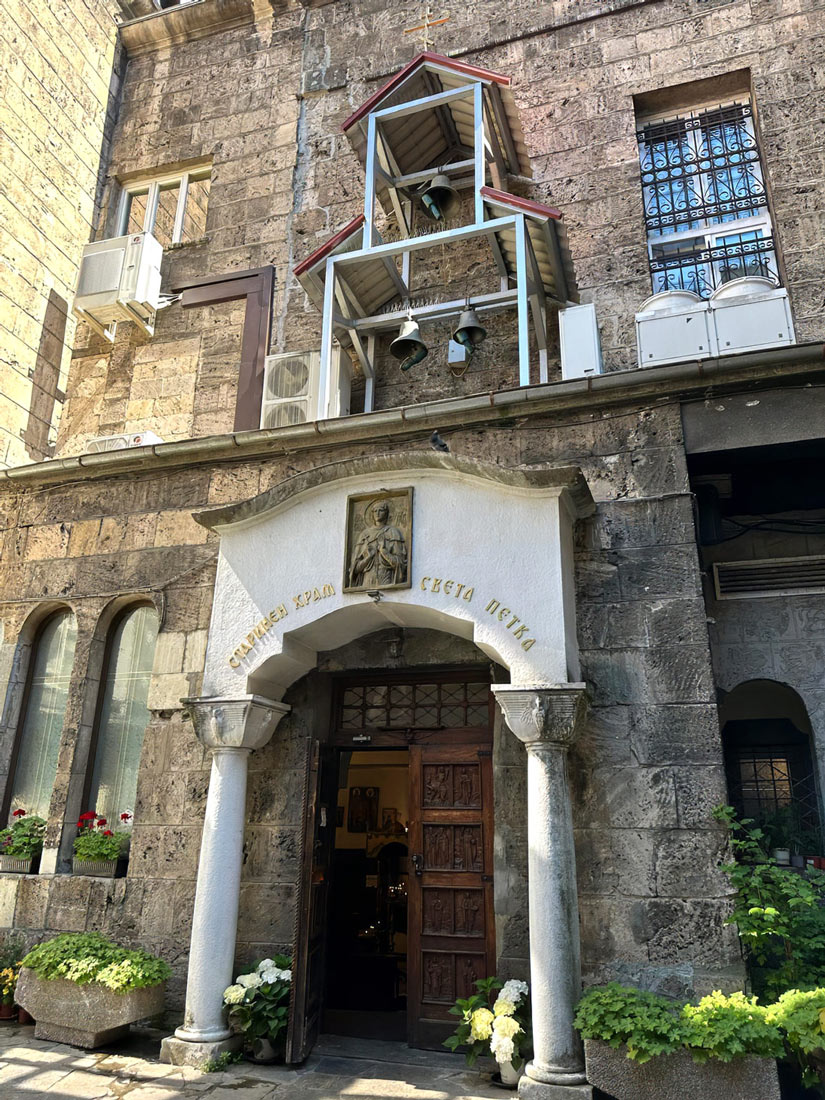
In the very center of Sofia, a few steps from some of the capital’s busiest streets, there is a church that almost hides from the city. You may pass along Tsar Kaloyan Street, look up at the stone facade of the Sofia Metropolia, notice an arched entrance, a small icon above the door, a cluster of bells, and a quiet courtyard, and only then realize that you have found one of Sofia’s most atmospheric sacred places: Sveta Petka Stara, or St Petka the Old.
This is not a grand cathedral. It does not dominate a square. It is not designed to impress from a distance. Its power is the opposite: it draws you inward. The church is small, partly sunken into the historical layers of the city, and embedded in the complex of the Sofia Holy Metropolia. Its official address is 9 Tsar Kaloyan Street, and the church’s own contact page lists it there, in the heart of old Sofia.
For visitors, Sveta Petka Stara is one of the best places to understand Sofia as a city of layers. Roman Serdica, medieval Sredets, Ottoman Sofia, the post-Liberation capital, and today’s urban center all seem to press against each other here.
Why this small church matters
Sveta Petka Stara is one of the oldest surviving Orthodox churches in Sofia. The inscription at the southern entrance gives the year 1241, although sources interpret this carefully: it may indicate that the church was newly built, or that an older sacred place was renewed on earlier foundations. Bulgarian National Radio notes that the date is traditionally connected with the transfer of the relics of Saint Paraskeva, known in Bulgaria as Saint Petka, to Tarnovo, then the capital of the Second Bulgarian Empire.
Academic and church-related sources also place the building history in the period 1241 to 1257, while allowing for the possibility of an earlier Christian site beneath or around the present church. This makes Sveta Petka Stara more than a “hidden gem.” It is a rare surviving piece of medieval Sofia, preserved inside the living fabric of the modern city.
The church is dedicated to Saint Paraskeva-Petka of Epivat, also known in Bulgaria as Saint Petka of Tarnovo or Saint Petka the Bulgarian. She lived in the 11th century and is among the most beloved saints in Bulgarian Orthodox tradition. Her feast day is celebrated on 14 October, which is also the church’s main feast day.
Stara means “old”
The word Stara means “old.” In Sofia, this is important, because there is another famous church dedicated to Saint Petka nearby: Sveta Petka Samardzhiyska, the small church in the Serdika underpass area. The two are often confused by visitors.
Sveta Petka Stara is the one hidden in the Sofia Metropolia complex on Tsar Kaloyan Street. Bulgarian National Radio explains that the addition “Stara” helps distinguish it from other Sofia churches dedicated to Saint Petka or Saint Paraskeva, especially Sveta Petka Samardzhiyska, which is associated with a different tradition of Saint Paraskeva.
For a traveler, this distinction matters. Sveta Petka Samardzhiyska tells one story of Sofia’s medieval and Ottoman urban life. Sveta Petka Stara tells another: the story of a small metropolitan church connected to the spiritual administration of the city.
A church connected with medieval Sredets
In the 13th century, Sofia was known as Sredets. The area around today’s Tsar Kaloyan Street, the Rotunda of St George, and the Largo was part of the city’s dense historical core. Visit Sofia’s medieval materials list: Sveta Petka Stara, among the important churches of the 7th to 14th-century urban landscape, alongside the Rotunda of St George, St Nikolay Mirlikiyski, Sveta Petka Samardzhiyska, Boyana Church, and the Basilica of St Sophia.
Some interpretations link the church to the medieval elite zone of Sredets, near residences associated with the sebastokrators who governed the region in the 13th century. Visit Sofia notes that the church was probably connected to the local ruler’s court and was built over remains associated with the late-antique palace area of Constantine the Great.
For non-specialists, the key point is simple: this is not an isolated chapel. Sveta Petka Stara belongs to one of the most historically charged areas of Sofia, where Roman, Byzantine, Bulgarian medieval, and later Orthodox memories overlap.
The Ottoman period and the testimony of Stephan Gerlach
The Ottoman period is one of the more intriguing parts of the church’s history. Sources differ on whether the church was damaged or destroyed when Sofia fell under Ottoman rule, but they agree on one crucial point: by the late 16th century, it was functioning again as an Orthodox church.
The German traveler and theologian Stephan Gerlach, who passed through Sofia in 1578, mentioned a church known as Sveta Petka Stara in the Metropolia. The Bulgarian Patriarchate material uses this testimony to argue that the church had a metropolitan status from its early history.
Bulgarian National Radio adds another important detail: according to the priest interviewed there, there is no clear evidence that the church was converted into a mosque or permanently closed during Ottoman rule. Instead, it appears in the record as a small but active Orthodox church, repaired over time and remembered for its rich wall paintings.
That continuity is part of the charm of Sveta Petka Stara. It is not only an archaeological survival. It is a place where religious life continued quietly, even as the surrounding city changed dramatically.
What to look for when you visit
From outside, the church is easy to miss. The entrance is modest, tucked into a courtyard, with a white arched portal and an icon above the door. Look up, and you will see the bells mounted against the old stone wall, creating one of the most distinctive small scenes in central Sofia.
Inside, the atmosphere changes quickly. The church is small and intimate. It is a single-nave basilica, with the central body lower than the narthex and at a similar level to the nearby Rotunda of St George. This difference in levels helps visitors feel the depth of the city’s accumulated layers.
The walls and altar area preserve traces of older painting. During restoration work in 2001 and 2002, fresco fragments in niches near the altar were dated to around the 15th century, according to the same BNR account.
The church is also known for its sacred objects. Pilgrims come to venerate a particle of Saint Petka’s relics, donated by the Vidin Metropolia in 2014, according to the church’s own website. BNR also mentions old icons from the 18th and 19th centuries, a revered icon of Saint Petka, a particle of the Life-Giving Cross, relics of several saints, and a slipper of Saint Spyridon, blessed at his relics on Corfu.
Another distinctive tradition is connected with Saint Therapon of Sofia, a local martyr venerated in the church. The Bulgarian Patriarchate notes that his feast is on 27 May, and Visit Sofia also lists 27 May as one of the church’s two feast days, together with 14 October for Saint Petka.
The holy spring and the “living” church
Sveta Petka Stara is not only a historic monument, but also a living shrine. Visit Sofia’s church guide lists among its sacred possessions the Holy Spring of St Petka, together with the tree of Holy Martyr Therapon and miracle-working icons.
For visitors who are not Orthodox Christians, this should be approached with respect rather than as folklore. The church is active. People come to pray, light candles, attend services, and ask for intercession. The experience is not like entering a museum room. It is closer to stepping into a private spiritual memory that the city has allowed to remain open.
Practical visitor information
The official church information lists the address as 9 Tsar Kaloyan Street, Sofia. The official service page gives opening hours as 07:00 to 18:00 in winter and 07:00 to 19:00 in summer.
Because this is an active Orthodox church, visitors should dress and behave respectfully. Speak quietly, avoid flash photography, and do not photograph worshippers or services without permission. If a service is taking place, it is usually best to stand aside quietly rather than walk around the church.
The church is very central and easy to combine with a short walk through old Sofia. Good nearby stops include the Rotunda of St George, St Nedelya Church, the Largo archaeological area, Sveta Petka Samardzhiyska, the Presidency courtyard, and Vitosha Boulevard.
Suggested mini-route: Sofia’s hidden sacred core
Start at St Nedelya Square, then walk toward Tsar Kaloyan Street and enter the courtyard of Sveta Petka Stara. Spend a few quiet minutes inside. From there, continue toward the Rotunda of St George, one of Sofia’s most important late antique monuments. Then walk to the Serdika archaeological area and finish at Sveta Petka Samardzhiyska.
This route takes you through almost two thousand years of Sofia in a compact area: Roman Serdica, medieval Sredets, Ottoman Sofia and the modern Bulgarian capital.
Is Sveta Petka Stara worth visiting?
Yes, especially if you enjoy places that are small but meaningful. Sveta Petka Stara is not a spectacle of a monument. It is a monument of survival.
Visit it because it shows a quieter Sofia, one that exists behind gates, courtyards, icons, and layered stone. Visit it because the church explains something important about the city: Sofia’s past is not only displayed in museums. Sometimes it is still alive, behind a half-open wooden door, below street level, under the sound of bells.