

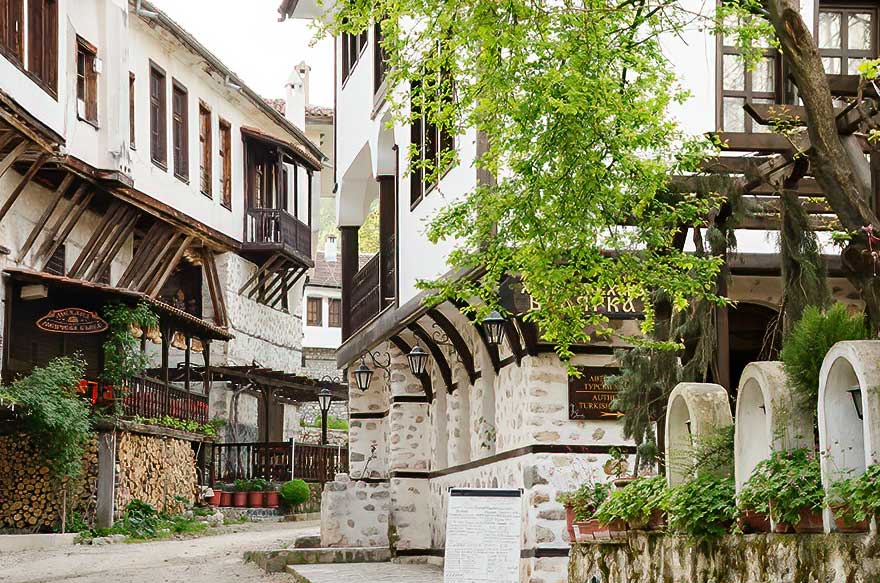
Melnik is a small historic town in southwest Bulgaria, best visited for its Revival-period houses, wine cellars, sandstone landscape, and easy pairing with Rozhen Monastery. It is compact, but it is not a five-minute stop: the streets are steep, the main houses need time, and the best views require walking. Bulgaria’s tourism portal places Melnik about 175 km from Sofia, 24 km from Sandanski, and close to the Greek border.
Quick visitor guide
How long to spend: 2 hours for a short street walk and Kordopulova House; half a day with the museum, churches, or a viewpoint; a full day or overnight if adding wine tasting and Rozhen Monastery.
Best ticket choice: There is no town-wide combo ticket. Buy separate tickets for Kordopulova House, the Historical Museum, and any other paid interiors.
What may be closed: Kordopulova House has seasonal opening days: daily in summer, fewer days in spring/autumn, and only Thursday–Sunday in winter.
Best transport: Car is strongly recommended, especially if pairing Melnik with Rozhen Monastery, wineries, or Rupite. Public transport is possible but less smooth.
Walking difficulty: Moderate. Expect cobbled lanes, slopes, steps, sandy paths, and exposed summer heat.
Accessibility: Limited. Historic houses, cellars, and viewpoints are not step-free.
What ticket should you buy?
Start with the Kordopulova House if you only pay for one interior. It is the best-known Revival-period house in Melnik, built in 1754, with large rooms, painted decoration, and wine cellars connected to the town’s merchant history. The official Kordopulova House site lists a standard visit to the architectural complex with local wine tasting at €5, with optional guided talks and larger tasting packages available separately.
Add the Historical Museum for more context. The Ministry of Tourism describes the museum as being on Melnik’s main street, with exhibits covering the town from antiquity to the early twentieth century. It is listed as a paid, year-round site with guide service available.
Drivers should plan a wine tasting carefully. Melnik’s wine culture is part of the visit, but tastings should be skipped or limited unless someone else is driving.
Discover more about Wine PDO Melnik
Opening hours and off-season reality
Melnik is visitable all year, but the experience changes outside of summer. Kordopulova House lists daily opening in May–September, Wednesday–Sunday opening in March, April, October, and November, and Thursday–Sunday opening in December, January, and February.
Outdoor sights such as the sand pyramids and viewpoints are not seasonal in the same way, but winter daylight is shorter, paths can be muddy, and some restaurants, guesthouses, or wine stops may operate reduced hours. Call ahead if your trip depends on a specific cellar, guesthouse, or guided experience.
What to see
The most useful route is simple: walk the main street, visit Kordopulova House, look at the church and the remains of the house above the town, then decide whether to continue to a viewpoint, a winery, or Rozhen Monastery.
Key stops include Kordopulova House, the Historical Museum, Boyar’s House, St. Anthony’s Church, the partly active St. Spileotisa site, and the active St. Nicholas church. Bulgaria’s tourism portal also highlights the Melnik Sand Pyramids as a natural landmark shaped by erosion, with formations reaching up to about 100 meters.
Do not expect polished city-museum infrastructure everywhere. Melnik’s appeal is partly its irregularity: old stone walls, sandy slopes, ruins, cellars, narrow lanes, and the dramatic pale cliffs rising behind the town.
How to get there
By car, Melnik is straightforward from Sofia via the Struma corridor and the Sandanski area, then by local road into the town. This is the best option for combining Melnik with Rozhen Monastery, wineries, and other stops in the Sandanski–Petrich area.
By public transport, the trip is possible but less convenient. The Ministry of Tourism notes that the nearest railway station is Damyanitsa, about 12 km from Melnik, and that Melnik is about 24 km from Sandanski. In practice, most visitors to public transport need to combine train or bus travel with a taxi or local connection.
Nearby pairings
Melnik & Rozhen Monastery is the classic pairing. Rozhen Monastery lies about 5 km east of Melnik and is described by Bulgaria’s tourism portal as the largest Orthodox monastery in the Pirin region.
Melnik & Sandanski work well if you want a softer town base, spa hotels, or easier transport.
Melnik & wineries are best visited by car with a designated driver, via a private transfer, or with an overnight stay.
Melnik & Rupite / Petrich area can make a strong full-day route, but it becomes a car itinerary rather than a relaxed public-transport day.
Why visit?
Melnik is worth visiting for a specific combination: old merchant houses, wine history, sandstone scenery, and a monastery pairing within a short drive. Keep expectations practical. Buy separate tickets, check Kordopulova House opening days outside summer, wear shoes suitable for slopes and cobbles, and treat Melnik as a half-day to full-day stop rather than a quick roadside photo opportunity.