

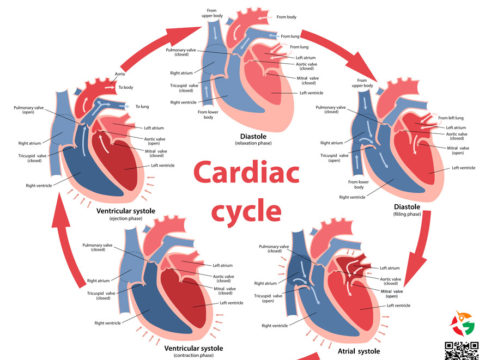
Your heart is one of the busiest organs in your body. Without you even thinking about it, it beats over 100,000 times a day, sending blood everywhere it needs to go. But this isn’t random or chaotic. Your heart follows an exact rhythm called the cardiac cycle – a repeating pattern of squeezing and relaxing that keeps you alive.
If you look at the infographic on page 1, you’ll see that the cardiac cycle moves in a single loop, just like a wheel. Each turn of this wheel is one heartbeat, and it has a few critical phases.
1. Diastole – Filling Up With Blood
The cycle begins when your heart relaxes. During this phase, called diastole, both the left and right sides of the heart open their inlet valves (the mitral and tricuspid valves) to allow blood to flow in.
It’s like the heart is taking a deep breath, preparing for its next big push.
2. Atrial Systole – The Small Squeeze
Next, the upper chambers of your heart — the atria — contract. This gentle squeeze pushes the last bit of blood into the ventricles.
Think of it as topping up a water balloon before tying it closed.
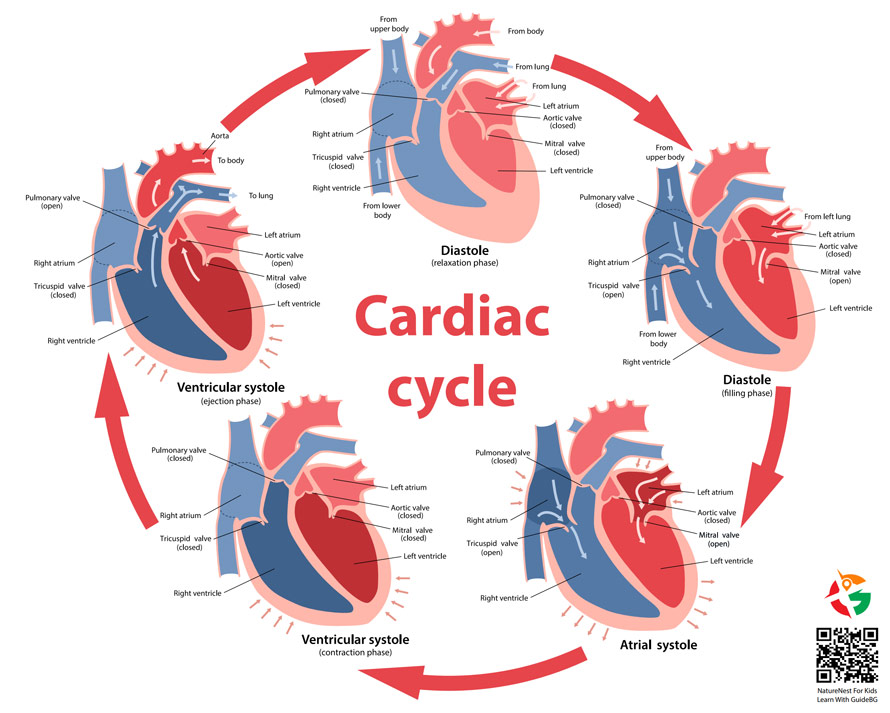
3. Ventricular Systole – The Big Pump
Now the ventricles, the powerful lower chambers, take over. They contract strongly in ventricular systole, pushing blood out of the heart — one side sending it to the lungs, the other to the entire body.
In the diagram, you can see the outlet valves (aortic and pulmonary) open wide during this phase. They act like doors that open only one way, ensuring the blood flows forward, not backward.
4. Reset and Repeat
After the ventricles finish contracting, the heart relaxes again. The valves switch positions — some close, some open — and the whole cycle resets.
This smooth, never-ending pattern ensures your cells get oxygen, your brain stays active, and your body keeps running.
Why This Matters
Understanding the cardiac cycle helps you see that your heartbeat isn’t just a simple “thump.” It’s a carefully timed mechanical and electrical sequence happening over and over, every moment of your life. And the more you learn about it, the more you realize how incredible the human body truly is.
Now, let’s take a look at the phases.