

Where this article fits
You’ve already seen:
- ATL: The Secret Skill Set Behind Every IB Class
- IB I&S Essay + ATL (thesis, PEEL, argument)
- IB Science Writing + ATL (labs, investigations, explanations)
This article is the Math piece of the puzzle.
Here we focus on IB MYP / early DP mathematics and how ATL skills show up when you:
- tackle hard problems
- prepare for tests
- explain your thinking
- work on investigations or explorations
You can think of this as:
“What does ATL look like when I’m doing Math?”
What IB Math is really trying to teach
IB math isn’t just about speed or memorizing tricks.
The big goals are to help you:
- Understand concepts (not just formulas)
- See patterns and connections between topics
- Reason and justify your answers
- Model real situations with graphs, tables, and equations
- Use technology sensibly (e.g., a calculator, a spreadsheet, or GeoGebra).
ATL skills sit underneath all of this. They’re the habits that turn “I don’t get it” into “I can figure it out if I work through it.”
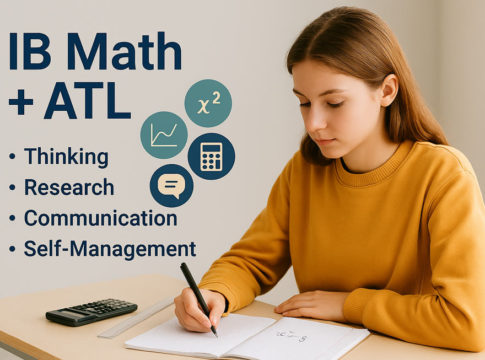
ATL in Math – the big picture
We’ll keep the same “toolbox” you saw in I&S and Science, but tuned to math:
- Thinking skills – understanding problems, spotting patterns, choosing strategies, checking answers
- Research skills – using examples, technology, and references to explore ideas and check methods
- Communication skills – precise notation, logical steps, explaining why something works
- Self‑management skills – practice planning, test prep, productive struggle, dealing with mistakes
- Social skills – group problem‑solving, explaining to peers, asking for help
Let’s unpack what each looks like in math class.
Thinking skills: your problem‑solving engine
In math, thinking skills are front and center.
Understand → Plan → Do → Check
A straightforward routine (like PEEL for essays) is:
- Understand: Underline key info, and rewrite the question in your own words.
- Plan: Choose a strategy: draw a diagram, make a table, use an equation, work backwards, etc.
- Do: Carry out the steps carefully, line by line.
- Check: Does the answer make sense? Try a quick estimate or plug it back into the original question.
Over time, this becomes automatic. You stop randomly “trying things” and start following a thinking process.
Typical thinking moves in Math
- Spot patterns: noticing how a sequence grows, how shapes change, or how graphs behave
- Break problems into parts: solve a simpler case first, then the full one
- Use multiple representations: number, algebra, table, graph, picture – and move between them
- Justify and generalize: not just “it works here,” but “it will always work because…”
If you can explain your strategy (not just your final answer), your thinking ATL is working.
Communication skills: showing your work like a pro
Good math communication is a bit like good essay writing: it has structure and clarity.
5.1 What clear math work looks like
- Neat layout: each step on a new line, aligned as much as possible
- Correct notation: =, ≈, →, units, labels on axes, proper use of brackets
- Words + symbols: short phrases like “Let x be…”, “Substitute x = 3”, “Therefore…”
- Final answer clearly marked: often with units, e.g., “Area = 24 cm²”
Mini “PEEL for Math”
For a complete written solution, think:
- State the idea: “Use Pythagoras’ theorem…”
- Do the calculation: show the algebra or steps
- Explain briefly: “because the triangle is right‑angled…”
- Answer clearly: “So the height is 5 cm.”
You’re not writing a whole paragraph, but you are telling a short, logical story.
Self‑management: surviving (and improving at) math
Math rewards consistent small effort, not last‑minute cramming.
Smart practice
- Mix easy, medium, and hard questions in one session.
- After class, redo one example without looking to see if you really understood.
- Keep a “mistake log”: write down questions you got wrong, what the error was, and how to fix it.
- Use timers: 15–20 minute focus blocks, then a short break.
Test prep with ATL
Before a test, ask yourself:
- Have I covered each topic, not only the ones I like?
- Can I do at least one typical example for each skill (solving equations, graphing, etc.)?
- Do I know where I usually make careless mistakes (signs, units, copying numbers)?
Self‑management in math is mostly about planning your practice and learning from errors, instead of just doing random exercises until you’re tired.
Research skills: yes, math uses them too
Math research in school isn’t about Googling answers. It looks more like:
- Exploring patterns (e.g., what happens to the area if you double the sides?)
- Using technology (graphing calculator, Desmos, GeoGebra, spreadsheets) to test conjectures
- Looking up definitions, theorems, and examples from multiple sources
- In DP, doing background reading for a Math Exploration / IA
Good research skills in math mean:
“I know how to look things up, test them, and then write it in my own words – not copy.”
Social skills: Math is a team sport more than you think
You don’t have to do every problem alone.
- Explaining to a partner often makes the idea click in your head
- Group tasks (investigations, projects) let you share different strategies
- Asking good questions (“Can you show me your first step?” instead of “What’s the answer?”) keeps collaboration meaningful
- Peer feedback on written solutions (checking each other’s steps) improves communication for both
The goal isn’t “the strongest student does everything,” but everyone grows by thinking together.
Typical IB math tasks & where ATL shows up
Everyday practice questions
- Thinking: choosing strategies, spotting shortcuts
- Self‑management: doing a bit daily, not just the night before
- Communication: writing steps so you can review them later
Inquiry/investigation tasks
For example: “Investigate how the area of a rectangle changes if its perimeter is fixed.”
- Research: Test different cases, maybe use a spreadsheet or graphing tool
- Thinking: Look for patterns, make conjectures (“maximum area at a square”)
- Communication: Write a short explanation of what you discovered
- Self‑management: Organize your work so the reasoning is straightforward to follow
Modeling/word problems
For example: population growth, sports statistics, finance, and geometry in design.
- Thinking: turning words into equations or diagrams
- Communication: clearly stating, “Let x be…”, defining variables
- Research: sometimes checking realistic values (e.g., interest rates, distances)
Longer tasks (projects, DP Exploration)
Here, math starts to look more like the I&S essay or Science investigation, but with a math focus:
- clear aim/question
- background examples or theory
- mathematical work (graphs, formulas, calculations)
- discussion/reflection on what it shows
All the ATL strands come together here.
Quick “Math + ATL” checklist
When you finish a piece of math work, ask:
- Thinking: Do I know why my method works, not just how?
- Communication: Could another student follow my steps without asking me questions?
- Self‑management: Did I give myself enough time to struggle productively, or did I rush?
- Research/Tech: Did I use tools (calculator, graphing, examples) to understand better, not just to get answers?
- Social: Did I try to explain or discuss at least one tricky problem with someone else?
If you can answer “yes” to most of these, you’re not just doing math – you’re building a transferable skill set that helps in every IB subject.