

Marselan is a modern French red grape created in 1961 by Paul Truel as a cross between Cabernet Sauvignon and Grenache. In Bulgaria, it has found convincing homes in both the Danubian Plain and the Struma Valley: Chateau Burgozone says it was the first winery to plant and register the variety in Northern Bulgaria, with plantings from 2007 and PGI Danube Plain recognition achieved in 2017, while producers such as Rupel and Orbelus show how well Marselan also performs in the warm southwest.
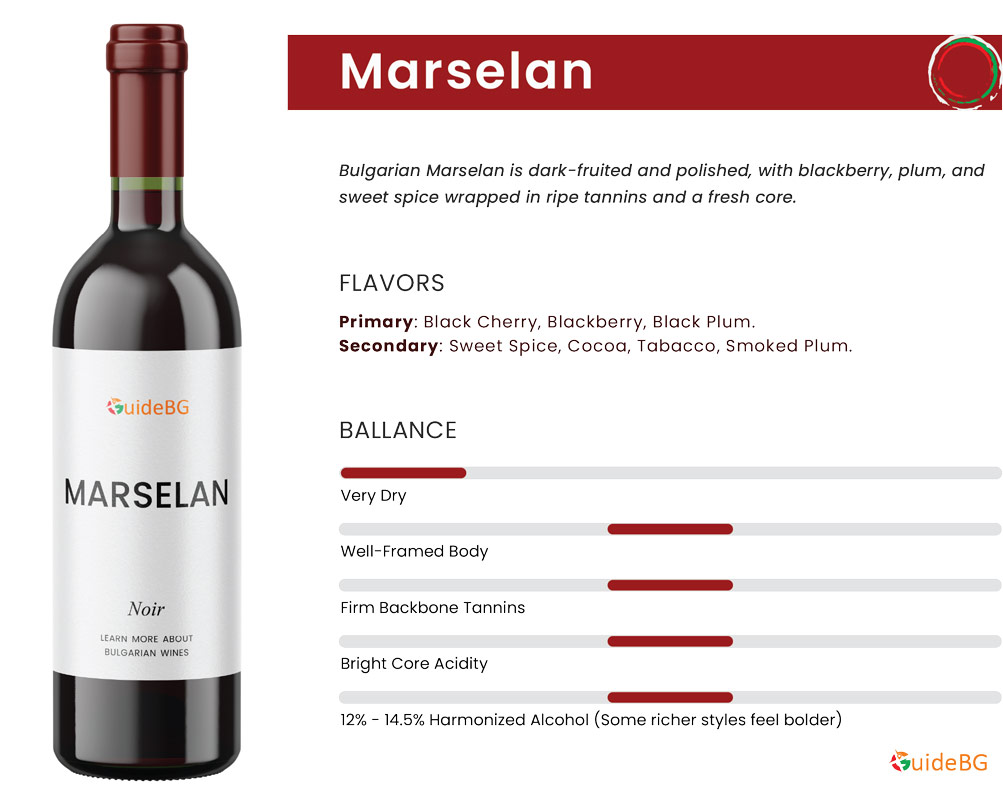
In Bulgaria, Marselan shows two distinct stylistic expressions. In the north, wines tend to be fresher, fruitier, and softer, while in the Struma Valley, they are typically darker, denser, and well-suited to oak ageing. Producer descriptions from Burgozone, Rupel, and Orbelus consistently highlight black fruit, spice, deep color, and smooth-to-ripe tannins, reflecting the variety’s naturally high anthocyanin and polyphenolic potential.
Serving
16-18°C

Standard red

20-40 min

Fresher Danubian Plain Marselan can be served slightly chilled in summer.
Food Pairing
Bulgarian Marselan is a natural match for grilled beef, lamb, game, smoked meats, mature cheeses, and richer winter dishes. The fresher northern style also handles vegetarian dishes and grills very well, while the denser southwestern examples are more comfortable with slow-cooked meats and long-aged cheeses.
What to Look For?
Look for a deep ruby-to-violet color, aromas of black fruit, sour cherry, plum, and spice, and a palate that feels concentrated yet not coarse. The best Bulgarian examples balance color and richness with freshness, avoiding heaviness and letting the tannins stay velvety rather than aggressive.
Cellaring Potential
Marselan has a solid capacity for ageing, especially when cropped low and raised in oak. General ampelographic sources describe good structure, high polyphenols, and round velvety tannins, while Bulgarian producers suggest that the stronger local bottlings can comfortably develop over 4–8 years, sometimes longer.
Blending Partners
In Bulgaria, Marselan is used both as a varietal wine and in blends. Verified local examples show it working with Cabernet Sauvignon, Syrah (Thracian), Egiodola, Merlot, Cabernet Franc, Malbec, Grenache Noir, and Melnik 55 (Early Melnik), depending on the region and style sought.
Breeding Background & Regional Context
Marselan was created in 1961 in southern France by ampelographer Paul Truel (at INRA) through a cross between Cabernet Sauvignon and Grenache. The variety was originally developed to combine Cabernet’s structure, color, and aging potential with Grenache’s warmth tolerance and generous fruit profile. In Bulgaria, Marselan has adapted well to both the Danubian Plain and the Struma Valley, where warm summers allow the grapes to reach full ripeness while still retaining freshness. These conditions highlight the variety’s ability to produce deeply colored wines with ripe tannins, concentrated fruit, and balanced acidity, making it increasingly attractive to Bulgarian winemakers seeking expressive and modern red styles.
Alternative Grapes
If you enjoy Bulgarian Marselan, start with Rubin for its dark fruit and spicy structure, or Melnishki Rubin for a deeper, more southwestern expression with supple tannins. For a lighter but still southern comparison, Melnik 55 makes sense; internationally, Marselan often sits stylistically somewhere between Cabernet Sauvignon’s structure and Grenache’s fruit generosity.