


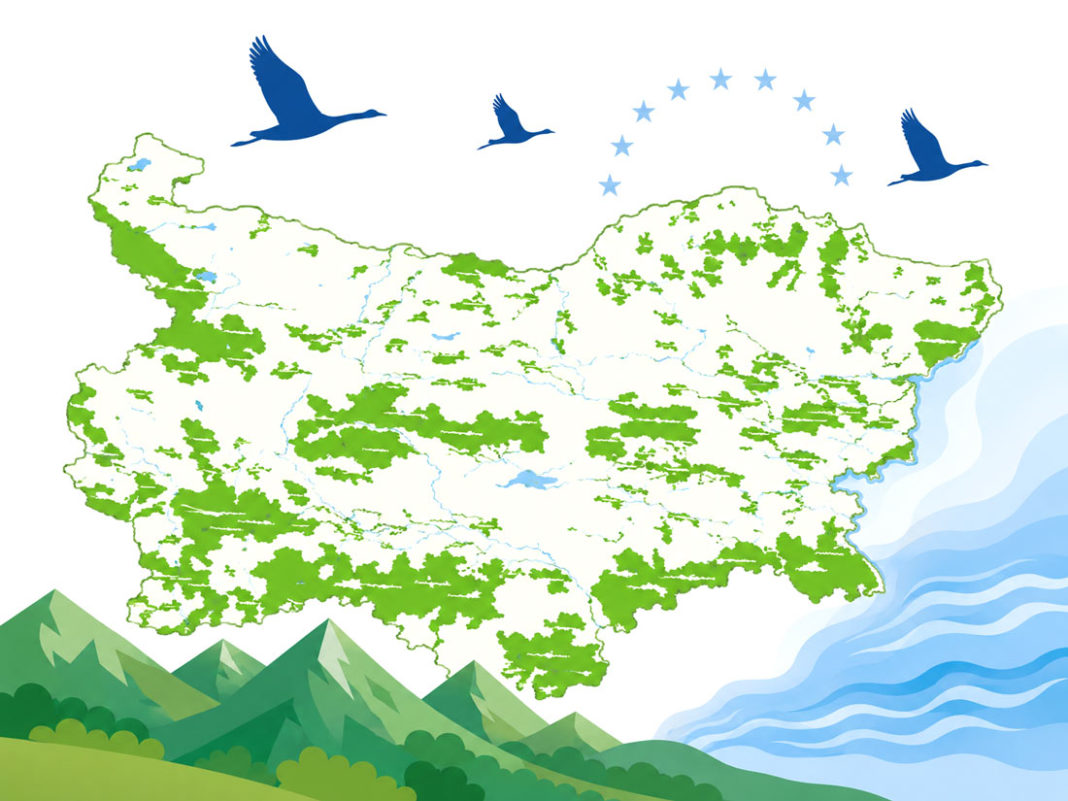
There is a real question at the heart of Bulgaria’s Natura 2000 debate, and it is not as simple as “nature versus construction”.
Europe did not start from scratch when Natura 2000 was introduced. Many of its cities, Alpine resorts, seaside towns, roads, and ski areas existed long before the modern EU nature-protection system. Natura 2000 is based on the 1979 Birds Directive and the 1992 Habitats Directive; Bulgaria started building its national Natura 2000 network after 2002 and joined the EU in 2007. That means Bulgaria entered the system later, with less developed mountain and seaside infrastructure than many older EU members.
The numbers are large
Bulgaria’s Natura 2000 network includes 340 sites, covering 3,873,704 hectares of land and 2,821.35 km² of Black Sea waters. On land, this equals 34.9% of Bulgaria’s territory. Habitat zones cover 30.3% of the country, and bird zones cover 23.1%; these figures overlap, so they should not be added together.
That is high by EU standards. Across the EU, Natura 2000 covers 18.6% of land, while in Bulgaria it covers 34.9%. So when Bulgarians say that a very large part of the country is under Natura 2000, that is factually correct.
The sea picture is different. Bulgaria’s official marine Natura 2000 area is 2,821.35 km². Bulgaria’s marine area exceeds 35,000 km², so Natura 2000 covers roughly 8% of Bulgaria’s Black Sea space. That is not a huge marine percentage, but the sensitive coastal areas are exactly where development pressure is highest: dunes, wetlands, lagoons, river mouths, cliffs, and shallow-sea habitats.
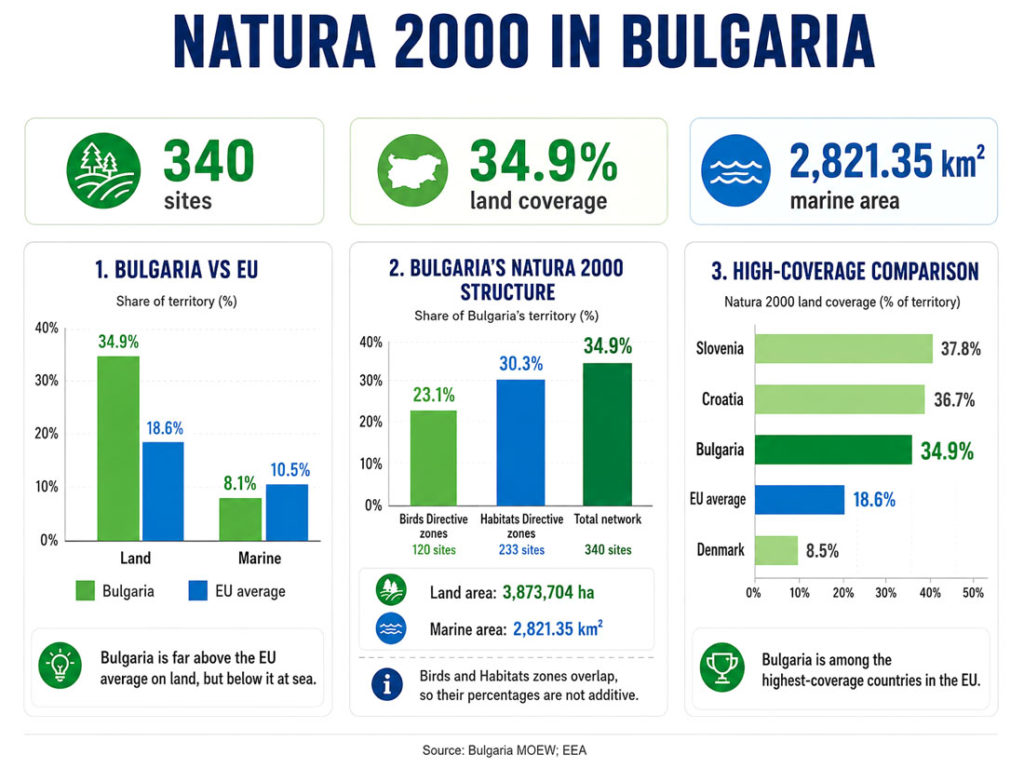
Note: Birds and Habitats zones overlap, so their shares are not additive. Natura 2000 allows development only when site-specific conservation impacts are properly assessed.
The mountain question is also more complex than one percentage point
There is no simple official figure saying “X% of Bulgaria’s high mountains are Natura 2000”. But the overlap is obvious in practice. Bulgaria’s most attractive ski landscapes, Rila, Pirin, parts of Stara Planina, and the Rhodopes, are also among the country’s most valuable natural areas. Bulgaria’s Natura 2000 network includes 38 Alpine biogeographical zones, while the Black Sea region has 46 zones.
So is the idea worth exploring?
Some older EU member states developed much of their tourism and urban infrastructure before the Natura 2000 framework was fully established, while Bulgaria is making many of these choices under today’s more developed environmental rules.
That argument has weight. A ski village in the Alps, a coastal town in France, or a resort in Italy may have been built decades before today’s Natura 2000 procedures. Bulgaria, however, often has to propose similar projects after the land has already been classified as environmentally sensitive.
But this does not mean Natura 2000 is a total ban. It is not.
New projects can happen inside or near Natura 2000 areas. The EU test is whether a project is likely to damage the site’s conservation objectives. If there may be significant effects, an “appropriate assessment” is required, based on scientific evidence. In exceptional cases, even damaging projects may be approved, but only if there are no better alternatives, there is overriding public interest, and compensation measures are secured.
This makes the development argument stronger when it becomes specific.
This exact project, in this exact place, has an acceptable impact, uses existing infrastructure where possible, avoids the most sensitive habitats, and creates real public value.
For seaside resorts, that means avoiding dunes, wetlands, and fragments of wild coast, while concentrating development in already urbanized areas. For ski projects, it means focusing on modernization, lift replacement, transport, water management, and existing resort footprints before opening entirely new mountain zones.
The fair conclusion is not that Bulgaria should be blocked from development. It is also not the case that Natura 2000 should be ignored because older EU countries were built first.
Bulgaria has a legitimate late-development problem, but the answer has to be smarter development, not simply more development.
The data support both sides of the question. Bulgaria really does have an unusually large share of land in Natura 2000. Europe really did build much of its tourism infrastructure before today’s rules were in place. But under the current system, the winning argument is not historical frustration. It is project-level proof.
Related Reads:
- Bulgaria Country Guide: Facts, History, Culture & Travel
- Bulgarian Islands
- Bulgaria Property Market Forecast 2026: Euro Adoption, Supply Frictions and Where Prices Go Next