

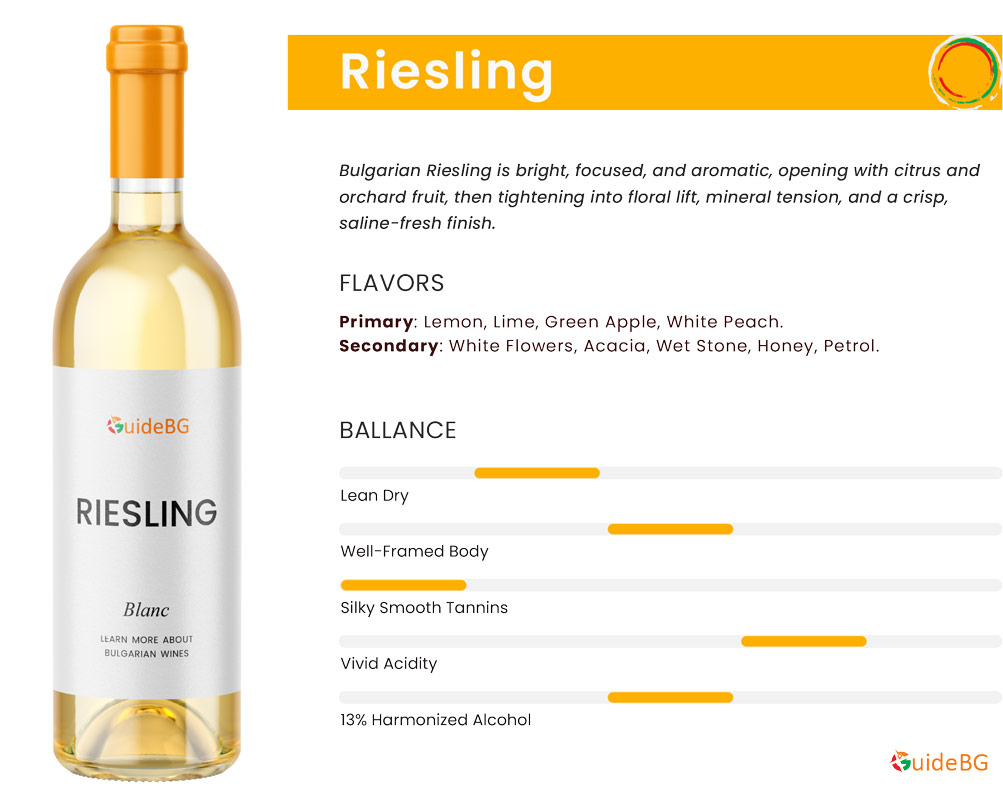
Bulgarian Riesling is one of the country’s quietly serious white grapes. Most examples lean dry, bright, and precise, with lemon, lime, green apple, white peach, blossom, mineral lift, and, in the better bottles, the faint petrol note that marks classic Riesling character. In Bulgaria, the grape feels most at home in the Black Sea zone and the Danubian Plain, where maritime moderation or cooler northern conditions help preserve acidity and shape.
Serving
8-10°C

Aroma white

no decanting

That is the cleanest serving window for Bulgarian Riesling. It is commonly recommended to serve it cold, within the 8–10°C window, while some wineries suggest serving it at 11°C. 8–10°C remains the sweet spot: cold enough to keep the wine sharp, warm enough to let the floral, citrus, and mineral notes unfold properly.
Food Pairing
Bulgarian Riesling is a natural table wine. Producer and retailer suggestions point toward seafood, fish, vegetables, salads, soft cheeses, white meats, and lightly spiced dishes. In Bulgarian terms, I would happily pour it with grilled trout, mussels, zucchini fritters, fresh goat cheese, shopska salad, or roast chicken with lemon and herbs. The wine’s acidity keeps the palate alert, while the fruit gives enough charm to handle spice and salt without losing precision.
What to Look For?
Look for a pale straw to light golden color, often with greenish flashes in youth. On the nose, you want citrus, green apple, white peach, flowers, acacia, mineral lift, and possibly a light petrol or resinous note in more serious bottles. On the palate, the wine should feel dry, bright, and focused, with a long, clean finish rather than softness or obvious sweetness.
Cellaring Potential
Most Bulgarian Rieslings are sold for early enjoyment, and several current listings frame them as “drink now” wines. Still, the category has more ageing potential than many people expect. Some wineries explicitly point to development over time, and others outline that some Riesling wines are intended for 5–15 years of bottle ageing. A fair window is 2–5 years for fresher everyday examples, with 5–10+ years possible for the more serious dry wines.
Blending Partners
Although Riesling is often bottled on its own, Bulgarian producers also use it effectively in blends. Current market examples show it paired with Vrachanski Misket, Dimyat, Sauvignon Blanc, and Chardonnay in fresher white cuvées. That makes sense stylistically: Riesling adds acidity, length, and aromatic tension without overpowering softer white varieties.
Breeding Background & Regional Context
Riesling is most likely native to the banks of the Rhine and is probably a descendant of Gouais blanc. It is a grape for great-quality dry whites with very high acidity and a slow evolution of bouquet toward petroleum notes, while also producing outstanding sweet wines when overripe or botrytized. That background explains why it works so well in Bulgaria’s cooler or acidity-preserving sites: the Varna coast, with its sea moderation, and northern Danubian sites with their fresher line.
The two clearest Bulgarian homes are the Black Sea Coast and the Danubian Plain, but Riesling is not absent from the south. Current Bulgarian examples from Four Friends and Jivankin in the Thracian Valley show that the grape can also work there, either in a peach-and-quince direction or in a tighter green-apple-and-lime style. Even so, the national center of gravity remains coastal and northern rather than southern.
Black Sea Coast Riesling
The Black Sea is the grape’s most natural Bulgarian address. The sea moderates summer temperatures and helps maintain acidity. Euxinograd, one of the country’s historic coastal references, still names Riesling among the grapes used for its white wines. In the glass, the coastal style usually feels taut, citrus-led, floral, and mineral, as you can see in current examples from Salla and other Black Sea producers.
Danubian Plain Rielsing
The Danubian Plain gives Riesling a slightly different accent. The current Danube wine map shows the grape planted across a spread of northern wineries, including Villa Grivitsa, Daniel’s Plain, Magura, and Ponte Dio. Bononia’s Riesling captures that northern Bulgarian mood beautifully: dry, fresh, mineral, with apple, honey, acacia, yellow fruit, and enough persistence to develop over time. This is still Riesling in a bright register, but the middle palate can feel a little broader and more orchard-fruited than on the coast.
Alternative Grapes
If this style speaks to you, move next to Traminer for a more perfumed, rounded aromatic white, then to Muscat Ottonel for a softer, floral-fruit profile. For a more local Bulgarian accent, try Varnenski Misket or Vrachanski Misket. If you want a saltier and less obviously aromatic coastal white, go toward Dimyat. Those are the most natural neighboring grapes in the same Bulgarian white-wine conversation.