

If Bulgarian Syrah has a more Mediterranean voice, it is here. The Struma Valley is Bulgaria’s deep southwestern red-wine corridor, stretching toward Melnik and the Greek border, and it is widely described as the country’s smallest wine region, shaped by warm, dry summers, very mild winters, and strong Mediterranean influence. It is, by instinct and by output, a red-wine landscape.
Syrah is not the ancestral headline grape of the valley; that honour still belongs to the Melnik family, but Struma has clearly adopted it. Regional route material lists Syrah among the international grapes grown along the valley, and current wineries around Melnik, Sandanski, Petrich, Kapatovo, Hotovo, and Damyanitza all grow or bottle it as a serious southern red.
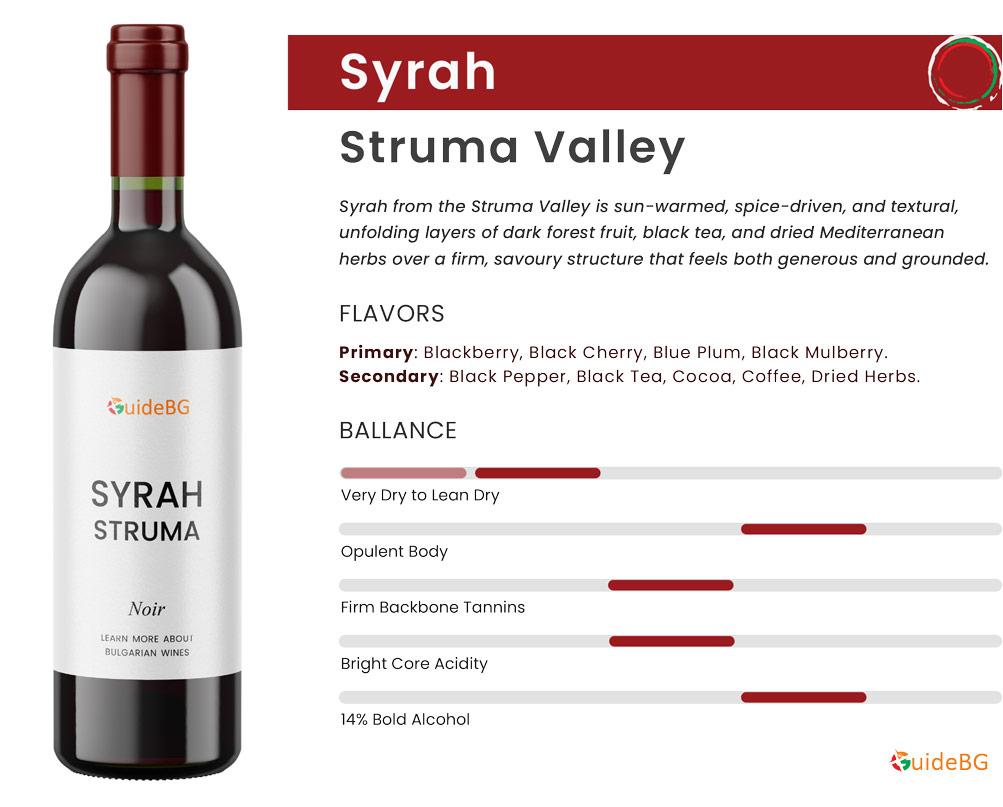
In the glass, Struma Syrah usually reads darker, warmer, and more Mediterranean than most Bulgarian Syrahs. Think blackberry, black cherry, blue plum, black mulberry, cracked pepper, black tea, dried herbs, warm earth, cocoa, coffee, and sometimes a faint meaty or olive-like savoury edge. The best examples stay dry, structured, and spicy, with the sun giving breadth while the valley’s soils and airflow keep the finish alive.
Serving
16-18°C

Standard red

30 – 60 min

That is the sweet spot for the region. Orbelia’s Syrah-containing reds are served at 16–18°C, and many of the valley’s better Syrahs see serious cellar work — 12 months in French oak at Sintica, 14 months of new-barrel ageing at Orbelia, 18 months in Bulgarian oak at Villa Melnik. A moderate decant lets the pepper, black tea, spice, and earthy tones unfold without pushing the wine out of shape.
Food Pairing
Typically, a reserve Syrah points toward wild fowl, turkey, and chicken, while some Syrah-based reds lean naturally toward game, veal, lamb, barbecue, red meats, and cheeses. In Bulgarian terms, that makes Struma Syrah a very natural partner for lamb chops with thyme, grilled pork neck, lukanka, kapama, mushroom kavarma, roasted aubergine, and mature kashkaval. The wine’s dark fruit cushions salt and smoke, and its peppery spine loves fire, herbs, and savoury fat.
What to Look For?
Look first for a deep ruby to dark garnet colour. Then look for a nose that moves cleanly from fruit into spice and savoury detail: blackberry, black cherry, plum, mulberry, pepper, black tea, dried herbs, warm earth, chocolate, coffee, sometimes a touch of smoked meat. On the palate, the wine should feel dry, broad but not blurry, with ripe tannins and a finish that stays spicy and earthy rather than flat or sugary.
Cellaring Potential
A sound editorial window is about 4–6 years for fruit-first bottlings and 7–10 years for stronger reserve examples, with room beyond that for the most serious cellar selections. That range is an inference from the valley’s typical structure around 14% alcohol, long macerations, and 12–18 months of oak at several leading producers, plus Syrah’s broader reputation as an age-worthy, tannic grape. Orbelia explicitly says its Via Aristotelis Syrah has very good bottle-aging potential.
Blending Partners
In real regional bottlings, Syrah already works comfortably with Cabernet Sauvignon, Merlot, and Cabernet Franc. Orbelia’s Essentials Red Blend and Via Aristotelis Cuvée show that combination in practice. In broader cellar logic, Syrah also sits naturally beside Broad-Leaved Melnik and Melnik 55 in regional portfolios at Villa Melnik, Libera, and Zlaten Rozhen, which is why Syrah belongs in the same regional conversation as the Melnik family even when the wine itself is varietal.
Breeding Context
Syrah itself is French, a red Vitis vinifera variety whose parents are Dureza × Mondeuse blanche. Plantgrape describes it as a quick-ripening grape capable of aromatic, robust, tannic, age-worthy wines with fairly high alcohol, strong colour, and notes that can include spice, violet, olive, and leather.
That profile explains why it feels so natural in Struma. The valley gives the grape exactly what it wants: warm, dry summers, very mild winters, Mediterranean air, and a patchwork of soils that includes sand, limestone, volcanic deposits, cinnamon-forest soils, and alluvial earth. Around Melnik, vineyards take advantage of south-facing exposure and breezes from the Pirin, Belasitsa, and Slavyanka mountains; around Petrich, growers work alluvial and cinnamonic sites; around General Todorov and Hotovo, producers emphasize warm air currents and the ripening advantages of the valley floor. In short, Struma gives Syrah not only ripeness, but contour.
Main Bulgarian homes: The clearest regional addresses sit in the Melnik–Sandanski–Petrich corridor: Harsovo and Vinogradi around Villa Melnik, Sandanski and Hotovo around Sintica and Libera, Kolarovo and the Petrich area around Orbelia, Kapatovo and Levunovo around Zlaten Rozhen, and Damyanitza near Sandanski.
Alternative Grapes
If this style speaks to you, move next to Melnik 55 for a softer and more obviously local southern red, then to Broad-Leaved Melnik for more tobacco, pepper, and old-Struma depth. Melnishki Rubin keeps you in the valley’s darker register, while Cabernet Franc gives you a leaner, fresher, more herbal line without leaving the same regional landscape. All four live naturally in the same Struma conversation as Syrah. For a broader, more polished and fruit-forward expression of the grape, explore Syrah from the Thracian Lowlands, where the same variety shows a rounder, more structured and internationally styled profile.