

Bulgarian Traminer is one of the country’s most openly aromatic white wines. In Bulgaria, bottles labeled simply Traminer usually fall into the fragrant pink Traminer/Gewürztraminer register: rose, white flowers, grapefruit, lychee, peach, sweet spice, and a palate that is more supple than sharp. The grape feels most at home on the Black Sea Coast and in the Danubian Plain, though current bottlings also show smaller southern expressions in the Thracian Valley and even the Struma Valley.
The Black Sea Coast is the clearest Bulgarian home for the grape. Official regional material describes the Black Sea as a white-wine kingdom, with leading grapes including Sauvignon Blanc, Chardonnay, Riesling, and Traminer, and the region is explicitly associated with finesse and little to no oak. Varna’s own tourism materials also list Traminer among the white grapes favoured there, while current coastal wineries such as Boshnakoff, Varna Winery, Salla Estate, Longoza, and Santa Sarah all reinforce that Black Sea identity in practice.
The Danubian Plain gives Traminer another convincing Bulgarian accent. Tsarev Brod grows Traminer in the climatic zone of the Middle Danube Plain and explicitly links its terroir to fresh, aromatic white varieties. Levent’s Traminer & Vrachanski Misket bottling shows the same northern mood in the glass: flowers, rose, lychee, citrus, juicy palate, and refreshing finish. Even farther northeast, Todor Oprev includes Traminer in its Dobrudzha range.
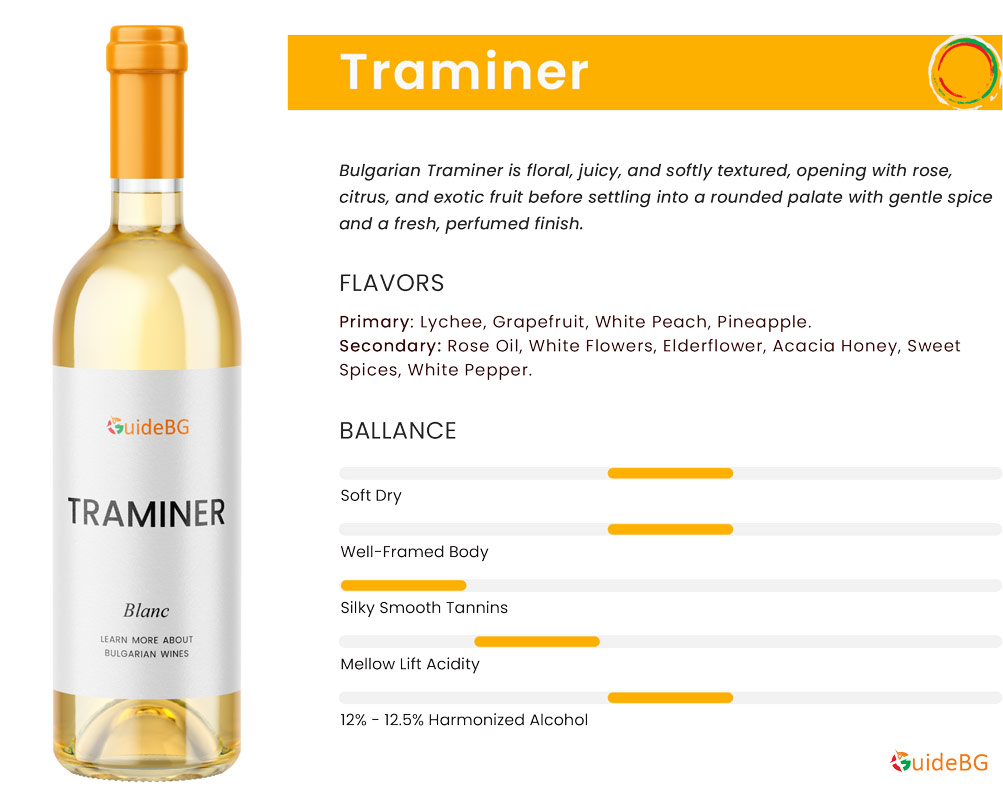
In style, Bulgarian Traminer is less about weight than about perfume and ease. A good bottle should smell of rose petals, white flowers, elderflower, grapefruit zest, peach, lychee, and a little sweet spice. The palate should feel juicy and rounded, but not sticky; fresh, but not sharp. That combination makes Bulgarian Traminer immediately friendly and very easy to understand, even for drinkers who do not usually chase aromatic whites.
Serving
8-10°C

Aroma white

no decanting

Most current Bulgarian Traminer listings simply recommend cold service, and that fits the style well. In practical terms, 8–10°C is the best window: cool enough to keep the wine lively, warm enough to let the rose, citrus, and spice notes open. That temperature range is an editorial inference from current Bulgarian serving guidance.
Food Pairing
Bulgarian Traminer is happiest with dishes that are fragrant, lightly spicy, or delicate in texture. Current pairing cues around Bulgarian bottlings point toward vegetables, seafood, fish, white meats, soft cheese, fruit-led plates, and exotic spices. In Bulgarian terms, I would happily pour it with grilled fish, prawns, zucchini fritters, fresh goat cheese, chicken with citrus and herbs, or a lightly spiced Asian dish. Those last pairings are my sommelier extension of the existing Bulgarian pairing pattern.
What to Look For?
Look for a pale straw-to-greenish-gold color, sometimes with faint steel, copper, or pinkish reflections, depending on the bottling. On the nose, the wine should move clearly through rose, white flowers, acacia, elderflower, grapefruit, lychee, peach, and soft spice. On the palate, the ideal bottle feels soft-dry, juicy, aromatic, and fresh, with a floral aftertaste rather than obvious sweetness.
Cellaring Potential
Most Bulgarian Traminer is best enjoyed young, with a vivid perfume and the fruit still feeling bright. Current retail and producer-facing listings consistently position these wines as drink-now bottles rather than long cellar projects. A practical drinking window is 1–3 years.
Blending Partners
Traminer also blends well in Bulgaria. Some winemakers combine it with Vrachanski Misket, and others use Traminer alongside Sauvignon Blanc and Pinot Gris in its white blends. That makes good sensory sense: Traminer contributes perfume and softness, while its partners bring lift, citrus, or extra line.
Breeding Background & Regional Context
For style calibration, Bulgarian Traminer sits very close to the Gewürztraminer / pink Traminer world. Plantgrape describes that family as relatively early-ripening, good at accumulating sugar, moderately acidic, and defined by rose and lychee aromas, while Tsarev Brod’s own wine is explicitly made from 100% Pink Traminer. That is why Bulgarian Traminer reads the way it does: floral, exotic, rounded, and softly spicy.
We can place Black Sea Traminer on the finer, fresher, more floral side, with a cleaner citrus line and less cellar makeup. Danubian Plain Traminer often feels a touch juicier and orchard-fruited. Smaller southern examples can show more rose, spice, and fruit sweetness. That regional sketch is an editorial inference drawn from current official regional descriptions and the available Bulgarian bottlings.
For style calibration, Bulgarian Traminer sits very close to the Gewürztraminer / pink Traminer world. Plantgrape describes that family as relatively early-ripening, good at accumulating sugar, moderately acidic, and defined by rose and lychee aromas, while Tsarev Brod’s own wine is explicitly made from 100% Pink Traminer. That is why Bulgarian Traminer reads the way it does: floral, exotic, rounded, and softly spicy.
Alternative Grapes
If this style speaks to you, move next to Riesling for more acidity and mineral cut, Muscat Ottonel for a gentler floral-fruit style, and Vrachanski Misket or Varna Misket for a more local Bulgarian aromatic accent. Those grapes already live in the same Black Sea and northern white-wine conversation as Traminer.