

Viognier is a French white grape, historically tied to the Northern Rhône, and in Bulgaria it has become a boutique but increasingly convincing variety, with notable expressions in the Danubian Plain, the Thracian Lowlands, smaller Struma sites, and selected Black Sea vineyards.
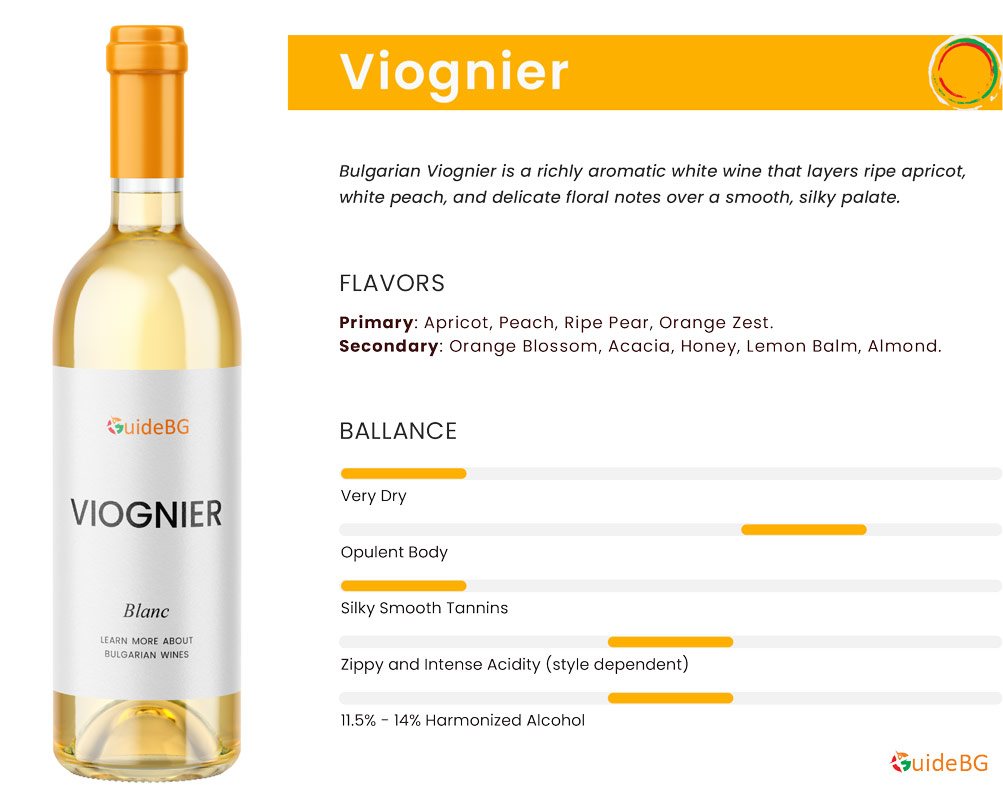
At its best, Bulgarian Viognier feels scented rather than heavy. The fruit usually leans toward apricot, ripe peach, pear, candied lemon peel, and white blossom, while cellar choices can add toast, vanilla, walnut, roasted almond, or a faint creamy sheen. In cooler or less worked examples, it stays fresher and more mineral; in richer southern bottlings, it becomes broader, more floral, and more textural.
Serving
Serve fresher examples at about 9–11°C, and richer barrel-fermented versions closer to 11–13°C. Viognier does not really need decanting, but a fuller bottle benefits from a few quiet minutes in the glass so the floral and stone-fruit aromas can unfurl.
9-11°C

Aroma white

no decanting

Food Pairing
Bulgarian Viognier pairs very naturally with grilled white fish, mussels, shrimp, roast chicken, poultry in cream sauce, rabbit, soft root vegetables, pumpkin, and yellow cheeses such as a good kashkaval. Because the grape carries both perfume and body, it also handles mild spice better than many Bulgarian whites, which is why it works so well with dishes that include ginger, sweet spice, or a touch of curry.
What to Look For?
Look for a wine with a pale lemon-to-gold robe, a nose centered on apricot, peach, pear, blossom, and citrus peel, and a palate that is rounder and more textural than Sauvignon Blanc. Better Bulgarian examples keep freshness under the fruit and often finish with mineral lift or a discreet, elegant bitter edge rather than anything obviously sweet.
Cellaring Potential
Most Bulgarian Viognier is at its most seductive in the first 2 to 4 years, when its floral perfume is still vivid. More serious oak-aged examples can comfortably stretch to 5 to 7 years, but the grape is generally more about aromatic charm and texture than very long evolution
Blending Partners
In Bulgaria, Viognier blends especially well with Chardonnay for breadth, Sauvignon Blanc for cut, and Tamyanka or Muscat for aromatic lift. That makes it a natural partner in modern white cuvées where perfume, flesh, and freshness all need to sit in balance.
Breeding Background & Regional Context
Viognier is not a Bulgarian-bred variety but an old French Vitis vinifera grape. In Bulgaria, it remains a comparatively small-scale planting rather than a traditional workhorse, yet it has found real footholds with quality-minded estates and experimental growers.
Danubian Plain
This is one of Viognier’s clearest Bulgarian homes. The grape is among the Danubian Plain’s main white varieties, and producers around Oryahovo describe the Danube hills as offering conditions reminiscent of the Northern Rhône. The style here often leans toward apricot, peach, citrus, white flowers, and a fresher, finer line.
Thracian Lowlands
In the Thracian zone, Viognier becomes broader and more opulent. Mogilovo shows a richer register of apricot blossom, candied lemon peel, honey-acacia nuance, toast, vanilla, and mineral persistence, while southern estates around the Eastern Rhodopes also bottle varietal Viognier with a distinctly warm-climate generosity.
Struma Valley
Struma remains smaller in scale for Viognier, but it is a promising landscape for the grape. Producers around Smochevo and Harsovo, along with organic estates farther south, show Viognier with peach, pear, citrus, herbs, honey, and a mineral line sharpened by altitude, slope, or diurnal swing.
Black Sea Coast
Pomorie proves that Viognier can also speak with a maritime accent. Black Sea Gold includes it in the Pentagram series as a grape capable of showing the mineral finesse of the Pomorian terroir, while catalogue tasting notes point to floral aromas, pleasant freshness, and an elegant, lightly bitter finish.
Alternative Grapes
For a similarly rounded Bulgarian white, reach for Chardonnay. For more overt perfume and floral intensity, Tamyanka is the natural aromatic cousin. For a crisper, more citrus-led profile, Sauvignon Blanc is the sharper stylistic neighbor. Red Misket sits somewhere between them, offering a softer local accent with a hint of fragrance.