

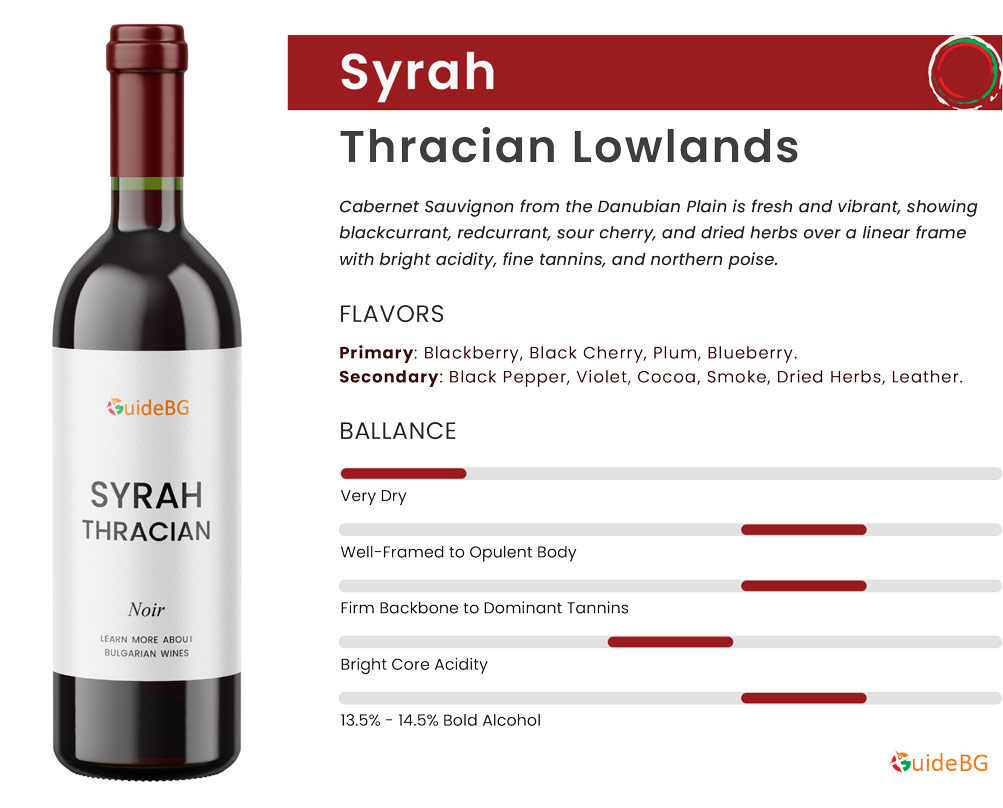
If Bulgarian Syrah has one flagship regional accent, it is this one. The Thracian Lowlands give the grape warmer shoulders, deeper colour, darker fruit, and a broader, more polished frame. In the glass, the style usually opens with blackberry, black cherry, plum skin, and blueberry, then moves into cracked black pepper, violet, smoke, cocoa, dried herbs, and a savoury finish that stays firm rather than sweet.
Syrah works in the Thracian Lowlands because the region gives the grape what it wants most: warmth, ripeness, and enough site character to stop the wine from becoming generic. Thracian Valley is the heart of Bulgarian winemaking, stretching around Plovdiv, Haskovo, and the Sakar Mountains. Inside that broad southern arc, estates such as Bessa Valley, Midalidare, Villa Velis, Rossidi, and Bratanov show just how naturally Syrah fits the landscape.
The best bottles feel settled. At first pour, Thracian Syrah usually shows a deep ruby-to-dark red colour and an immediate aromatic presence. The nose leans dark rather than red: blackberry, black cherry, plum, cassis, blueberry skin. Then the more interesting layers arrive — black pepper, violets, smoke, natural chocolate, dried thyme, sometimes a slightly meaty or olive-like savoury note. On the palate, the wine usually lands between medium-plus and full body. Tannins are ripe and clearly present. Acidity is not sharp, but the better wines keep enough freshness to stop the fruit from becoming lazy. That balance is exactly what makes the regional style convincing.
Syrah is the most persuasive international red style in southern Bulgaria today. It does not read like an imitation of northern Rhône austerity, and it does not need the glossy sweetness of warmer New World Shiraz either. Instead, it sits in a more attractive middle register: sun-ripened fruit, polished tannins, spice, and a firm savoury finish.
The style also carries more range than outsiders often expect. Bessa Valley can make Syrah look architectural and composed, shaped by clay-limestone soils and a refined oak regime. Midalidare gives the grape a broader, darker expression from Mogilovo, with black cherry, chocolate, smoke, and spice wrapped around a generous structure. Velis, from Karabunar, tends to speak with black cherry, cassis, pepper, and a more classically restrained reserve profile. In South Sakar, Bratanov shows another face entirely: more transparent to site, often more peppery, more herbal, and, in the Sans Barrique wines, more openly terroir-driven.
Serving
16-18°C

Standard red

30 – 60 min

Young, fruit-led Syrahs often open in the glass after a few swirls, but reserve or oak-aged wines benefit from decanting. Air lifts the pepper, violet, and black-tea notes, letting the dark fruit fall into place more naturally. The goal is not to soften the wine into sweetness; it is to give the structure room to breathe.
Food Pairing
Thracian Lowlands Syrah is built for the table. Producers repeatedly point toward barbecue pork, veal, lamb, mushroom dishes, hard cheese, mould cheese, dry-cured meats, roasted vegetables, and even richer gamey preparations. In Bulgarian terms, this is a beautiful wine for lamb chops with thyme, grilled pork neck, duck breast with plum sauce, kavarma with mushrooms, roasted red peppers, lukanka, grilled eggplant, and mature kashkaval. The wine’s peppery line, dark fruit core, and ripe tannins make it especially comfortable with smoke, char, and savoury fat.
A more polished, oak-shaped bottle can handle slow-cooked veal cheeks or venison. A fresher, less oaky South Sakar style can be brilliant with quail, turkey with chestnuts, or wild mushroom risotto. Some richer expressions even stretch toward dark chocolate at the end of a meal, but that works best when the wine keeps its savoury spine.
What to Look For?
Look first for colour and clarity of intent: deep ruby to dark red, sometimes with purple flashes in younger wines. Then look for a nose that moves cleanly from black fruit into spice: blackberry, black cherry, plum, blueberry, then pepper, violet, smoke, cocoa, herbs, and a hint of earth. On the palate, the wine should be dry, structured, and energetic, with ripe tannins and a finish that stays spicy and savoury.
I would avoid bottles where vanilla shouts louder than pepper or where the fruit feels confit and flat. The best Thracian Syrahs do not chase easy sweetness. They deliver dark fruit with tension, and oak should support that shape rather than perfume it.
Cellaring Potential
A safe editorial window is 3–5 years for fruit-led, earlier-drinking Syrahs, 5–8 years for serious oak-aged examples, and 8–12 years for more ambitious estate bottlings. Some top South Sakar wines can stretch comfortably beyond that. Bessa Valley gives its varietal Syrah an 8–12 year window; Midalidare lists 5 years for Grand Vintage Syrah and 2–4 years for Angel’s Share; Bratanov’s Syrah Sans Barrique 2021 is explicitly positioned for development through 2035.
What improves with time is not just softness. Good Thracian Syrah develops in layers: the fruit darkens, the pepper becomes finer, and notes of leather, tea leaf, tobacco, olive, and warm earth begin to emerge. A serious bottle should age into detail, not just mellowness.
Blending Partners
In the Thracian Lowlands, Syrah has very natural company. Cabernet Sauvignon sharpens the frame; Merlot rounds the middle; Petit Verdot adds colour and aromatic lift; Viognier can perfume the wine without weakening its spine. Bessa Valley’s Enira uses Syrah with Merlot, Petit Verdot, and Cabernet Sauvignon; Midalidare bottles Syrah with Cabernet Sauvignon; Bratanov works both Merlot & Syrah and Syrah & Viognier. Outside Bulgaria, grape authorities also note the classic Syrah–Viognier logic for adding finesse and aroma to red blends.
Breeding Context
Syrah’s success in the Thracian Lowlands begins with the grape itself. UC Davis identifies it as a French Vitis vinifera variety, the offspring of Dureza × Mondeuse blanche, while Plantgrape describes it as a quick-ripening grape with a relatively short optimal harvest window, capable of producing aromatic, tannic, age-worthy wines with fairly high alcohol and relatively low acidity. That profile explains why warm southern Bulgarian sites suit it so well, but only if growers pick with discipline.
Within the region, the terroir details are especially revealing. At Bessa Valley, Syrah occupies the upper parts of the hills on clay-limestone soils, with the influence of Rhodope winds and the Maritsa River helping preserve acidity and minerality. At Midalidare’s Dabovets vineyard in Mogilovo, the estate points to red clay soils rich in iron oxides, south exposure, 360–390 m altitude, and strong day-night amplitude. At Villa Velis in Karabunar, Syrah benefits from sandy, loamy soils that drain better than the more clay-rich parcels, and the estate keeps yields down, avoids irrigation, and ages reserves in French barrique.
South Sakar adds another regional accent. Bratanov describes its vineyards on the sunny hills near Shishmanovo and Harmanli as shaped by Maritsa-linked winds from the Aegean, creating an almost Mediterranean climate. The winery also leans into spontaneous fermentations and lower-intervention styles, which helps explain why some Sakar Syrahs feel especially vivid, peppery, and terroir-transparent.
So yes, the Thracian Lowlands are warm. But the important detail is not just warmth. It is the quality of ripening: sunlight, drainage, exposure, and enough temperature movement to keep the wine from becoming broad without definition. That is where the best regional bottles earn their authority.
Alternative Grapes
If this regional Syrah style speaks to you, move on to Mavrud for a more local, darker Thracian register, Rubin for another southern Bulgarian red with depth and spice, and Cabernet Franc for a more lifted, herbal, slightly stricter frame. Official tourism material already defines the Thracian Valley through varieties such as Mavrud and Rubin, while regional producers such as Midalidare and Bessa show how comfortably Syrah lives beside the Bordeaux family in the south. For a more Mediterranean, herbal, and slightly wilder expression of the grape, explore Syrah from the Struma Valley, where warmth and terrain shape a more savoury, black-tea-driven profile.