

This collaborative project is intended to reinforce students’ learning about Ancient Rome within the I&S curriculum in an engaging manner. It concludes the unit by allowing students to apply their knowledge and demonstrate ATL skills. By working together to “bring Ancient Rome to life,” students deepen their understanding and make personal connections to the material.
Time Allowed: 45 minutes
Test Instructions
Answer all questions in each part. For multiple-choice questions, circle the correct letter. For written responses, use full sentences and support your answers with facts. The collaborative task (Part D) shall be completed in small groups (in class or as homework, as instructed). This test assesses your knowledge of Ancient Rome and develops ATL skills, including thinking, communication, research, and collaboration. Good luck!
Part A: Multiple-Choice Questions (Knowledge & Understanding)
Circle the letter of the best answer for each question.
- Which of the following correctly describes the two main social classes of ancient Roman society?
A. Patricians were common farmers, and plebeians were the nobility.
B. Patricians were wealthy aristocrats, and plebeians were common citizens.
C. Patricians were all the citizens of Rome, and plebeians were enslaved people.
D. Patricians were military leaders, and plebeians were high-ranking priests. - The religion, art, and architecture of ancient Rome were greatly influenced by the culture of the ____.
A. Persian Empire
B. Carthaginians
C. Greeks
D. Egyptians - Why did the Romans establish a republic in 509 BCE?
A. To give all residents, including non-citizens, the right to vote on every law.
B. To allow the king and Senate to share power equally in governing Rome.
C. To ensure Rome could rapidly expand its territory without opposition.
D. To prevent any one person (like a king) from holding absolute power over Rome. - What engineering achievement did Roman engineers build to carry fresh water from distant hills into cities?
A. Aqueducts
B. Canals
C. Wells
D. Ditches - Which of the following was a major factor in the decline of the Western Roman Empire?
A. Strong, stable leadership by a series of capable emperors
B. A long period of peace and prosperity with no military threats
C. A powerful army that successfully defended all borders
D. Frequent invasions by barbarian (Germanic) tribes and outside forces - What was the basic unit of the Roman army, consisting of approximately 5,000 soldiers, called?
A. Phalanx
B. Century
C. Legion
D. Cohort
Part B: Source-Based Analysis (Critical Thinking)
Examine the following sources and answer the questions that follow. ATL skills: Thinking (analysis of sources), Research (information literacy), Communication (interpreting data).
Source A (Text): Excerpt from the Roman poet Juvenal (c. 100 CE) commenting on Roman society:
“…the mob that used to grant power, high office, the legions, everything, curtails its desires, and reveals its anxiety for two things only, bread and circuses.“
7a. What does the phrase “bread and circuses” mean in the context of ancient Rome? (Use Source A to explain what two things the Roman populace wanted, and why.)
7b. What does Juvenal’s comment suggest about the relationship between Roman leaders and the people? (Explain how Roman rulers kept the population satisfied and what the people neglected as a result.)
Source B (Map): Map of the Roman Empire at its height, c. 117 CE
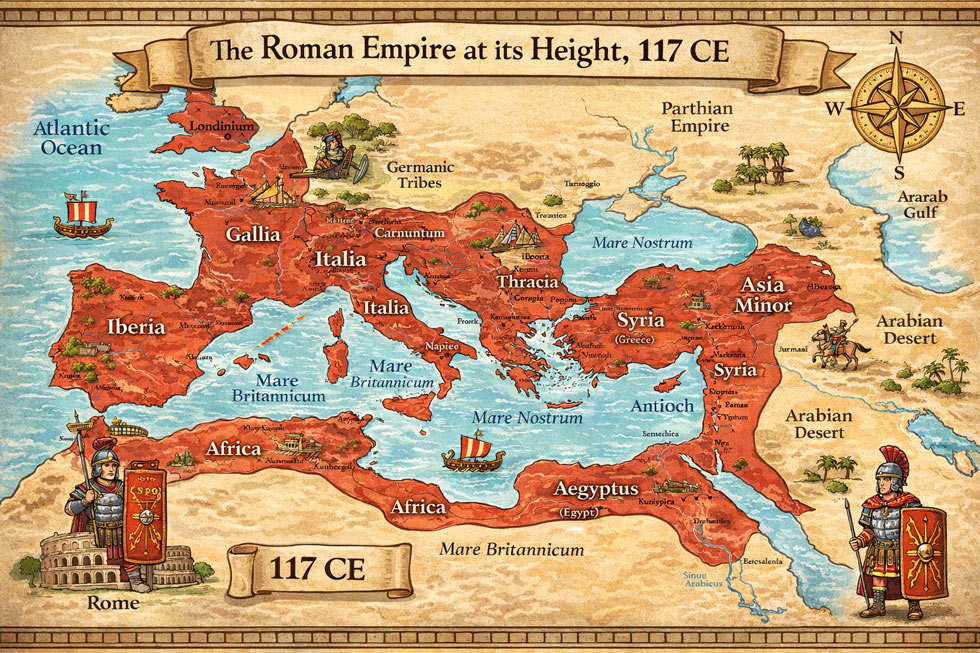
8a. Identify one modern country that was part of the Roman Empire at its height (as shown in Source B).
8b. Based on Source B, explain one challenge that the vast size of the Roman Empire might have posed to its rulers. (Think about governing, communication, defense, etc., across such a large territory.)
Part C: Short-Answer Question (Historical Reasoning)
ATL skills
Thinking (analysis, comparison), Communication (clear written response).
9. Comparing Roman Government Systems: In a short paragraph, compare the Roman Republic with the Roman Empire in terms of how each was governed and who held power. Identify at least two key differences between the Republican system of government and the Imperial system. (For example, consider leadership, citizen participation, and how decisions were made.) (Write 3–5 sentences.)
Part D: Collaborative Creative Task (Research, Communication, Collaboration)
This task will be done in small groups, either in class (after the written test) or as a short project. ATL skills: Research (gathering information), Communication (presenting findings), Collaboration (teamwork).
10. Roman Life & Legacy Group Project: Work in groups of 2–4 to explore an aspect of daily life or legacy of Ancient Rome and create a brief presentation or product to share with the class. Choose one of the following topics (or a similar teacher-approved topic):
- Daily Life: e.g., “A Day in the Life of a Roman” – illustrate daily routines, food, housing, education, or entertainment of average Romans. You could create a short skit role-playing a family in Rome, a diary entry from a teenager in Rome, or a poster showing the layout of a typical Roman domus (house) and activities.
- Achievements & Legacy: e.g., “Roman Innovations Museum” – showcase a key Roman achievement (roads, aqueducts, Roman law, the calendar, etc.) and explain its significance. For instance, create a mini-model or poster of a Roman aqueduct or the Colosseum, accompanied by an explanation of how it was used in ancient times and how similar ideas are used today.
- Government & Society: e.g., “Roman Senate Debate” – reenact a debate in the Roman Senate or an assembly, with each student playing a role (a consul, a senator, a plebeian tribune, etc.). Discuss an issue (like granting land to veterans or how to deal with a crisis) to demonstrate how the Republican political process worked and how different social classes might disagree.
Outcome: Each group will present their chosen topic in a 5-minute presentation (through a skit, speech, poster, model, or digital slideshow). Each group member should contribute to both the research and the presentation. Be creative and informative: include at least 3 facts from our Ancient Rome unit in your presentation. This task will build your research skills (finding and selecting relevant information), communication skills (presenting and explaining to an audience), and collaboration skills (working as a team).
Answer Key & Teacher Guidance
Part A: Multiple-Choice Answers (each 1 point)
- B. Patricians were the wealthy elite aristocrats, while plebeians were the common working citizens. (Patricians were the small class of noble families that initially controlled the Senate, whereas plebeians were the broader class of farmers, artisans, and merchants.)
- C. Greek culture. (The Romans borrowed heavily from the Greeks – for example, they adopted Greek gods (renaming Zeus to Jupiter, etc.), and Greek art/architecture styles like columns and statues. Persian, Carthaginian, and Egyptian cultures had some influences, but Greek influence was dominant in mythology, art, and architecture.)
- D. To prevent one person (a king) from having absolute power. (In 509 BCE, the Romans overthrew their last king (Tarquin the Proud) and set up the Republic, so no monarch could rule over them. They wanted a system where power was shared by elected leaders and the Senate, rather than a hereditary king.)
- A. Aqueducts. (Aqueducts were bridge-like water channels that the Romans built to carry fresh water from hills and mountains into cities. Canals and ditches were used in agriculture, and wells provided water locally, but the Romans’ major innovation for city water supply was the aqueduct.)
- D. Barbarian invasions. (One of the major reasons the Western Roman Empire fell was the pressure from invading tribes such as the Visigoths, Vandals, etc., which the Roman army struggled to repel. In contrast, options A, B, and C describe positive conditions (strong leadership, peace, strong army) which were not true in Rome’s final years – in fact, Rome had weak and corrupt leaders, economic troubles, and military defeats.)
- C. Legion. (The legion was the fundamental military unit of about 5,000 Roman soldiers. For example, Julius Caesar’s army in Gaul was composed of several legions. A century was a smaller unit of roughly 80–100 men led by a centurion; a cohort (about 480 men) was a division of a legion; a phalanx was a Greek infantry formation, not a Roman unit.)
Part B: Source Analysis Answers
Teacher Note: For source-based questions, student responses should combine information from the source with their own knowledge. The ATL thinking skill of interpreting and analyzing information is emphasized. High-achieving responses will also place the source in context or note its reliability/perspective.
7a. “Bread and circuses” refers to food and entertainment provided to the Roman populace as a distraction. In context, Juvenal suggests that Roman commoners cared primarily about being fed (bread) and entertained (circus games such as chariot races and gladiatorial contests). An expected answer will explain that Roman leaders kept the people satisfied with grain handouts and spectacular games, so the people stopped paying attention to politics or their civic duties. An advanced answer might add that this phrase criticizes how Romans relinquished their political power (their votes and voices in government) in exchange for superficial pleasures. Students at a higher level may note that emperors used free grain and gladiatorial games to maintain control over the masses – a form of public appeasement so that people wouldn’t revolt or demand more rights. (ATL: This question builds research/information literacy skills as students interpret the meaning of a historical quote, and critical thinking as they infer social commentary.)
7b. Juvenal’s comment suggests that Roman leaders maintained power by keeping the people happy with basic needs and entertainment, rather than by encouraging public participation in governance. An expected response will say that rulers (especially during the Empire) placated the populace with bread and circuses – for example, distributing free grain and hosting gladiator games – so that people would not complain about the government. This implies that people became dependent on government handouts and largely ignored politics. An advanced response might further discuss the relationship: Roman leaders understood that when people’s stomachs were full, and they were amused, they were less likely to protest or engage in state affairs. Thus, the government used entertainment and food as tools of control. Students might note that this reflects a loss of Republican ideals: citizens who once had the power to elect leaders in the Republic had, by the Empire, become politically disengaged. Juvenal criticizes both the rulers (for manipulating the populace) and the populace (for surrendering their responsibilities in exchange for pleasure). (ATL: This question develops critical thinking, prompting students to connect a primary source to historical circumstances, and communication skills in articulating the implications.)
8a. Students should name one modern country that was part of the Roman Empire shown on the map. The map (Source B) shows the empire covering most of Europe around the Mediterranean. Expected answers include (but are not limited to): Italy (the heart of the empire), Spain, France (then Gaul), Greece, Egypt, Turkey (Asia Minor), Tunisia or Libya (North Africa, where Carthage was), Israel/Palestine (Judea), Syria, Britain (England/Wales), etc. Any present-day country that lies within the highlighted area of the Roman Empire in 117 CE is correct. (ATL: This item checks content knowledge and map-reading.)
- Basic expected response: One correct country (e.g., “Spain was part of the Roman Empire”).
- Advanced response: One country plus additional detail (e.g., “Spain (the Roman province of Hispania) was part of the empire” or naming multiple examples). Extra detail is not required for full credit, but it shows deeper knowledge.
8b. One major challenge of the Roman Empire’s vast size was the difficulty of governing and defending such a large territory.
- An expected answer will identify a clear challenge, for example: “The empire was so large that communication was slow and it was hard for the emperor to send orders or respond quickly to problems far away,” or “The Roman Empire’s borders were enormous, making it difficult to defend against invasions on multiple frontiers.” Other acceptable basic points: the cost of maintaining roads and legions across great distances was very high; cultural differences across provinces made unity hard; or the empire became too large to manage effectively from one capital. Any one of these is sufficient for a correct answer.
- An advanced answer might combine or elaborate on these points, for example: “The vast size made it challenging to govern — messages could take weeks to travel, so decisions were delayed. It was also hard to enforce laws uniformly across such diverse provinces. Militarily, the empire struggled to defend its long borders (for instance, fighting Germanic tribes in Europe while also guarding against Parthians in the East stretched the legions thin). Overextension meant resources were drained, and local uprisings or invasions could not be addressed everywhere at once.” This response shows a deeper analysis of administrative and military difficulties, possibly noting that overexpansion was one factor in the empire’s eventual decline. (ATL: This question strengthens thinking skills by having students infer problems from a visual source and connect them to historical outcomes.)
Part C: Short Answer (Suggested length: one well-developed paragraph)
9. Roman Republic vs. Roman Empire – Key Differences:
- An expected level answer will identify at least two clear differences in governance between the Republic and the Empire. For example, a typical response: “In the Roman Republic, power was held by elected officials and institutions – two consuls (elected each year) led the government and had to share power, and the Senate (mostly aristocratic patricians) made laws. Ordinary citizens (plebeians) could vote for some leaders and had representatives called Tribunes to protect their interests. In contrast, under the Roman Empire, power was centralized under a single emperor who ruled for life. The emperor held ultimate authority over the laws, the military, and the provinces, and the Senate’s power and the people’s voice declined significantly. For example, Augustus (Octavian) became the first emperor and maintained the appearance of Senate authority but held absolute power over Rome.” This response addresses leadership (consuls vs. emperor) and the roles of citizens/Senate, meeting the requirement for two differences.
- An advanced answer will include the above and further detail or additional differences, showing a strong understanding of political structures:
- It might mention term limits and succession: e.g., “Republican officials like consuls served short, fixed terms (one year) and were expected to consult the Senate, whereas emperors often ruled for life and hereditary succession or violent power struggles decided the next ruler rather than elections.”
- It could note differences in citizen participation: “Citizen assemblies in the Republic voted on laws and magistrates (though women and slaves couldn’t vote), while in the Empire, those assemblies lost influence and citizens had little direct say in government.”
- It may also mention legal differences or examples: “During the Republic, the Twelve Tables and a system of checks and balances (like the veto power of Tribunes) kept any one group from dominating, but in the Empire the emperor’s word was law.” Advanced students might cite specific historical examples (e.g., comparing the Senate’s role under Cicero in the late Republic to its ceremonial role under Emperor Nero).
In summary, a strong answer highlights that the Republic was a form of representative government (though limited to male citizens) with separated powers, whereas the Empire was an autocracy where the emperor held supreme power. (ATL: This task builds critical thinking by requiring comparison and contrast, and communication, as students must clearly organize their points in writing.)
Part D: Collaborative Creative Task – Teacher Guidance
10. Roman Life & Legacy Group Project: This is an open-ended, formative task aimed at encouraging creativity, research, and teamwork. There is no single “correct” answer; instead, students will be assessed on their engagement, use of factual content, and demonstrated skills. Here’s what to expect and encourage:
- Content Expectations: Each group’s presentation should accurately include at least 3 factual points from the Ancient Rome unit related to their chosen topic. For example, if a group is portraying daily life, they might mention the foods commonly eaten (e.g., bread, olives), the use of public baths, or the structure of the family (paterfamilias). If focusing on an achievement like aqueducts or roads, they should explain what it is and how it benefited Roman society (e.g., “Aqueducts brought clean water to cities, supporting public baths and sanitation”). Ensure groups have facts correct (the teacher may need to review drafts or outlines).
- ATL Skills Developed: This project explicitly targets communication and collaboration. Students must communicate their ideas clearly in whatever format they choose – spoken (skit or speech), visual (poster/model), or written (dialogue, script, or descriptions). They must also work together, dividing tasks, listening to each other’s ideas, and combining their efforts into a single presentation (practicing social skills of teamwork). Additionally, students apply research skills by gathering information from class notes, textbooks, and library sources to develop their presentation. If done as homework, self-management (organization and time management) is also involved.
- Expected vs Advanced Outcomes: All groups should produce a coherent presentation with factual information:
- An expected level group product might demonstrate understanding of the topic, with facts drawn primarily from class materials. For example, a basic skit on daily life might feature characters discussing going to the Forum or the baths and eating bread, reflecting knowledge from the unit. The presentation is understandable and covers the main points, though it may rely closely on examples discussed in class. The group demonstrates cooperation (e.g., each member speaks) and basic creativity (perhaps simple props or a poster).
- An advanced-level group might go further by incorporating additional research or creative flair. For instance, an advanced group conducting the “Roman Senate Debate” might research a specific historical issue (such as the Gracchi brothers’ land reforms or the debate over Julius Caesar’s powers) and reenact it with nuanced arguments. A creative project on Roman achievements might include a hand-drawn map of Roman roads or a model aqueduct, and even draw connections to modern infrastructure (e.g., “Our modern roads/highways are similar to the Roman roads, which were first built to connect the empire”). The presentation would be polished and engaging (perhaps with costumes or interactive elements), and each student’s contribution would be clear and substantive. This level of work demonstrates not only knowledge but also initiative, deeper understanding, and high-level collaboration (effective role division and smooth teamwork).
- Teacher’s Role: Provide guidance on accurate content and ensure that each group’s plan is on track. You may allow a brief research phase in the library or on approved websites if time permits (to build ATL research skills). During presentations, use a simple rubric assessing content accuracy, creativity, clarity of communication, and teamwork. Praise students for teamwork and creative effort. (Optionally, peers can give feedback, which builds reflective and communication skills further.)

: MCQ, source analysis, short writing, and group task—plus differentiated answer key and ATL skills.)