

The Black Sea Coast is not Bulgaria’s loudest Cabernet territory, but it can be one of its most refined. The coastal expression is brighter-fruited, softer-lined, peppery, and lightly mineral, especially around Pomorie and the Varna/Byala orbit. That impression is consistent with the broader maritime framing of the coast, where sea influence moderates temperature and stretches the growing season.
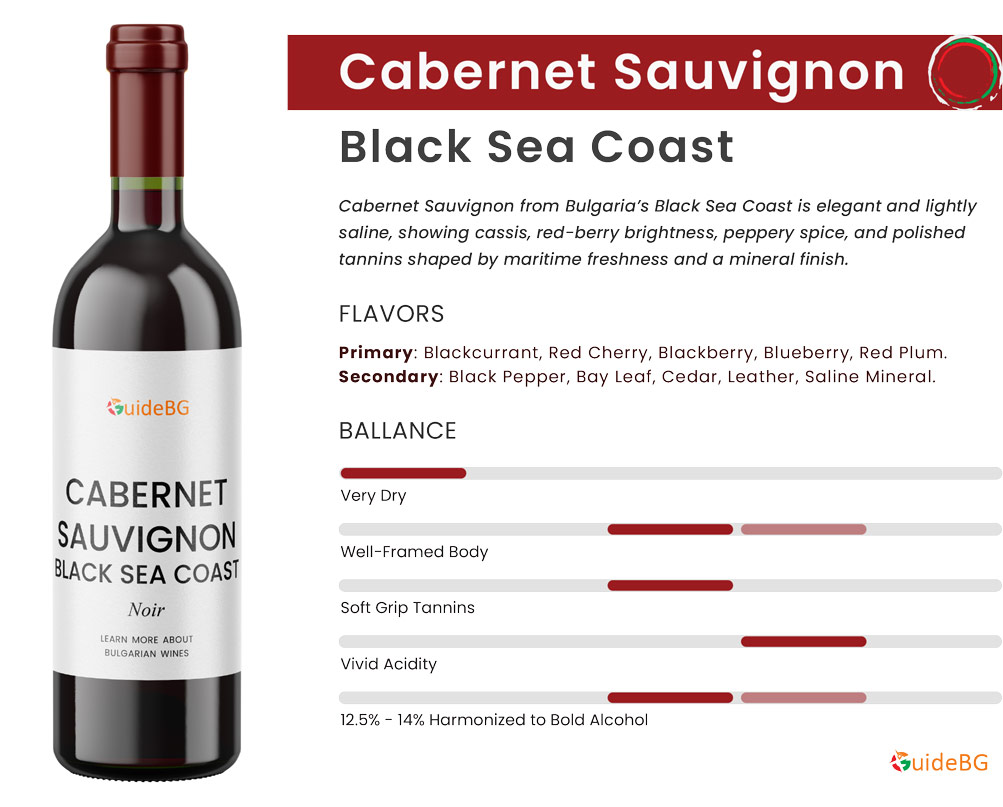
This style is built from two coastal dialects. On the northern coast, the Northern Black Sea is a region of moderate alcohol, balanced structure, and freshness, and its Cabernet Sauvignon is red-fruit driven, with dill, roasted pepper, velvety tannins, fresh acidity, and a long, cool finish. On the southern coast, the Pomorie PDO profile points to Cabernet-based reds with blackcurrant, blueberry, peppery spice, a firm tannic backbone, elegance, and minerality, rather than jammy weight, while some wineries emphasize fresh fruit, spice, finesse, and mineral character in their Pomorie reds.
In other words, this is not the Black Sea version of a thick, sun-swollen Cabernet. It is a more maritime, breezy, and polished Bulgarian expression: still unmistakably Cabernet in structure, but with less blunt force and more line, freshness, and aromatic lift.
Serving
15-17°C

Standard red

15 – 30 min

A slight chill works beautifully here. Compared with inland southern Cabernet, the coastal style reads fresher and less massive, so it does not require aggressive decanting. Young bottles are usually happiest with a short splash of air, while more serious barrel-aged examples can take a little longer to open.
Food Pairing
This is a lovely Cabernet for lamb chops, pork tenderloin, duck breast, grilled vegetables, burgers, sausages, mushroom dishes, and semi-soft to semi-hard cheeses. The tannins are present enough for meat, but the wine’s fresher coastal line also makes it more comfortable than inland Cabernet, besides roasted peppers, herb-led dishes, and lighter grills. The Northern coastal Cabernet pairs well with red and white meats, grilled vegetables, lamb, filet mignon, burgers, sausages, and soft cheeses, which fit the regional style very well.
What to Look For?
Look for a bright ruby-to-deep garnet color rather than sheer, opaque density. Aromatically, the best bottles move between cassis, red cherry, blackberry, blueberry, cracked pepper, bay leaf, and subtle leather or cedar, sometimes with a more unusual herbal accent such as dill or roasted pepper on the northern coast. On the palate, the wine should feel dry, polished, and fresh, with enough tannin to read clearly as Cabernet, but with a finish that turns cooler, spicier, and more mineral than heavy. In the strongest examples, there is a distinct sea-breeze impression, not salty in a literal sense, but lightly saline and lifted.
Cellaring Potential
Most Black Sea Coast Cabernets are best over about 3–6 years, while the fruit is still vivid and the maritime freshness remains fully alive. Better-made reserve or barrel-aged bottles can go 6–10 years, especially when the wine has the patient oak-and-bottle élevage.
Blending Partners
On the coast, Cabernet Sauvignon’s most natural partner is Merlot, which rounds the mid-palate and softens the edge without erasing freshness. Cabernet Franc and Syrah (Thracian) also make good sense here, adding aromatic lift, pepper, or darker spice depending on the house style. Some wineries already work with a Cabernet Sauvignon & Merlot blend, while other coastal red programs include Cabernet Sauvignon alongside Merlot, Syrah, Cabernet Franc, and Pinot Noir.
Breeding Context
The coast slows Cabernet down just enough to make it more articulate. On the northern Black Sea, Odessos describes a region with warm summers, mild winters, breezes, about 2080–2250 hours of sunlight, around 450 mm of annual rainfall, and soils of chernozem, limestone, and gray forest, all of which are favorable for balanced ripening. On the southern coast, Pomorie combines long, gentle autumns, about 4000°C heat accumulation over the growing season, sandy-loam and limestone-rich soils, and low elevations, mostly under 200 meters, with an evening maritime influence that helps retain acidity and aroma. Together, these conditions explain why coastal Cabernet tends to show ripe skins, clear fruit, preserved freshness, and finesse rather than raw mass.
Alternative Grapes
If you enjoy this coastal Cabernet style, the first Bulgarian comparison is Black Sea Coast Merlot, softer, rounder, and more immediately supple, but shaped by the same maritime polish. From there, Pamid and Gamza take you toward lighter, redder-fruited, more relaxed Bulgarian reds, while northern coastal Pinot Noir offers another elegant route with less tannin and more perfume. For a broader view of the grape, explore Cabernet Sauvignon from the Thracian Lowlands, the Danubian Plain, and the Struma Valley, where the style shifts from bold and structured to fresh and vibrant, and then into lush, herbal expressions.