


How to Write an IB I&S Essay
A quick, ATL-powered guide for Individuals & Societies
Need more detail, worksheets, and model answers?
See the Full PDF Guide: IB I&S Essay + ATL
What “good” looks like
A strong IB I&S essay shows:
- Clear answer to the question (thesis)
- Focused paragraphs (one main idea each)
- Specific evidence + explanation (facts, case studies, data)
- Logical structure (intro → body → conclusion)
- Academic tone + correct terms
- Basic citations (as required)
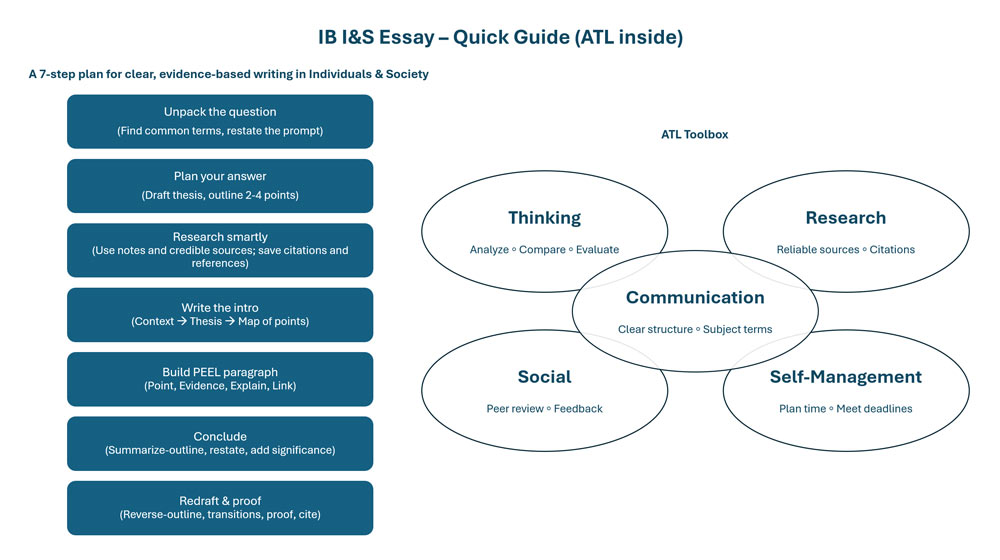
The 5 ATL skills (your toolbox)
- Thinking: analyze, compare, evaluate
- Research: find and judge reliable info
- Communication: write clearly, structure well
- Social: seek feedback, peer review
- Self‑Management: plan time, meet deadlines
The 7‑Step Plan (follow this every time)
1) Unpack the question (Thinking)
- Circle command terms: explain, analyze, compare, evaluate, to what extent…
- Rephrase the prompt in your own words. List what you must cover.
2) Plan your answer (Thinking + Self‑Management)
- Draft a working thesis (your one‑sentence answer).
- Outline 2–4 body points that prove it. Drop in your best evidence.
3) Research smartly (Research)
- Start with class notes/textbook → add 2–3 credible sources.
- Save exact facts/data/quotes + where you found them (for citations).
4) Write the intro (Communication)
- 1–2 lines of context → restate the question → thesis → brief “map” of points.
5) Build PEEL paragraphs (Communication + Thinking)
- Point (topic sentence)
- Evidence (specific fact/example/quote)
- Explain (how it proves your point—the why)
- Link (back to thesis / to following paragraph)
6) Conclude (Communication)
- Summarize your main points (no new evidence).
- Restate the thesis in a stronger form.
- Add a short so‑what (significance/implication).
7) Redraft & proof (Self‑Management)
- Reverse‑outline: Does each paragraph support the thesis?
- Add transitions; check rubric; fix grammar/format; cite sources.
Mini‑example (I&S history)
Question: What were the main causes of the Industrial Revolution?
Thesis (one sentence):
Britain’s Industrial Revolution grew mainly from agricultural innovation, accessible coal, and capital‑backed inventions that multiplied production.
One PEEL paragraph (sketch):
- P: Agricultural innovation freed labor and increased food supply.
- E: Crop rotation and the seed drill boosted yields; enclosure consolidated farms.
- E: Surplus food → population growth; fewer farm jobs → urban workers for factories.
- L: Thus, improved agriculture set the foundation for rapid industrialization.
See the Full PDF Guide for a complete model outline, sample evidence, and a marked paragraph.
Quick checklists
Before you write
- I underlined command terms
- I drafted a clear thesis
- I chose 2–4 strongest points + evidence
While you write
- Each paragraph has one idea + specific evidence
- I explain why each fact matters (analysis)
- I use correct I&S terms (e.g., urbanization, reform, resources)
Before you submit
- I answered the exact question
- Intro + body + conclusion are present
- Citations/refs as required, spelling/grammar checked
Common fixes (fast)
- Vague thesis → make it specific: “X and Y were most significant because Z.”
- Fact‑dump → add “This shows that…” to explain the evidence.
- Wandering paragraph → rewrite the topic sentence to match the thesis.
- No time → write a tight intro + 2 PEEL paragraphs + conclusion.
Time guide (class or exam)
- 5 min: unpack question + plan
- 25–30 min: draft intro + 2–3 PEEL paragraphs
- 5–10 min: conclusion + quick proofread
Reuse‑ready templates
Thesis frames
- Although A and B contributed, X was more significant because…
- The main causes were X, Y, and Z, since…
PEEL starter
- One key factor was… (Point)
- For example,… (Evidence)
- This matters because… (Explain)
- Therefore,… (Link)

 isn’t just listing facts—it’s building a clear, evidence‑based argument. A 7‑step plan and maps)