

Storgozia is one of the most distinctive modern Bulgarian red grapes, created in 1976 at the Institute of Viticulture and Enology in Pleven from Buket × Villard Blanc and named after the ancient Roman-era name Storgosia associated with Pleven. It is widely described as a high-fertility, stress-tolerant Bulgarian breeding variety with resistance to mildew, grey mould, powdery mildew, and low winter temperatures.
In style, Storgozia feels unmistakably northern Bulgarian. It tends to give dry reds with bright acidity, juicy red and dark fruit, moderate structure, and a smoky-herbal undertow, rather than the broad-shouldered weight of hotter southern varieties. The Danubian Plain is a source of fresher, fruitier reds fits Storgozia very naturally, especially around Pleven and the wider northern belt.
Serving
15-17°C

Standard red

Short decant

Serve Storgozia at 15–17°C. That range keeps the fruit bright, the acidity alive, and the smoky spice in focus. A short decant of 15–20 minutes suits younger bottles, especially examples with a little oak. A current commercial bottling from Vidinska Gamza recommends the same serving window and notes 6 months in French oak, which makes that gentle aeration especially sensible.
Food Pairing
Storgozia belongs with food that welcomes freshness and spice rather than brute force. It works beautifully with duck breast, roast pork, lamb meatballs, mushroom kavarma, grilled aubergine, roasted peppers, and mature Kashkaval cheese. Its vivid acidity cuts through roasted fat, while the tannins stay gentle enough for paprika, herbs, and earthy vegetables.
What to Look For?
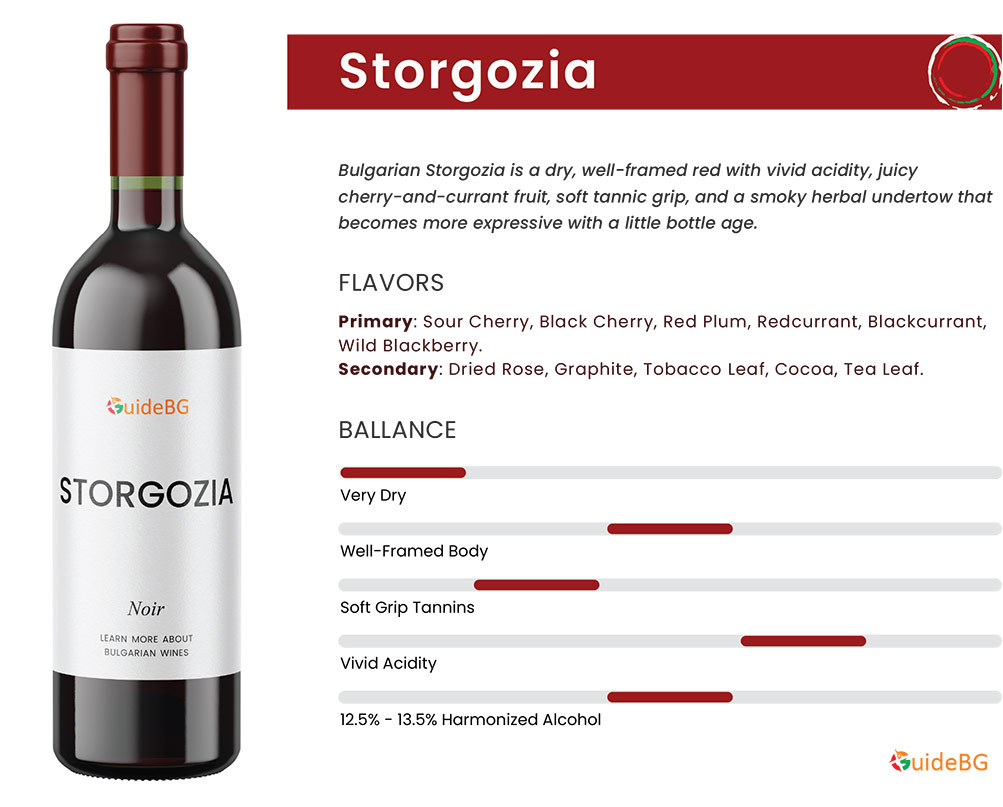
Look for a bright ruby to deep ruby colour, a palate driven by juicy cherry and currant fruit, and a finish shaped by freshness, light smoke, spice, and a faintly earthy or herbal note. The best examples should feel energetic and extracted, but not heavy. Pleven research describes the wines as dense, fresh, intensely red, and fruity, while commercial and critical notes add soft tannins, ruby colour, and a more layered bouquet of cocoa, tobacco, graphite, and dried floral notes.
Cellaring Potential
Storgozia is not a fragile early-drinking red, but neither is it usually a monumental long-haul cellar wine. The safest editorial placement is medium-term ageing: around 3 to 5 years for most good bottles, with stronger examples going a little longer. That view is supported by research on ageing potential, noting that the wine’s taste clearly improves after about 1-1.5 years, while a Decanter-reviewed 2018 bottling was given a 2022–2025 drinking window.
Blending Partners
Editorially, Storgozia is convincing enough on its own to deserve single-varietal treatment. In blends, though, it can play a very useful role: it brings freshness, colour, and a juicy fruit core. In a Bulgarian context, the most natural partners would be Gamza for a lighter northern expression, Merlot for extra roundness, or Cabernet Sauvignon for more frame and depth
Breeding Background & Regional Context
Storgozia comes from the Pleven school of grape breeding, which aimed to produce varieties that could combine wine quality, stable fertility, and better resistance to disease and winter stress under Bulgarian vineyard conditions. That purpose is still visible in the grape today: it is practical in the vineyard, but not anonymous in the glass. It was bred for real northern conditions, not only for laboratory neatness.
Its most natural home remains Northern Bulgaria, especially the Danubian Plain and the wider Pleven orbit. The Danubian zone is temperate-continental, with cold winters, hot summers, and soils including chernozem and grey forest soils. In that setting, Storgozia’s resistance and freshness make deep sense. It behaves like a northern Bulgarian red: vivid, fruit-led, and more shaped by lift than by raw mass.
Alternative Grapes
For readers who enjoy Storgozia, the first local comparison is Gamza, which offers a lighter and more delicate northern red style. The second is Kaylashki Rubin, another Pleven-linked breeding variety, usually a little denser and darker in profile. For an international comparison inside Bulgaria, Pinot Noir is the nearest in terms of freshness and finesse, though Storgozia is darker, smokier, and more structured.