

A food price is not born on the supermarket shelf. It travels there.
It begins with land, seeds, feed, water, labor, fuel, machinery, weather risk, and, very often, debt. But by the time a loaf of bread or a bottle of sunflower oil reaches the consumer, the farm-gate value is only one part of the final price. The rest is built layer by layer: processing, packaging, storage, traders, importers, transport, retailer operations, taxes, and, increasingly, risk.
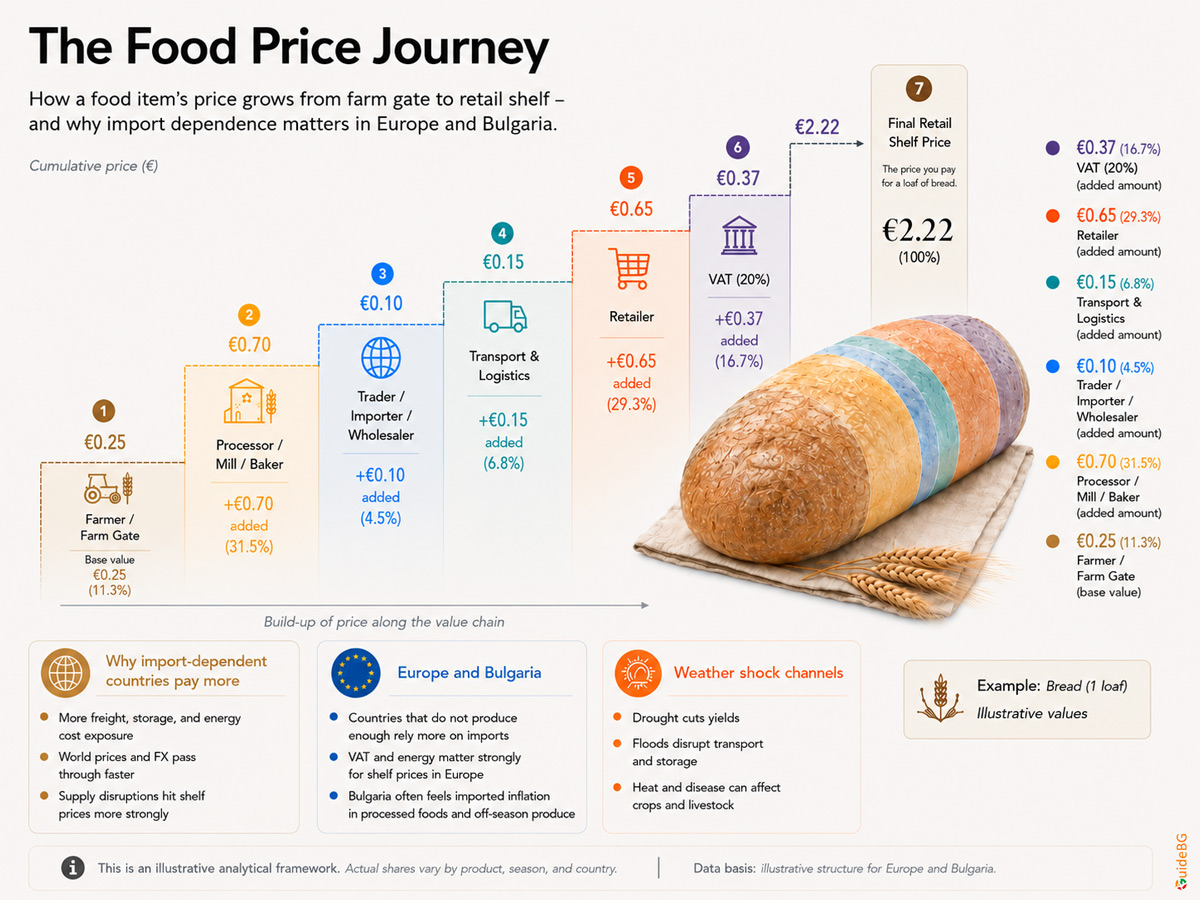
That is what the two infographics show. The bread example makes the point sharply: in an illustrative €2.22 loaf, the farm-gate component is only about €0.25, or roughly 11% of the shelf price. The processor, mill, or baker adds about €0.70 more, while the retailer layer adds another €0.65. VAT then adds €0.37 because a 20% VAT rate amounts to around 16.7% of the final VAT-inclusive shelf price.
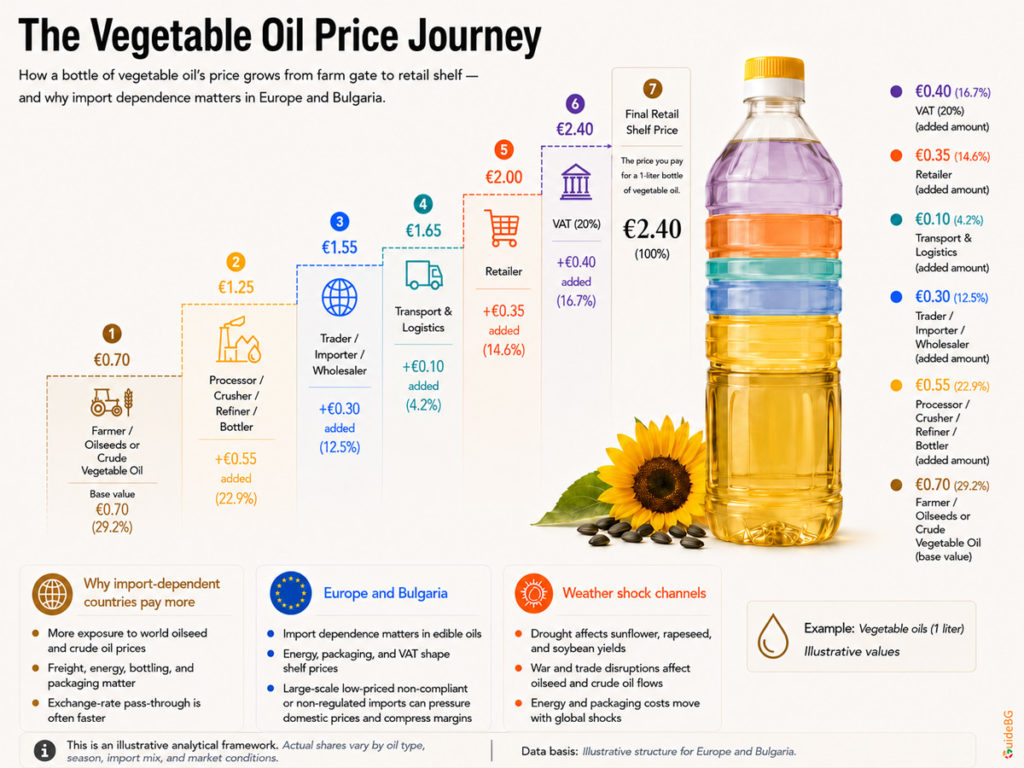
The sunflower oil example is different but follows the same logic. A €2.40 bottle begins with a larger raw-material base — oilseeds or crude vegetable oil at about €0.70, or 29% of the final price. But crushing, refining, bottling, trading, logistics, retail, and VAT still make up most of what the consumer pays.
This is why food inflation often feels unfair. Farmers and landowners carry heavy production risk, but the price power often shifts downstream. Landowners may benefit from higher rents when agricultural prices rise, while farmers face higher fertilizer, fuel, labor, and credit costs. Producers then pass into a chain where processors control capacity, traders control access and timing, and retailers control shelves, visibility, promotions, and final consumer pricing.
Recent global data show why these chains matter. FAO’s food price index in March 2025 was still about 21% below the March 2022 peak, but it was 6.9% higher year-on-year. Vegetable oils were especially volatile, rising 3.7% in one month and almost 24% year-on-year, driven by demand and prices for palm, soy, rapeseed, and sunflower oils. Weather adds another shock channel: analysts have linked sharp moves in sunflower oil to drought pressure in Bulgaria and Ukraine, while coffee, cocoa, and other food commodities have also been hit by extreme weather.
Retail margins have become a political issue across Europe. Hungary even introduced a 10% markup cap on selected staples, a move later challenged by the European Commission, highlighting how sensitive the retail layer has become in public debate. But the retail layer is not pure profit: it includes rent, staff, refrigeration, spoilage, promotions, financing, losses, and logistics. The real question is not simply “who is greedy?” but where bargaining power sits.
For import-dependent countries, the chain is even more exposed. When a country does not produce enough of a product, it incurs not only the product’s price but also freight costs, exchange-rate risk, global commodity volatility, and supply disruptions. Alternative sourcing helps: local contracts, producer cooperatives, direct procurement, diversified import origins, and transparent origin labeling can reduce dependency. But low-priced non-compliant or non-regulated imports can also distort the market: they may temporarily lower prices while compressing margins for domestic producers that follow higher standards.
The shelf price is therefore not a single number. It is a map of power, risk, and distance. These infographics make that hidden journey visible.
Related Reads:
Short Sources & Methodology Disclaimer: This article and the infographics are illustrative analytical frameworks, not product-specific audits or official margin calculations. The examples illustrate how food prices may increase from the farm gate to the retail shelf through production, processing, trading, logistics, retail operations, and VAT. Actual shares vary by product, season, country, import mix, energy costs, packaging, contracts, spoilage, promotions, and market power. Retail “margin” here refers to a broad retail layer, not net profit. Import dependence is considered a general risk factor because it can increase exposure to freight costs, exchange rate fluctuations, global commodity prices, weather-related shocks, and supply disruptions. References to non-regulated or non-compliant imports are general market-risk considerations, not claims about specific companies. The content is for informational and analytical purposes only, not for legal, tax, financial, regulatory, or commercial advice.