

Look at a church in Bulgaria, and you are often looking at more than one century at once. A ruined basilica may belong to the Roman and early Byzantine world. A small stone church with almost no exterior drama may hide one of the richest fresco cycles in the country. A mountain monastery may combine medieval memory, Ottoman-period survival, and 19th-century National Revival confidence.
This guide explains the main church types you will see in Bulgaria, how to recognize them, and where to look for good examples.
Before we start: style, period, and place are not the same thing
Bulgarian churches do not fit neatly into one architectural label. Many were destroyed, rebuilt, extended, repainted, or restored. A monastery may have a medieval foundation, a 19th-century church, 17th-century frescoes, and modern conservation. A medieval town such as Nessebar may contain early Christian ruins, Byzantine-style churches, and later painted interiors within a few streets.
So the best way to read Bulgarian church architecture is not as a rigid list of styles. It is a field guide to layers.
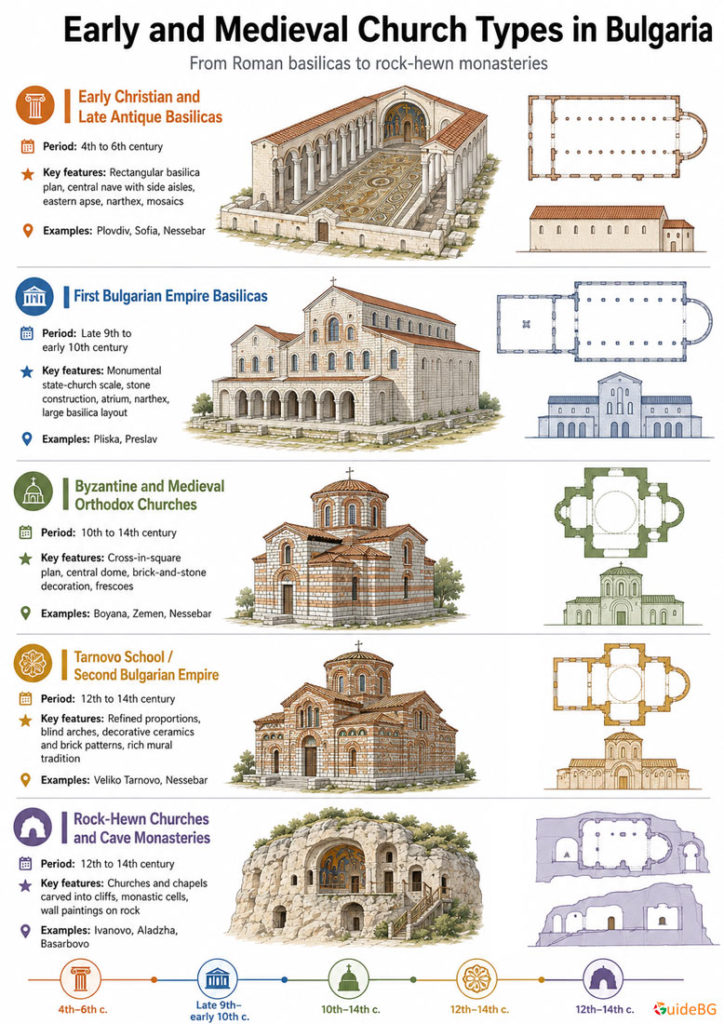
Early Christian and Late Antique basilicas
Period: 4th to 6th century
Look for: long rectangular plans, central nave, side aisles, eastern apse, narthex, mosaics
Examples: Plovdiv, Sofia, Nessebar
This is the oldest Christian architectural layer visible in Bulgaria. These churches belong to the Late Antique world, when cities such as Philippopolis, Serdica, and Mesembria were part of the Roman and early Byzantine cultural sphere.
The key form is the basilica: a long hall divided by columns, usually ending in a semicircular apse. The best visual clue is the floor. In places such as Plovdiv, the surviving mosaics are not decorations added to a church. They are the church’s main surviving voice.
The Bishop’s Basilica of Philippopolis in Plovdiv is one of the strongest examples. Official visitor material describes it as a three-nave, single-apse building from the 4th to 6th century, with mosaic floors covering more than 2,000 square meters.
First Bulgarian Empire basilicas
Period: late 9th to early 10th century
Look for: monumental scale, stone construction, large basilica layouts, atrium, and narthex
Examples: Pliska, Veliki Preslav
After the Christianization of Bulgaria in the 9th century, church architecture became part of state-building. The old capitals of Pliska and Preslav were not only political centers. They were also places where Bulgaria’s new Christian identity was made visible in stone.
The Great Basilica of Pliska is the emblem of this layer. Pliska was the capital of the First Bulgarian Empire from 681 to 893, and the basilica complex near it became one of the major monuments of early medieval Bulgarian Christianity.
These churches are often ruins today, but their scale is the message. Even when only the foundations and wall lines survive, they reveal a very different ambition from that of the compact medieval churches of later centuries.
Byzantine and medieval Orthodox churches
Period: 10th to 14th century
Look for: compact plans, central domes, cross-in-square layouts, brick-and-stone decoration, frescoes
Examples: Boyana, Zemen, Nessebar
The medieval Orthodox church is more intimate than the basilica. Instead of a long hall, you often get a compact, domed interior. The plan may be cross-in-square, with a central dome and a clear east-facing altar zone.
Boyana Church near Sofia is one of the most famous examples of this layer. UNESCO describes the church as having wall paintings from several periods, including the 11th, 13th, 15th to 17th, and 19th centuries, with the 13th-century layer being of outstanding artistic value.
For visitors, the outside may seem modest. The real drama is often inside: saints, donors, biblical scenes, and carefully organized fresco cycles that turn a small space into a painted theological world.
Tarnovo School and the Second Bulgarian Empire
Period: 12th to 14th century
Look for: refined proportions, blind arches, decorative brick and ceramic patterns, rich mural tradition
Examples: Veliko Tarnovo region, Ivanovo, Nessebar
The term “Tarnovo School” is especially important for painting, but it also helps visitors understand the cultural confidence of the Second Bulgarian Empire. This was the period when Tarnovo became one of the major Orthodox cultural centers of the Balkans.
Architecturally, look for decorative brickwork, blind arches, ceramic ornamentation, elegant proportions, and a strong relationship between the building and the painting. Nessebar is one of the best places to see this decorative medieval layer. The Christ Pantocrator Church in Nessebar is dated to the 13th to 14th century and is described by the local museum as one of the best-preserved medieval churches in the town, with rich exterior articulation and three eastern apses.
This is not a “large building” style. It is a style of precision: pattern, rhythm, color, and compact sacred space.
Rock-hewn churches and cave monasteries
Period: mainly 12th to 14th century
Look for: chapels carved into cliffs, monastic cells, frescoes painted directly on rock
Examples: Ivanovo, Basarbovo
Some Bulgarian churches are not built upward. They are cut inward.
The rock-hewn churches and cave monasteries belong to a monastic world of cliffs, cells, chapels, and silence. Their architecture is partly natural and partly carved. The result is neither a standard church nor a simple cave, but a sacred landscape.
The Rock-Hewn Churches of Ivanovo are the most famous example. UNESCO describes the Ivanovo group as a complex of chapels, churches, monasteries, and cells, comprising historical monuments from the 13th and 14th centuries and connected to the artistic culture of the Second Bulgarian State. Another UNESCO text notes that the first hermits dug out cells and churches there during the 12th century, while the 14th-century murals are linked to the Tarnovo School of painting.
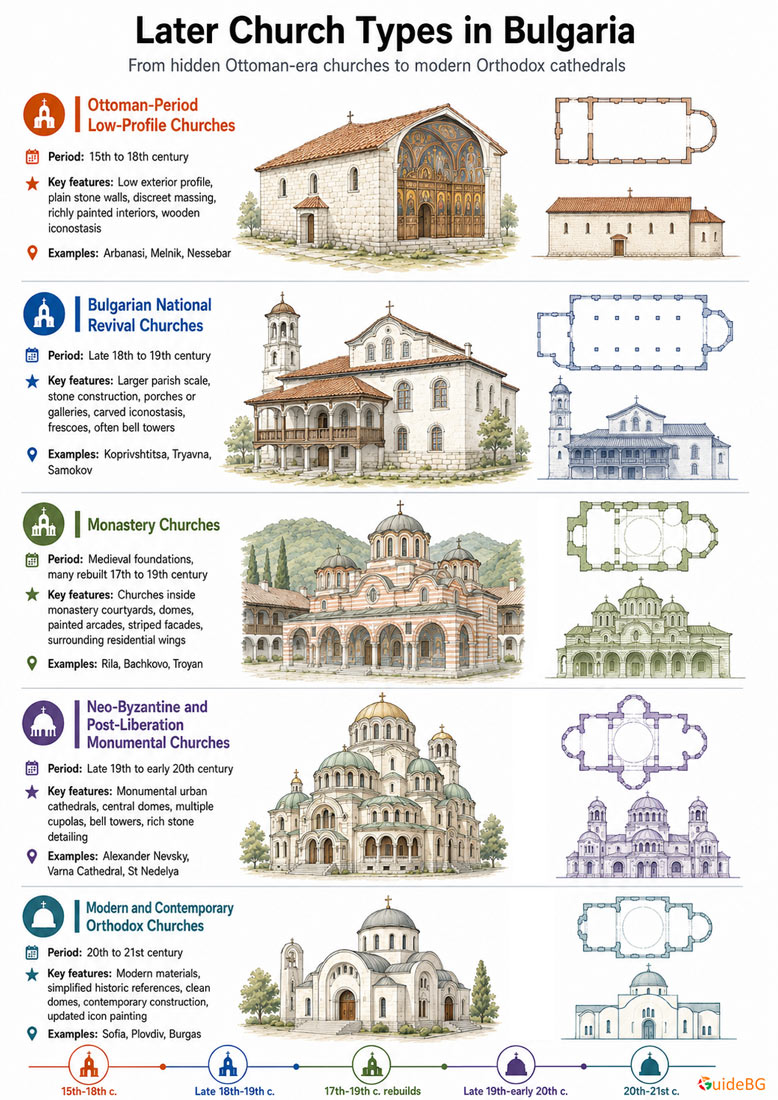
Ottoman-period low-profile churches
Period: 15th to 18th century
Look for: low exterior profiles, plain stone walls, small windows, discreet massing, richly painted interiors
Examples: Arbanasi, Melnik, Nessebar
Many churches from the Ottoman period are quiet on the outside and overwhelming on the inside. Their exteriors can look almost defensive: low, stone-built, modest, and closed. Step inside, and the walls may be completely covered with frescoes.
Arbanasi is the classic place to understand this contrast. The Church of the Nativity in Arbanasi was built in stages, and the oldest layer of wall paintings is dated to the end of the 16th century. Another Arbanasi church, St Dimitar, includes a 16th-century chapel and was completed in 1621.
This is one of the most rewarding styles for travelers. The outside gives almost nothing away. The inside tells the story.
Bulgarian National Revival churches
Period: late 18th to 19th century
Look for: larger parish scale, stone construction, porches or galleries, carved iconostasis, frescoes, bell towers
Examples: Koprivshtitsa, Tryavna, Samokov, Bansko
The Bulgarian National Revival was not only a political and literary awakening. It was also an artistic and architectural one. Churches became larger, more confident, and more visible. Woodcarvers, icon painters, and builders from regional schools such as Tryavna, Samokov, and Bansko shaped the visual language of the period.
A National Art Gallery overview notes that the Revival period was associated with the renovation and construction of many churches and monasteries, and that the second half of the 18th century saw the development of major Revival art schools, including Tryavna, Samokov, and Bansko.
The key object inside is often the iconostasis. In some Revival churches, the carved wooden screen is as important as the architecture itself.
Monastery churches
Period: medieval foundations, many rebuilt or expanded from the 17th to the 19th century
Look for: churches inside monastery courtyards, painted arcades, domes, striped façades, and surrounding residential wings
Examples: Rila, Bachkovo, Troyan
A monastery church is not just a building. It is the center of a protected world. Around it are residential wings, cloisters, gates, towers, kitchens, schools, libraries, and mountain or valley landscapes.
Rila Monastery is the visual icon. UNESCO states that it was founded in the 10th century by St John of Rila, destroyed by fire at the beginning of the 19th century, and rebuilt between 1834 and 1862.
Bachkovo shows a different monastic layer. UNESCO’s tentative list entry notes the importance of the 12th- to 14th-century Holy Archangels church, the 17th-century refectory, and the preserved 17th-century murals in the main monastery church.
This is why monasteries are difficult to date in one line. They are living complexes, not frozen monuments.
Post-Liberation monumental churches
Period: late 19th to early 20th century
Look for: monumental urban scale, central domes, multiple cupolas, bell towers, stone detailing
Examples: St Alexander Nevsky Cathedral, Varna Cathedral, St Nedelya
After the liberation in 1878, church architecture became a public statement. New urban cathedrals were not hidden or defensive. They were monumental and symbolic, and were placed in major city spaces.
St Alexander Nevsky Cathedral in Sofia is the clearest example. The official cathedral site states that its cornerstone was laid in 1882 and describes it as the largest Orthodox temple on the Balkan Peninsula. The cathedral is widely described as Neo-Byzantine, a style that uses domes, arches, monumental massing, and historic Orthodox references to create a national urban symbol.
For visitors, this is the easiest type to recognize: large domes, broad façades, urban squares, and a strong sense of national memory.
Modern and contemporary Orthodox churches
Period: 20th to 21st century
Look for: modern materials, simplified historic references, clean domes, contemporary construction, updated icon painting
Examples: Plovdiv, Sofia, Burgas, and newer residential districts
Modern Orthodox churches in Bulgaria usually do not reject tradition. They simplify it. You still see domes, apses, iconostases, and fresco programs, but the materials, proportions, and construction techniques are modern.
Some are modest parish churches in new neighborhoods. Others are larger symbolic projects. The style varies widely, but the pattern is clear: contemporary churches continue the Orthodox visual language while adapting it to new urban settings.