

Cabernet Sauvignon is one of the defining international red grapes of modern Bulgaria. It is grown across the country’s north–south wine axis, with strong expressions in the Danubian Plain, the Thracian Lowlands, the Black Sea Coast, and the Struma Valley. Its national importance was reinforced by large post-war plantings of international varieties, and Suhindol in particular helped build the foreign-market reputation of Bulgarian Cabernet in the late 20th century.
Note: The profile below is a composite overview of Cabernet Sauvignon as expressed across Bulgaria. It blends characteristics of the Thracian Lowlands, the Danubian Plain, the Black Sea Coast, and the Struma Valley. The regional Cabernet articles further sharpen those differences.
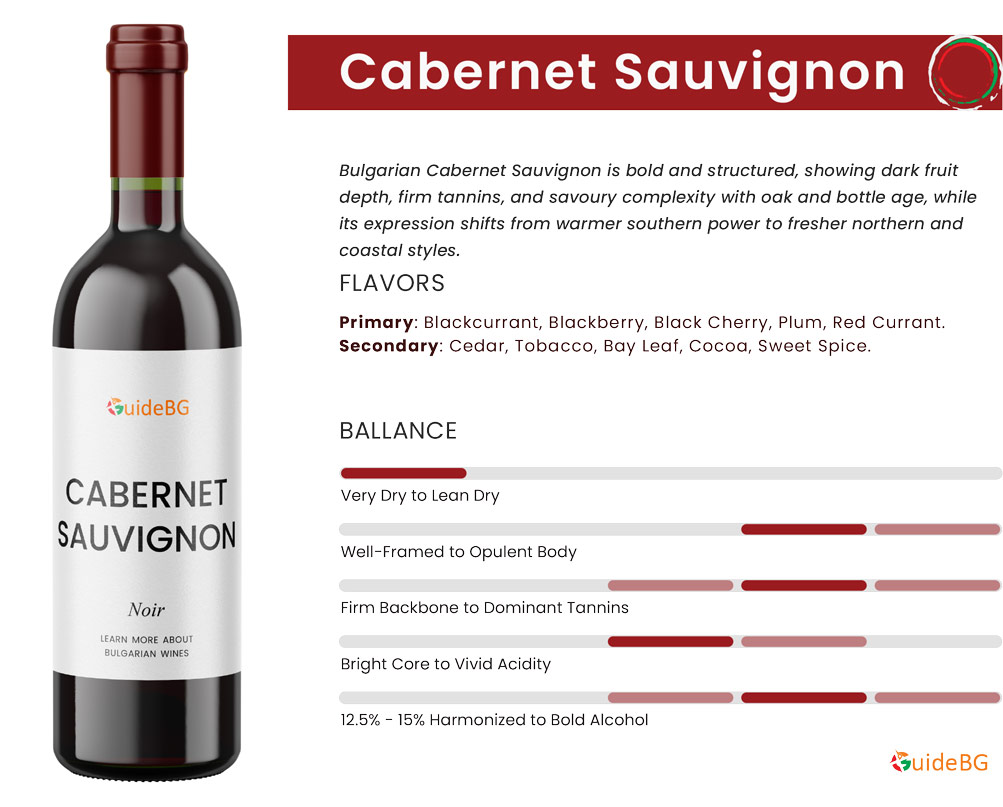
Though it is born in Bordeaux, Bulgarian Cabernet does not feel like a copy of Bordeaux. In the glass, it usually moves through blackcurrant, blackberry, dark cherry, cedar, tobacco, dried bay leaf, and sweet spice, with firmer tannins and more frame than Merlot. Warm southern sites push it toward darker fruit, fuller body, and oak-friendly depth, while northern and coastal sites can make it fresher, straighter, more aromatic, and occasionally lightly mineral.
Serving
16-18°C

Standard red

30 – 60 min

Serve Bulgarian Cabernet Sauvignon at 16-18°C in a standard red wine glass. Young, concentrated, or oak-aged bottles usually benefit from half an hour or more of air. Fresher northern or coastal examples can be served with only a short decant.
Food Pairing
Bulgarian Cabernet Sauvignon is happiest at the table with grilled beef, lamb, duck, venison stew, kapama, mushroom kavarma, stuffed peppers with minced meat, roasted aubergine, and mature kashkaval. Its tannic spine loves protein, and its cassis, cedar, tobacco, and dried-herb profile sits beautifully beside smoke, paprika, char, and slow-cooked sauces.
What to Look For?
Look for a deep ruby-to-garnet color and a nose centered on blackcurrant (cassis), blackberry, and dark cherry, often layered with cedar, tobacco leaf, dried herbs, and subtle spice. On the palate, Bulgarian Cabernet Sauvignon should feel dry, structured, and firmly framed, with noticeable tannins and a balanced acidity that keeps the wine lifted rather than heavy.
In warmer southern expressions, expect riper fruit, fuller body, and a broader, more powerful finish, while northern and coastal styles show brighter fruit, fresher acidity, and more aromatic precision. In well-made examples, the wine evolves beautifully with air, revealing cocoa, leather, and earthy nuances, especially in oak-aged or bottle-aged wines.
Cellaring Potential
A safe editorial placement for fruit-forward, everyday Bulgarian Cabernets is about 3–5 years. Reserve or oak-aged examples, especially from stronger, southern- or northern-structured sites, can comfortably develop for 6–10 years, sometimes longer, gaining notes of dried black fruit, tobacco leaf, cedar chest, leather, and savoury forest-floor nuance. The age-worthy side of the grape is particularly clear in Stambolovo, Varbitsa, Suhindol, and stronger Pomorie bottlings.
Blending Partners
In Bulgaria, Cabernet Sauvignon works both as a varietal wine and as a structural backbone in blends. Its most natural partner is Merlot, which rounds the mid-palate and softens the tannic grain. It also pairs convincingly with Mavrud and Rubin when a producer wants more local character, with Pamid when extra frame is needed, and with Melnik-linked varieties in the southwest when the goal is a more herbal, spicy, regionally inflected red.
Breeding Context and Regional Expressions
Cabernet Sauvignon is French in origin, and DNA work identified it as the offspring of Cabernet Franc and Sauvignon Blanc. In Bulgaria, it has become more than an imported grape: it has influenced local wine style and even local grape breeding. The clearest example is Melnishki Rubin, a Bulgarian cross of Shiroka Melnishka Loza and Cabernet Sauvignon, created to fuse Cabernet’s structure with the spicy, earthy southern identity of Melnik.
The beauty of Bulgarian Cabernet lies in how clearly it changes shape from one zone to another.
Thracian Lowlands — bold and structured. In the warm south, Cabernet takes on a broader shoulder: cassis, blackberry, ripe black cherry, plum, tobacco, cedar, and sweet spice. Tannins are firm, the body is full, and the oak can feel very natural rather than imposed. This is the most powerful and classically “Bulgarian Cabernet” expression.
Danubian Plain — fresh and vibrant. Northern Bulgaria brings more continental lift. Cabernet here can show blackcurrant, redcurrant, sour cherry, dried herbs, pepper, and a more linear, energetic palate. Even when structured, it tends to feel brighter and less sun-soaked than the southern styles. Suhindol and Varbitsa remind us that northern Cabernet can still be serious and cellar-worthy.
Black Sea Coast — elegant and saline. Along the coast, moderated heat and a longer autumn season tend to preserve freshness and polish. Around places like Pomorie and the Varna/Byala orbit, Cabernet can show brighter fruit, softer lines, peppery spice, and a lightly mineral, almost sea-breeze-like impression rather than sheer mass. It is one of the more graceful Bulgarian dialects of the grape.
Struma Valley — lush and herbal. In the southwest, Cabernet gains a warmer Mediterranean accent. Expect darker fruit, dried thyme, bay leaf, tobacco, spice, and a more generous texture. It rarely reads as severe. Instead, the wine often feels southern, herbal, and sun-bathed, especially when Cabernet enters blends with Melnik-family varieties.
For a lighter, fresher expression of the grape, explore Cabernet Sauvignon Rosé, where structure gives way to bright red fruit, citrus lift, and a more immediate, food-friendly style.
Alternative Grapes
If you enjoy Bulgarian Cabernet Sauvignon, the first local grape to try is Mavrud for comparable depth and ageing ability, but with a more distinctly Bulgarian soul. Rubin is the next natural step if you want dark fruit with more spice and floral lift. Merlot offers a rounder, softer, more immediately generous profile, while Melnishki Rubin brings a southwestern accent of herbs, earth, and spice that many Cabernet drinkers find deeply satisfying.