

If the Thracian Lowlands give Bulgarian Cabernet a broader chest, the Danubian Plain gives it more line. Northern Bulgaria is cooler and more temperate than the south, and the Danubian expression adds more of blackcurrant, redcurrant, sour cherry, dried herbs, pepper, and a more energetic, linear palate. Even when the wines are structured, they usually feel brighter and less sun-soaked than their southern counterparts.
This is also one of the few Bulgarian macro-regions where Cabernet carries real historical weight. Suhindol helped build the foreign-market reputation of Bulgarian Cabernet, while Varbitsa and Lozitsa show just how central the grape became in the north: both PDOs authorize only Cabernet Sauvignon, although Lozitsa today is much more a regulatory-historical name than an active commercial appellation.
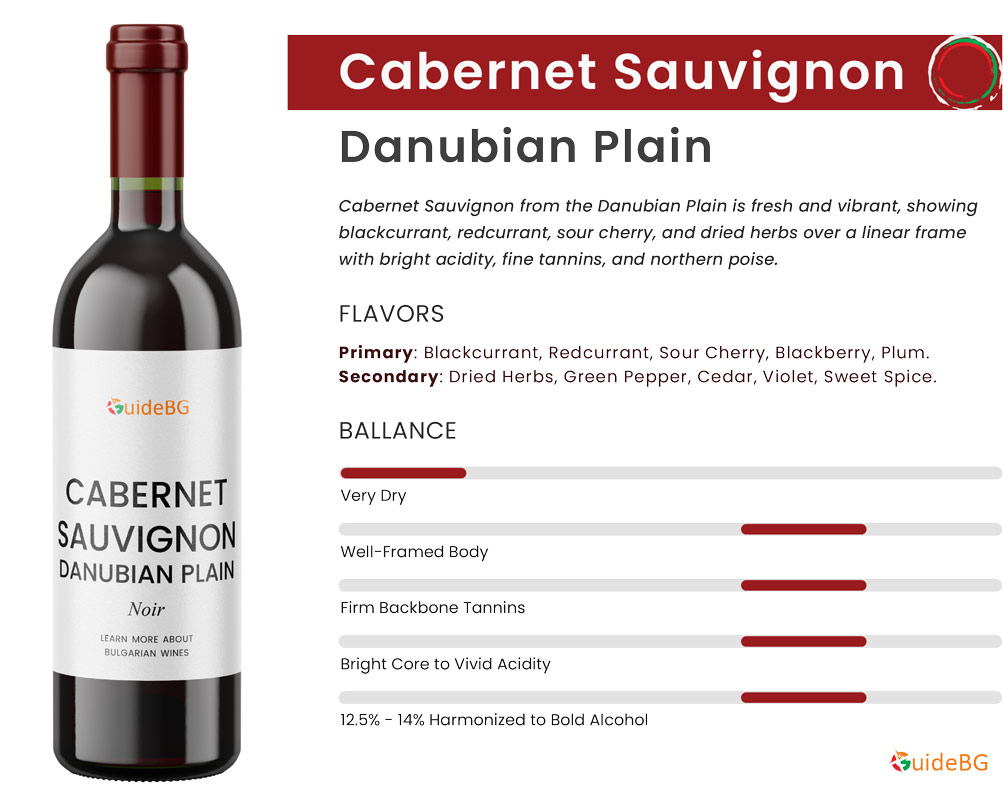
In the glass, the style often feels like Cabernet with a northern breeze in its shoulders. Some wineries define this northern Bulgarian wine through the 3F’s — freshness, fruitiness, and finesse; some northern Cabernets are herb-scented and elegant, while others prove that the Danubian Plain can still ripen Cabernet into serious blackcurrant fruit, violet, plum, spice, oak, and age-worthy structure.
Serving
15-17°C

Standard red

15 – 30 min

This style does not usually need the long, forceful decanting of a dense southern Cabernet. A short opening is enough for younger bottles, while oak-aged or reserve examples can take a little longer. Some wineries recommend 15–17°C for their northern Cabernet, while others recommend serving it at 16–18°C, which makes a regional window of 15–17°C feel exactly right.
Food Pairing
Danubian Plain Cabernet is a beautiful partner for roast pork, grilled beef, leg of lamb, game, ceps, and other mushroom dishes, and mature hard cheeses. The region’s fresher line makes the wine less heavy at the table than many warmer-climate Cabernets, but the tannins still want protein and roasted depth. Some wineries recommend pairing Cabernet with roasted meat, ceps, lamb, and hard cheese, while others point toward red meat, game, and long-aged cheeses.
What to Look For?
Look for a deep ruby-to-garnet color, then a nose that moves between cassis, redcurrant, sour cherry, blackberry, dried herbs, pepper, and cedar. On the palate, the wine should feel dry, firm, and upright, with enough tannin to read unmistakably as Cabernet, but with a fresher, more chiselled finish than the broader Thracian style. In the better bottles, air brings out violet, chocolate, vanilla, or gentle tobacco-like savoury notes without losing the region’s defining lift.
Cellaring Potential
A safe editorial window is about 4–7 years for fruit-led, everyday Danubian Cabernets. More ambitious, oak-raised bottles can go 8–12 years, sometimes longer. Varbitsa and Suhindol are age-worthy northern references, and some wineries go even further by listing over 15 years of maturation potential for some selected Cabernet Sauvignon editions. That ceiling will not apply to every bottle, but it clearly shows that northern Bulgaria can produce serious cellar-worthy Cabernet.
Blending Partners
In the Danubian Plain, Cabernet Sauvignon’s most natural partners are Merlot and Cabernet Franc. Many wineries have long worked the Cabernet–Merlot direction, while others in the Cabernet Sauvignon & Cabernet Franc direction, and still others will continue with Cabernet-led cuvées, showing how well Cabernet Franc sharpens aromatics and Merlot rounds the mid-palate. This is classic northern-blend logic: Cabernet gives the spine, Franc gives lift, Merlot gives breadth.
Breeding Context
Danubian Cabernet is shaped by a temperate-continental climate with warm sunny summers, cold winters, and enough diurnal movement to preserve line and aroma. Suhindol sits at roughly 230–350 m on chernozem over clay-limestone marl; Varbitsa at around 100–240 m on loess, chernozem, and grey forest soils; Lozitsa (a rere find Cabernet) brings Danube influence, 550–650 mm rainfall, and about 3700–4100 GDD; and Seven Generations adds the detail of a warm Danube slope where breezes create a 10–15°C day-night shift over black soil, clay, and limestone.
Alternative Grapes
If you enjoy this northern Cabernet style, start with Gamza for a lighter, juicier Danubian red with more red-berry charm and less tannic grip. Then try Storgozia for another distinctly northern Bulgarian expression built on bright acidity and a smoky-herbal undertow. Danubian Plain Merlot is the softer and rounder cousin: less architectural than Cabernet, but shaped by the same cooler northern cadence.
For a broader perspective on the grape, explore the other Bulgarian Cabernet Sauvignon expressions, from the bold, structured Thracian Lowlands to the elegant Black Sea Coast and the lush, herbal Struma Valley styles, each offering a distinct regional interpretation of Cabernet.