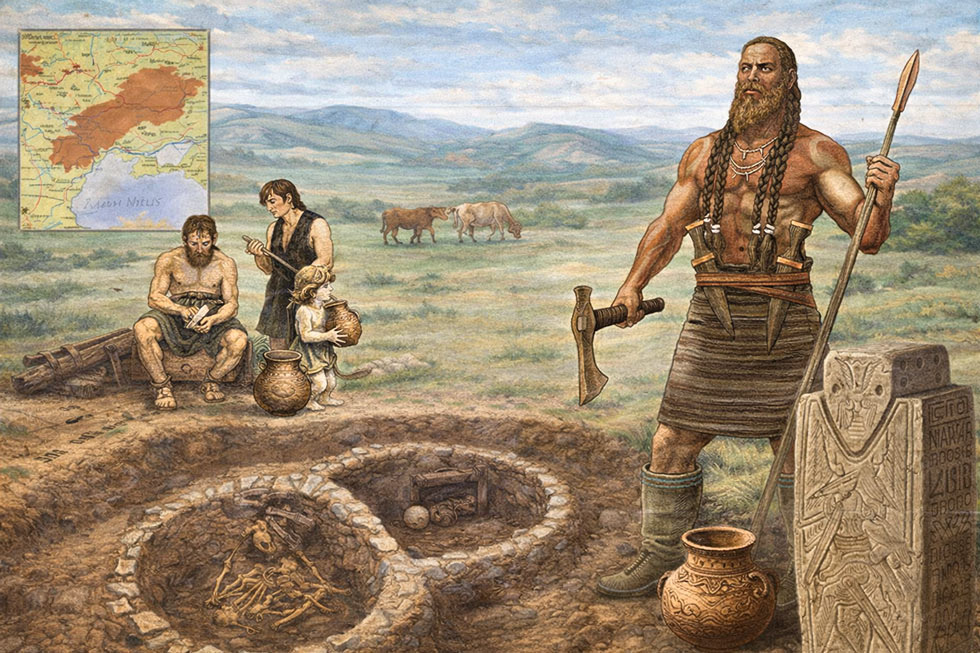

If you’ve ever wondered why one book says “Yamnaya” while another insists on “Pit Grave,” you’re not looking at bad history. You’re looking at how archaeology works across borders, languages, and research traditions.
Prehistoric “cultures” are modern labels. Archaeologists group sites together when they share recurring patterns in pottery, settlement life, burials, tools, and symbols. The people themselves did not call their world “Vinča,” “Karanovo,” or “Hamangia.” Those names derive from typological sites, national scholarly traditions, and, at times, from stratigraphic phases at key tells.
This article explains why naming discrepancies occur in Balkan and Bulgarian prehistory and provides a practical set of “translation rules” and synonym pairs. For the broader framework of how cultures, complexes, and phases are structured in GuideBG, see “How to Classify Bulgaria’s Prehistoric Cultures.”
A key idea: not all “names” refer to the same kind of thing
A big source of confusion is that archaeological terms can refer to different levels:
- A site/context (e.g., a cemetery with a datable series)
- A phase in a tell sequence (e.g., “Karanovo VI”)
- A regional culture label (e.g., “Hamangia”)
- A supra-regional complex/horizon (e.g., “KGK VI”)
- A phenomenon/interaction sphere (e.g., “Varna phenomenon”)
- A transition band (archaeological labels that intentionally blur boundaries)
When two authors use different names, they may not be disagreeing about “what existed” — they may be using different labels for different scales of the same reality.
How archaeological names are created
Most culture names come from one of four sources:
1) Type-sites and first discoveries
Many labels are place names: a key site was excavated first, the pattern was recognized there, and the site-name became shorthand.
Examples: Karanovo, Starčevo, Vinča, Hamangia, Ezero, Cucuteni, Trypillia.
2) National research traditions
Because archaeology developed inside modern states (and academic schools), neighboring countries sometimes name the same horizon differently. Later, cross-border syntheses either:
- Adopt one label,
- Merge labels into a composite, or
- Keep multiple names, but clarify their equivalence.
3) Stratigraphic phases that become regional terms
At long-lived tells, layers are numbered and become reference sequences. Those phase labels can drift into wider usage, so one author uses a phase name while another uses a regional culture name for roughly the same horizon.
This is one of the most common sources of “false disagreement.”
4) Composite names and abbreviations
Hyphenated names are often a solution, not a problem: they signal that scholars recognize unity across borders while preserving the different national labels.
Once composite names become standard, they often get abbreviations (useful — but opaque to newcomers).
Why does the same horizon get different names
Naming differences typically come from:
- Parallel discovery: similar material is excavated in different countries and named locally.
- Language and transliteration: the same term appears with different Latin spelling; diacritics may be dropped.
- Different classification scales: some scholars prefer broad “horizons/complexes,” whereas others divide into local cultures and groups.
- Different boundary definitions: “late phase of X” in one tradition becomes “early phase of Y” in another.
- Translation vs transliteration: some names are translated into English (“Pit Grave”), others are transliterated (“Yamnaya”).
This isn’t academic pedantry. Names shape how readers interpret maps, dates, and “influence.” If you don’t recognize synonyms, you can mistakenly treat one network as two separate cultures.
Period vocabulary also varies: Eneolithic vs Chalcolithic vs Copper Age
One of the most frequent “naming disputes” is not a culture name at all, but the period label:
- Chalcolithic = “Copper Age” (often preferred in Balkan syntheses)
- Eneolithic = often used in parts of Eastern Europe as a near-equivalent term
- Some authors also use Final Neolithic for horizons; others place it in “Early Chalcolithic”
Key examples connected to Bulgaria
Starčevo, Körös, Criș (SKC)
These are essentially regional labels for the same Early Neolithic farming horizon. “Starčevo” is common in the central/western Balkans, “Körös” in parts of Hungary, and “Criș” in Romania.
You will often see Starčevo–Körös–Criș (SKC) used explicitly to avoid false separations.
What it refers to: Early Neolithic farming horizon in the Balkans and Lower Danube.
| Label | Commonly used by | Why |
|---|---|---|
| Starčevo | Serbian and Western Balkan scholarship | Named after the Serbian type-site |
| Körös | Hungarian scholarship | Named after sites in Hungary |
| Criș | Romanian scholarship | Romanian regional designation |
| SKC | Cross-border syntheses | Used to signal one broad horizon across regions |
Vinča and the Vinča–Karanovo interface
“Vinča” is the major Neolithic tradition centered in today’s Serbia, with a strong influence on northwestern Bulgaria. In overlap zones, authors may write Vinča–Karanovo (or “interface”) to signal entanglement rather than forcing a hard border between labels.
Boian vs Marița / Maritsa (and “Giulești–Marița”)
In Lower Danube frameworks, Boian is a major label; in Bulgarian-facing traditions, parts of the same broad horizon are sometimes discussed with Marița/Maritsa terminology (and you will also see the composite “Giulești–Marița”).
This is a classic example of “same horizon, different school,” often used for synchronism rather than implying two separate cultures.
Karanovo: “sequence” vs “culture” vs phase labels
“Karanovo” can mean three things in different texts:
1) the tell site (type-site),
2) the Karanovo sequence (a chronological backbone),
3) a broad shorthand “Karanovo culture” in older or simplified summaries.
Within it, phase labels such as Karanovo V or Karanovo VI can be used either as strict stratigraphic terms or as broader horizon labels. Always check whether the author is describing a layer or a regional world.
KGK VI: Gumelnița, Kodžadermen, Karanovo VI
This is one of the most important cross-border naming cases for Bulgaria.
- Romanian literature often uses Gumelnița
- Bulgarian literature historically used Kodžadermen in some regions
- Karanovo VI is the phase label in the tell sequence for Thrace
Many works use the composite form Gumelnița–Kodžadermen–Karanovo VI, often abbreviated KGK VI, to indicate that these names denote closely aligned components of a single Late Chalcolithic system.
Varna I cemetery vs Varna “culture” / Varna phenomenon
“Varna” can mean:
- a specific cemetery (Varna I) — a datable, high-quality context
- a broader regional phenomenon (“Varna culture,” “Varna group,” “Varna horizon”) — an interpretive label for a particularly rich coastal expression of the Late Chalcolithic world
GuideBG deliberately keeps these conceptually distinct (site-level anchor vs broader construct), even though both naturally lead readers into the same Varna article.
Bubanj–Sălcuța–Krivodol (BSK) and spelling variants
For the late Copper Age/transition band, you’ll see a familiar pattern:
- Serbian-facing traditions: Bubanj
- Romanian: Sălcuța (often written without diacritics as Salcuța/Salcuta)
- Bulgarian: Krivodol
The hyphenated composite Bubanj–Sălcuța–Krivodol complex (often shortened to BSK) signals a cross-border complex rather than three isolated entities.
Cucuteni–Trypillia: Cucuteni, Trypillia, Tripolye/Tripolie
This is one culture with several names reflecting language and transliteration traditions:
- Romanian scholarship: Cucuteni
- Ukrainian: Trypillia
- Older Russian-influenced literature: Tripolye / Tripolie
- Modern cross-border writing often prefers Cucuteni–Trypillia
Yamnaya / Yamna / Pit Grave / Ochre Grave
This is the classic translation case:
- Yamnaya / Yamna = transliteration variants
- Pit Grave = English translation of the underlying meaning (“pit” burials)
- Ochre Grave = older descriptive nickname linked to burial practice (red ochre)
These refer to the same broad steppe horizon that becomes important for Bulgarian prehistory through contacts, burials, and mobility in the wider region.
Coțofeni and Kostolac
In northwestern Bulgaria and the neighboring regions, Romanian and Serbian terminologies often converge in cross-border syntheses. You may see Coțofeni, Kostolac, or a paired form such as Coțofeni–Kostolac when authors discuss overlapping or closely aligned expressions.
Cernavodă / Cernavoda (and “Cernavodă I”)
Sometimes the “discrepancy” is simply diacritics or phase notation:
- Cernavodă vs Cernavoda
- Cernavodă I is a phase label that may be used as a shorthand for a wider horizon in some texts
Quick synonym map (reader-friendly)
| GuideBG primary label | Also appears as | Why it varies / what it signals |
|---|---|---|
| Starčevo–Körös–Criș | Starčevo; Körös; Criș; SKC | Different national type-sites for the same Early Neolithic horizon |
| Vinča | Vinča–Karanovo; “interface” | Overlap/interaction framing in border zones |
| Boian | Marița/Maritsa; Giulești–Marița | Lower Danube vs Bulgarian-facing synchronism labels |
| Karanovo sequence | “Karanovo culture” | Sequence/backbone vs simplified culture shorthand |
| Karanovo VI | “Karanovo VI culture” | Phase label used as a horizon label in some writing |
| KGK VI | Gumelnița; Kodžadermen; Gumelnița–Kodžadermen–Karanovo VI | Cross-border complex with parallel national names |
| Varna I cemetery | Varna necropolis; Varna cemetery | Same context, different wording |
| Varna phenomenon | Varna culture; Varna group; Varna horizon | Interpretive label (regional expression), not a single site |
| Bubanj–Sălcuța–Krivodol | Salcuța–Krivodol–Bubanj complex; BSK | Cross-border transition complex + spelling order conventions |
| Cucuteni–Trypillia | Cucuteni; Trypillia; Tripolye/Tripolie | Romanian vs Ukrainian vs older Russian transliteration |
| Yamnaya | Yamna; Pit Grave; Ochre Grave | Transliteration vs translation vs older descriptive nickname |
| Coțofeni | Kostolac; Coțofeni–Kostolac | Neighbor traditions + synthesis pairing |
| Chalcolithic | Copper Age; Eneolithic | Period vocabulary differences across regions/schools |
Handling naming differences
Our editorial approach is designed to reduce confusion without flattening scholarship:
- One primary label per page, with common alternatives listed at the beginning.
- Ages are containers; cultures/complexes are labels — labels can overlap, shift, or be renamed as evidence improves.
- We flag whether a term is primarily a Bulgarian core label or a regional synchronism/correlation label (useful for cross-border alignment, not a claim of “ownership”).
- Where appropriate, we distinguish site-level anchors from broader interpretive labels (e.g., Varna I cemetery vs Varna phenomenon).
- We keep diacritics when possible (Starčevo, Coțofeni, Gumelnița), but also recognize that many English texts omit them — both spellings point to the same terms.
How to read archaeology pages without confusion
Keep these six rules in mind:
- Look for the place-name clue. If a term matches a village/tell, it’s likely a type-site label.
- Watch for hyphens and abbreviations. Hyphenated names often mean “same horizon across borders”; abbreviations like KGK VI and BSK are shorthand for those composites.
- Check if it’s a phase label. Roman numerals often signal stratigraphy (layers/phases), not a separate “people.”
- Notice the scale word. “Complex,” “horizon,” “phenomenon,” “group,” “interface,” and “transition” signal different scopes.
- Expect overlap. Real cultural change is uneven; names often reflect where a style was first recognized, not where it “belongs.”
- Don’t equate an archaeological culture with an ethnic group. “Culture” here means recurring material patterns, not a confirmed identity label.
Once you apply these rules, naming differences stop looking like contradictions and start looking like a map of research history.